An Ichimoku cloud that adapts to volatility and scores every setup out of 100
Kumo Forge Pro draws the full Ichimoku on your cTrader chart, but in its default Adaptive mode the Tenkan, Kijun and Span B periods stretch and shorten with volatility.
- Periods 9, 26 and 52 stretch or shorten with volatility, by up to 40 percent either way in Adaptive mode.
- Every Tenkan and Kijun cross carries a confluence score, graded Strong from 80 and Standard from 50.
- Each signal draws a blue entry, a red stop and green targets at 1.5R, 2.5R and 4R.
- A dashboard reads the cloud, the newest signal, the tracked trade and three higher timeframes.
- A cTrader indicator. Double-click the .algo file and “Kumo Forge Pro AlgoFX” appears in your Indicators list.
- A 11-page PDF manual with installation, every setting and how to read the chart. One-time €47.
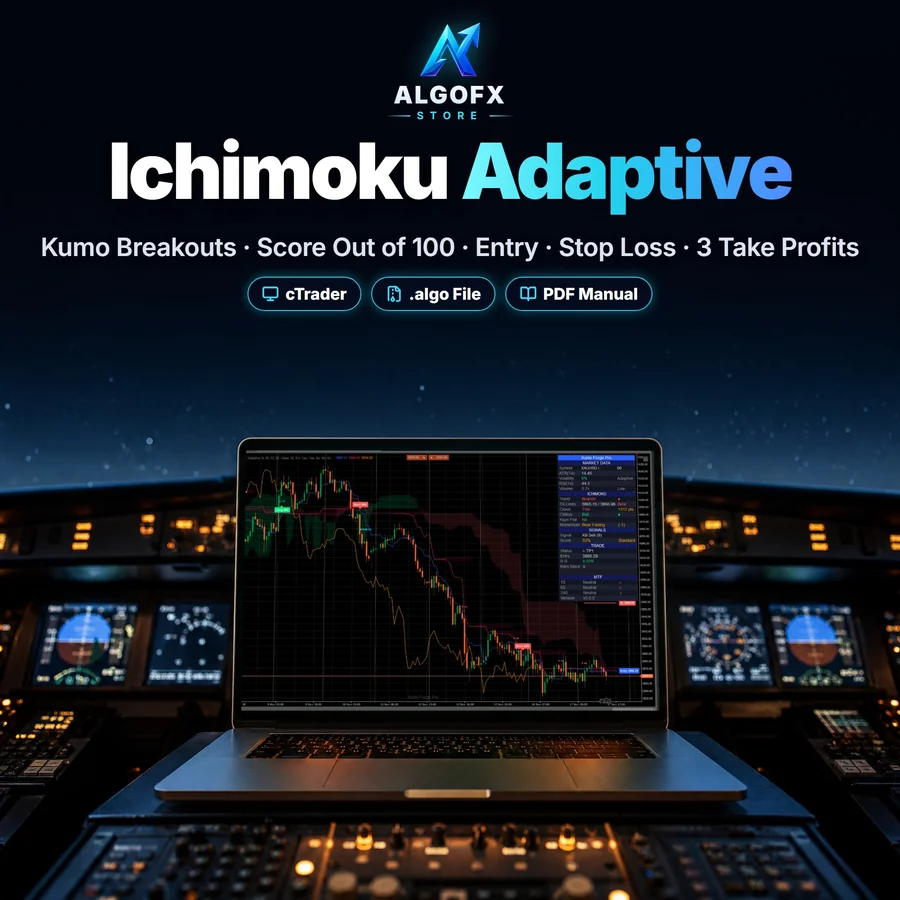
See Kumo Forge Pro on a real chart
Press play; use the full-screen button to see every detail.
A plain Ichimoku shows you a lot but never says how much agrees
Ichimoku gives you trend, momentum, support and resistance in one picture, and it is one of the slowest indicators to read under pressure. A Tenkan and Kijun cross looks exactly the same above a thick, rising cloud with the Chikou clear of old price as it does inside a thin, flat cloud on a quiet afternoon. You have to check every component yourself, on every candle, and on a fast chart that check comes too late.
The fixed 9, 26 and 52 periods also treat a fast session and a dead one the same way, so the lines lag when the market runs and whip around when it drifts. And once you are in, the cloud says nothing about where the trade is wrong or where to take profit. Most traders end up guessing a stop and a target, which is exactly where a good read of the cloud turns into a poor trade.
Kumo Forge Pro keeps the Ichimoku you know and adds three things you can check on the chart: periods that follow volatility, a score that counts how many components agree on the signal candle, and a drawn plan with an entry, a stop and three targets the moment a signal prints.
What Kumo Forge Pro draws, and what each mark means
Read from the shipped cTrader edition.
| What you see | What it means |
|---|---|
| Green 'Long 74%' plate under a candle | Tenkan crossed above Kijun on that closed candle and passed every filter; 74 % = confluence score. |
| Red 'Short 68%' plate above a candle | Bearish Tenkan/Kijun cross that passed the filters. |
| Cyan 'BK Up' / 'BK Dn' | Close through the cloud with above-average volume; a small circle later marks a retest. |
| up / down 'KB' and 'CB' | Bounce off the Kijun line or off a cloud edge in the direction of the trend. |
| Blue line 'Entry <price>' | Entry: close of the signal candle. |
| Red line 'SL <price>' | Stop loss: beyond the far cloud edge plus 0.5 ATR by default. |
| Green lines 'TP1' 'TP2' 'TP3' | Targets at 1.5, 2.5 and 4 times the risk; '+' once reached. |
| Shaded boxes on flat Kijun | Support and resistance zones where the Kijun stopped moving. |
How it decides: an adaptive cloud, a score and a plan
All of it is visible on the chart or in the dashboard, so you can check each signal instead of trusting it. Signals are decided on closed candles, after 80 candles of warm-up.
- 1
The periods follow volatility
In Adaptive mode the indicator measures volatility with the ATR over 'Volatility Lookback' (50 candles) and scales the Tenkan, Kijun and Span B periods with it, by up to 40 percent either way at the default 'Adapt Strength' of 0.4. The cloud reacts faster in volatile markets and slower in quiet ones. 'Calculation Mode' Classic keeps the textbook 9, 26 and 52 with a displacement of 26.
- 2
Nine factors make the score
Price against the cloud pays 20 on the right side and 8 inside. Tenkan and Kijun aligned pay 15, Chikou agreement 15, cloud direction 10, a cloud that is not thin 8 (2 when thin), volume a fifth above its 20-candle average 10, momentum 12 or 6, and momentum building rather than fading 10. With 'RSI Confluence Filter' on, RSI(14) on the right side of 50 adds 10, so the total reaches 110.
- 3
Filters decide the cross plate
A Long or Short plate needs the Tenkan to cross the Kijun on a closed candle, a cloud that is not too thin, the volume filter (which switches itself off on forex symbols), the Chikou agreeing with the direction and a score of at least 'Min Confluence Score' 40. The plate shows the score, for example Long 74%, which is points of agreement, not a probability.
- 4
Four more kinds of entry
KB marks price dipping to the Kijun and closing back on the trend side while price is beyond the cloud. CB marks the same against a cloud edge. A cyan diamond BK Up or BK Dn marks a close through the cloud with volume above 1.3 times its average, and a small circle marks a retest of the broken edge within ten candles. Chikou breakouts exist but are off by default.
- 5
Every signal gets its own plan
The close of the signal candle is the entry. 'SL Mode' KumoEdge puts the stop beyond the far cloud edge plus 0.5 ATR; Kijun mode uses the Kijun plus the buffer; ATR mode uses a fixed 2 x ATR. Targets sit at 1.5, 2.5 and 4 times the risk, and the risk is never taken as less than half an ATR. TP3 or the stop ends the tracked trade, and a new signal replaces it.
- 6
Three higher timeframes in one corner
The MTF rows read M15, H1 and H4 by default with a classic Ichimoku test: Bull when that timeframe's close is above both leading spans with the Tenkan above the Kijun, Bear mirrored, Neutral otherwise. They use the classic periods and the close, follow the higher-timeframe candle while it forms and settle when it closes. They are context only and never a condition of a signal.
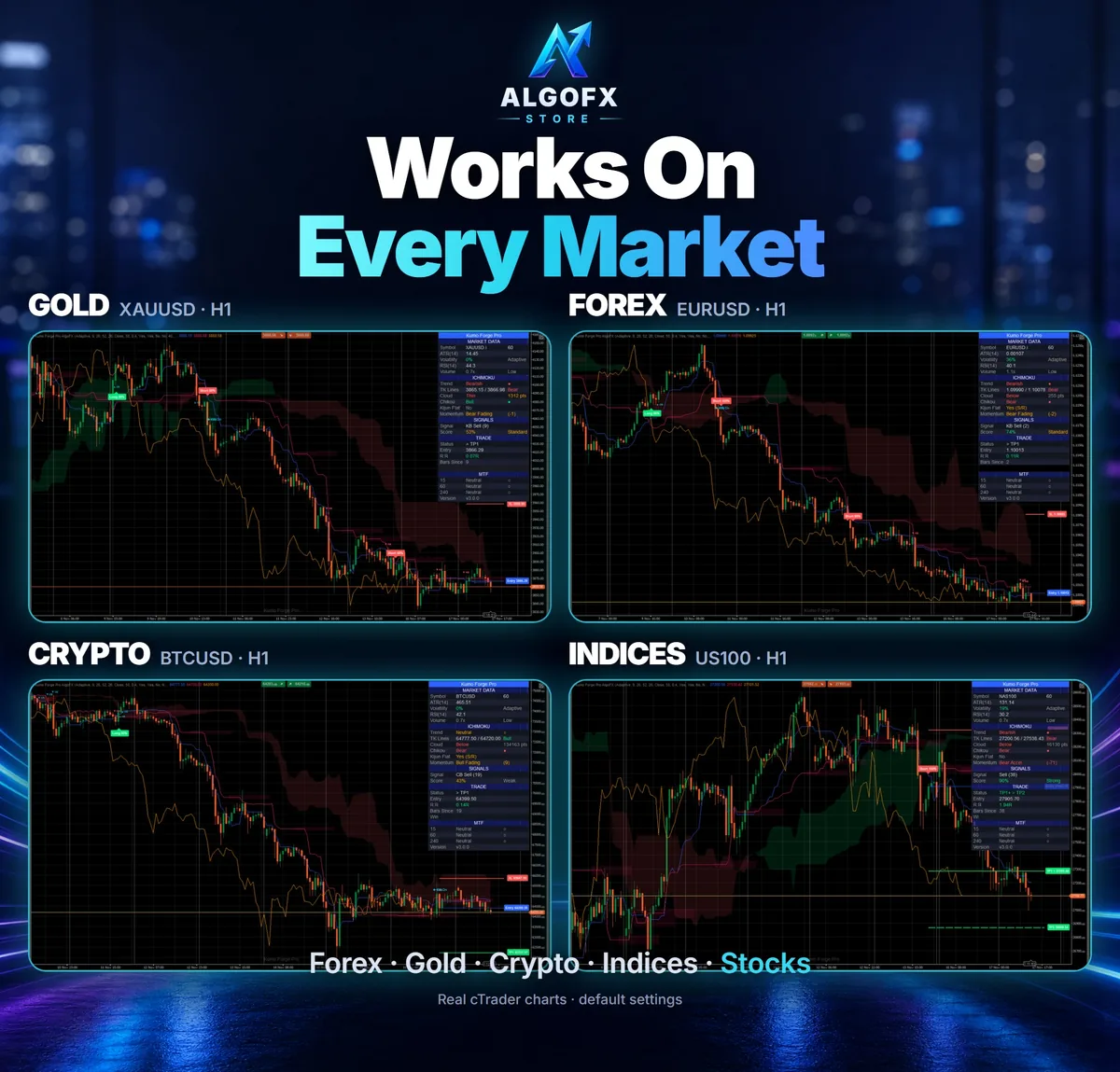
Kumo Forge Pro on 12 different markets
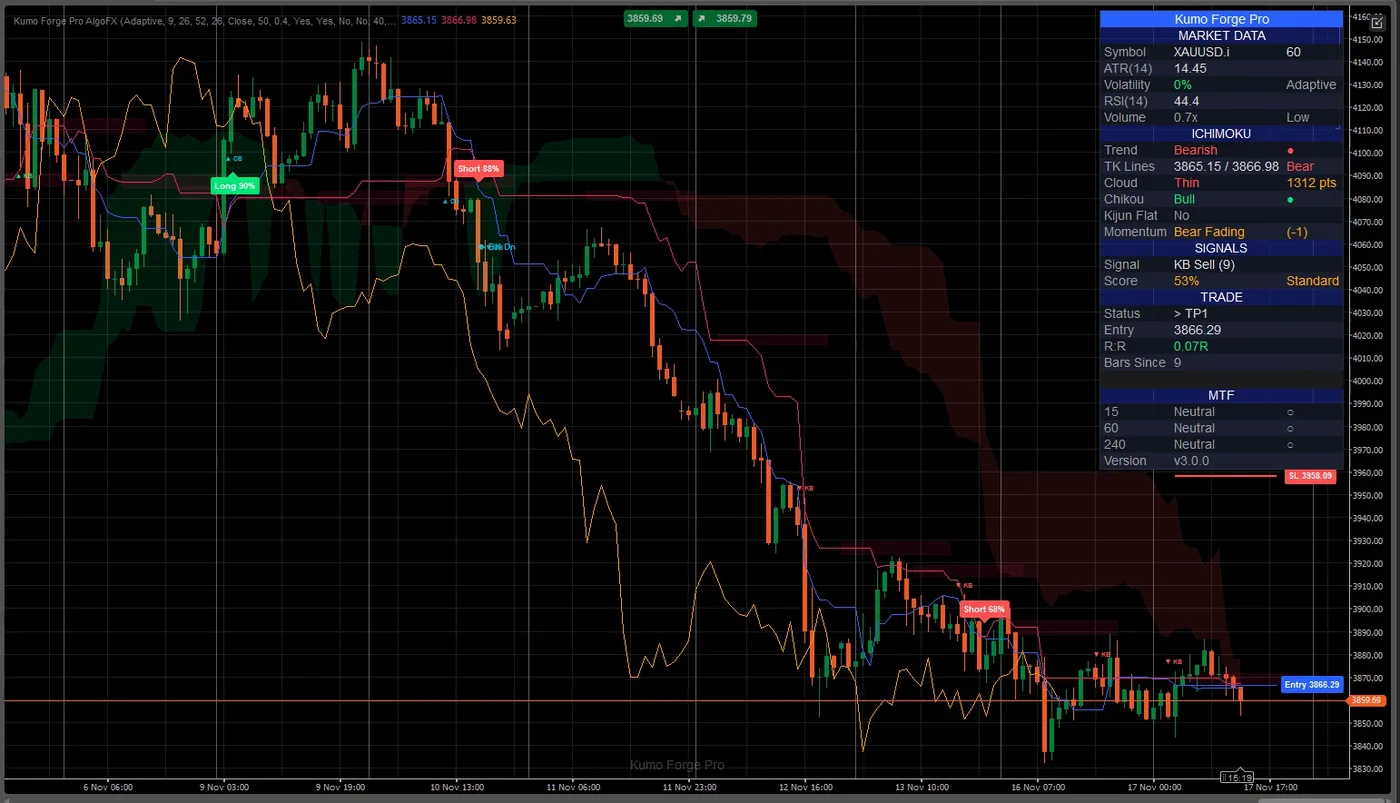
Every chart below is a screenshot of cTrader itself with the shipped Kumo Forge Pro AlgoFX attached at its default settings. Forex, metals, indices, energy and crypto, so you can see how it reads each kind of market. They show what the indicator draws; they are not trading results. Tap or click any chart to open it full size.
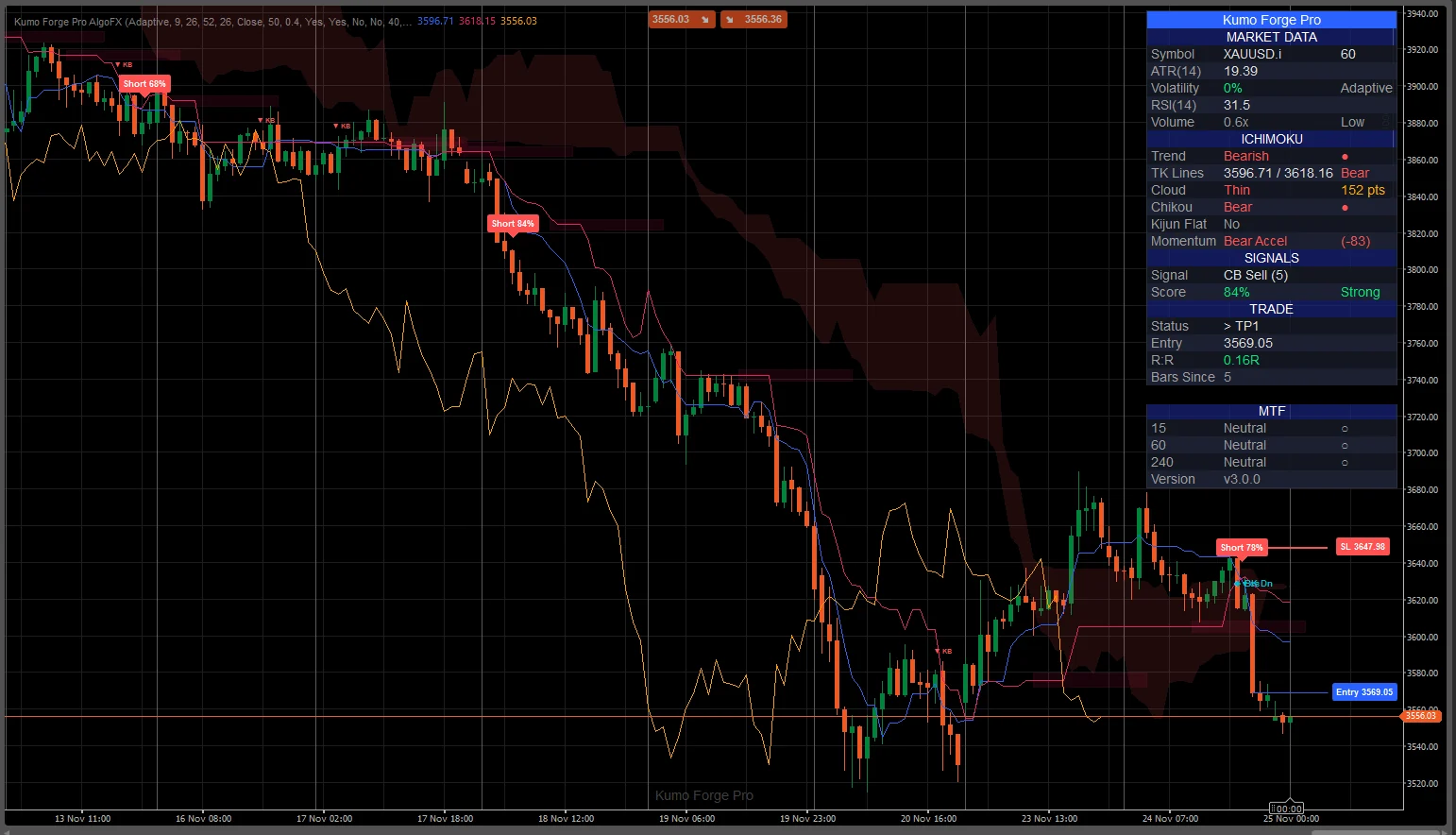
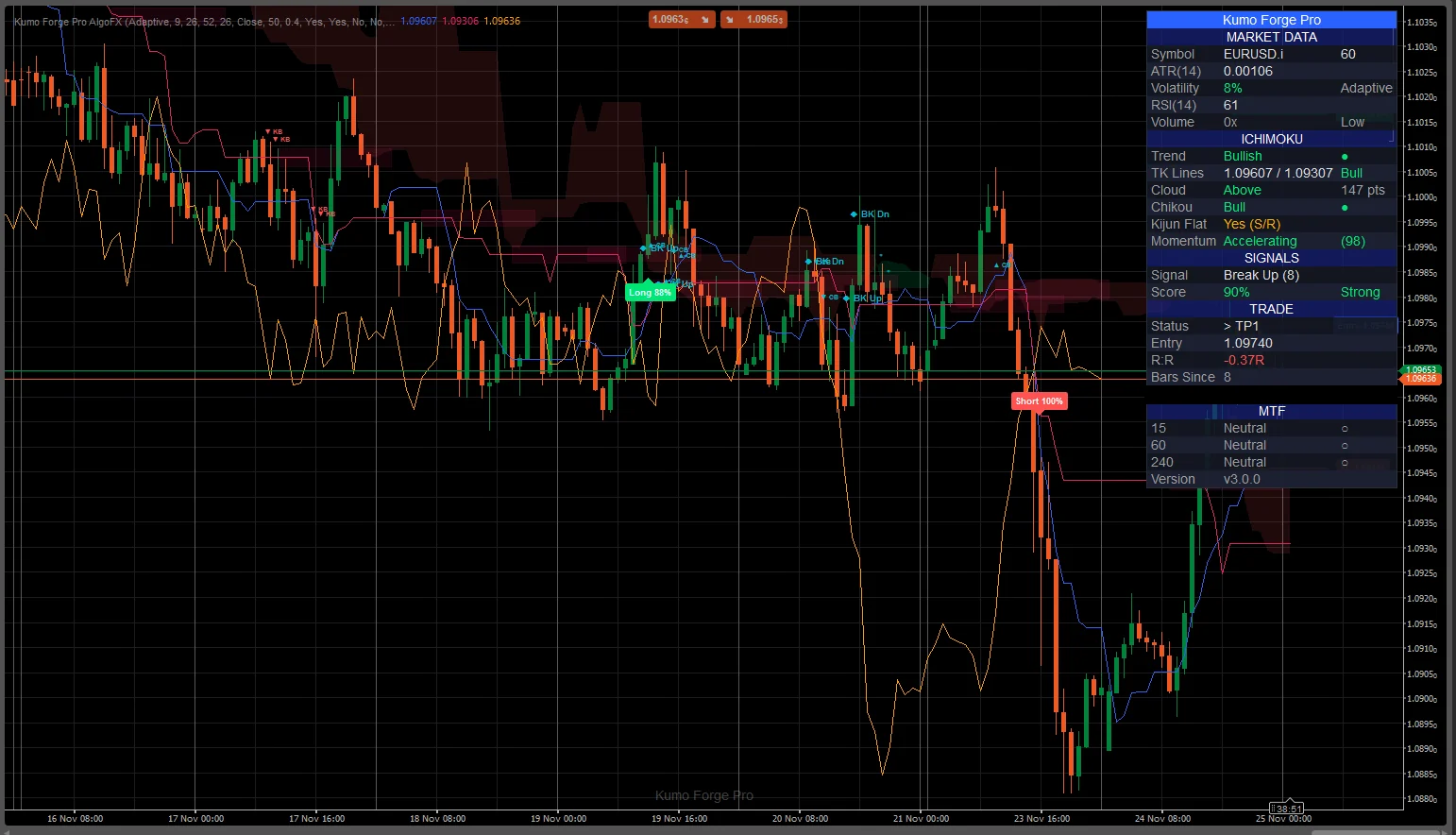
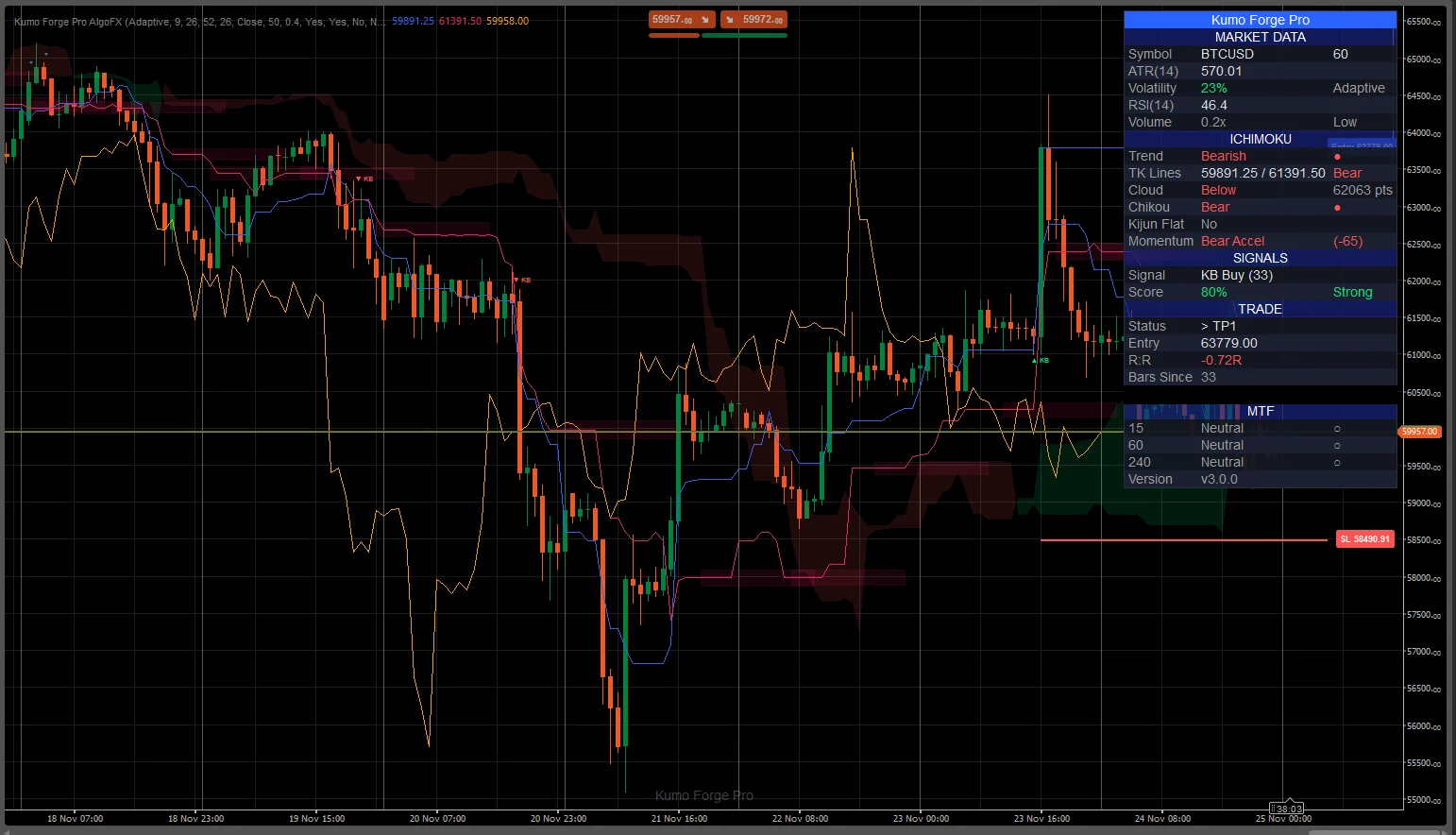
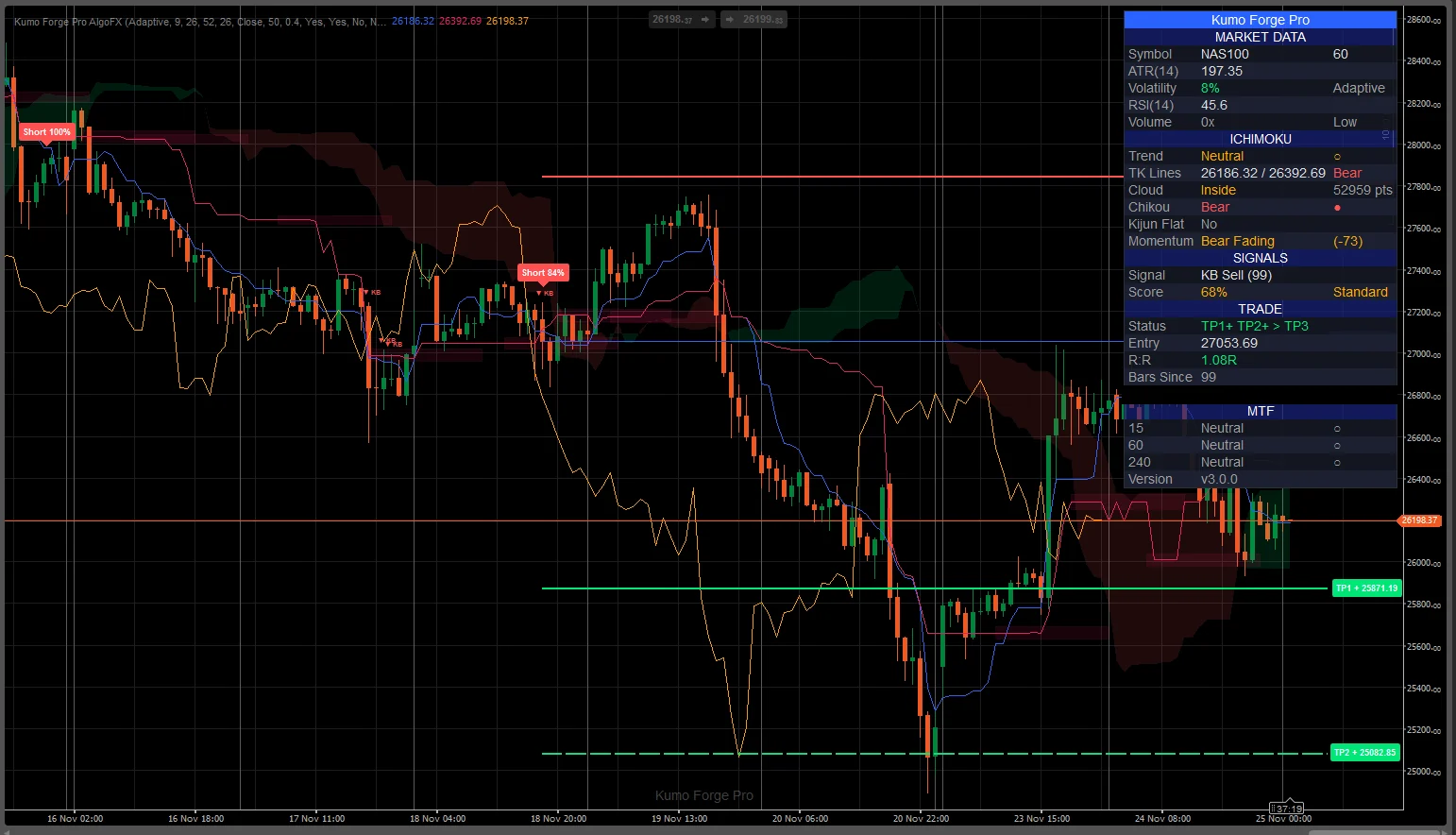
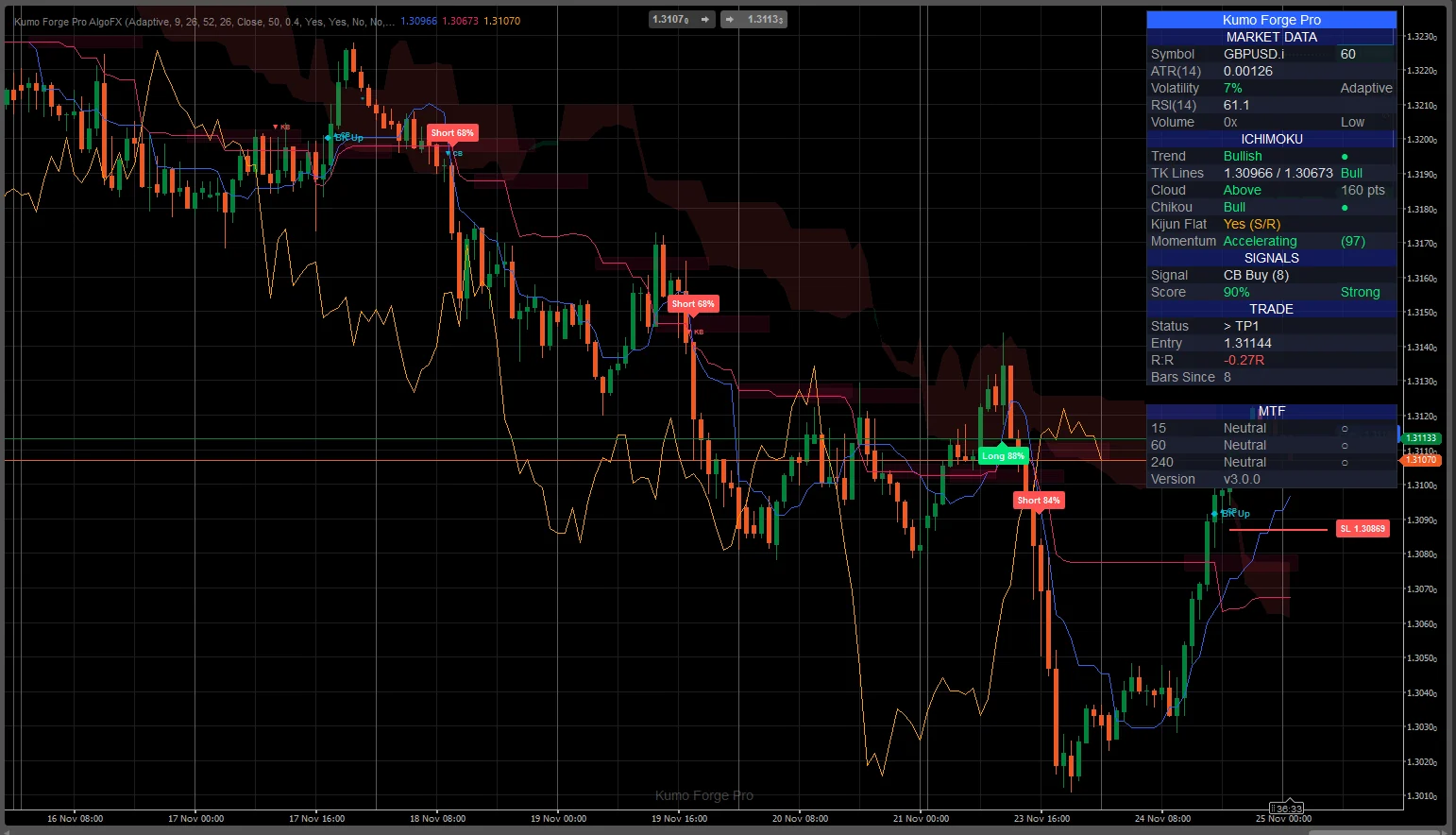
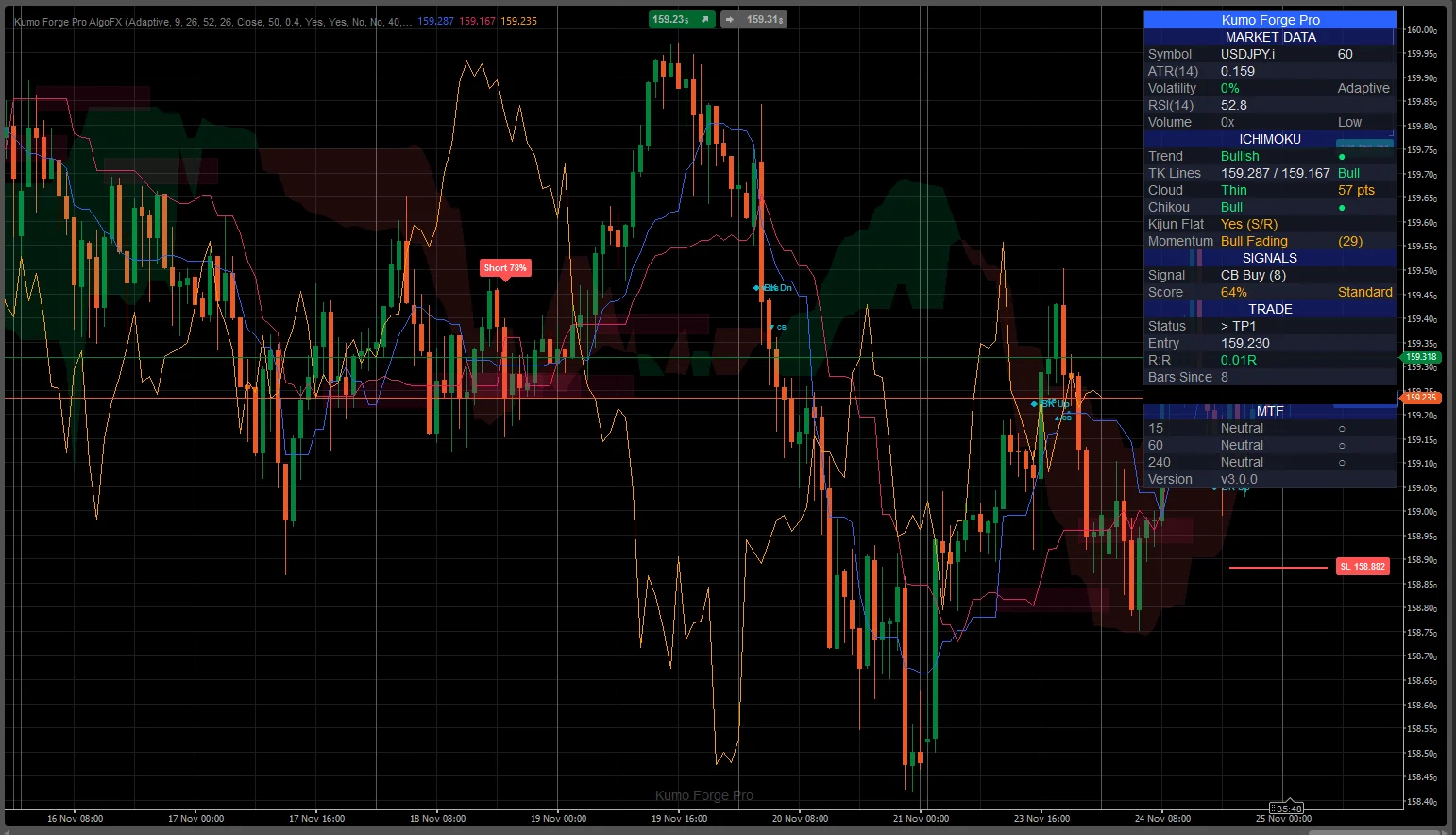
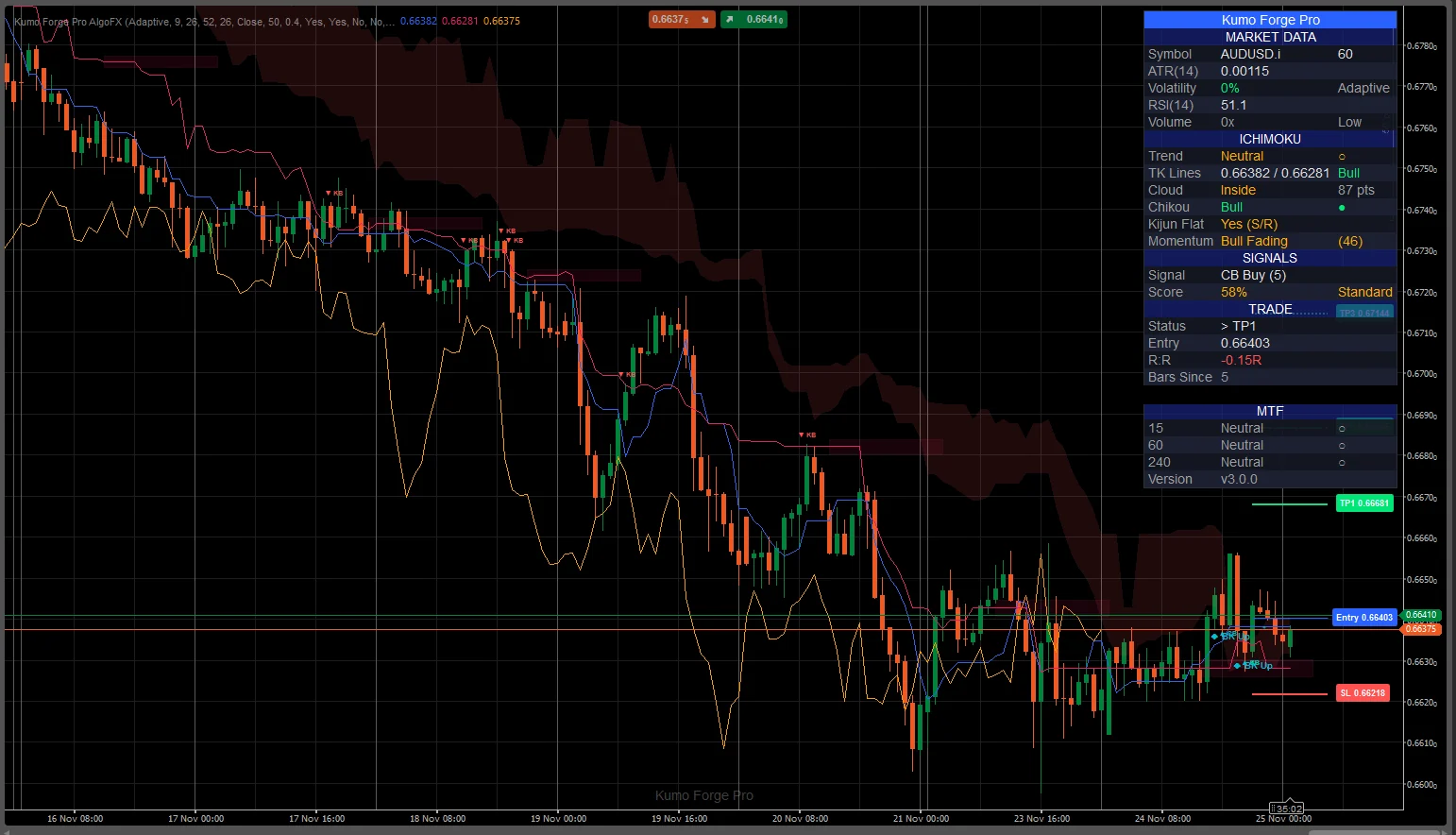
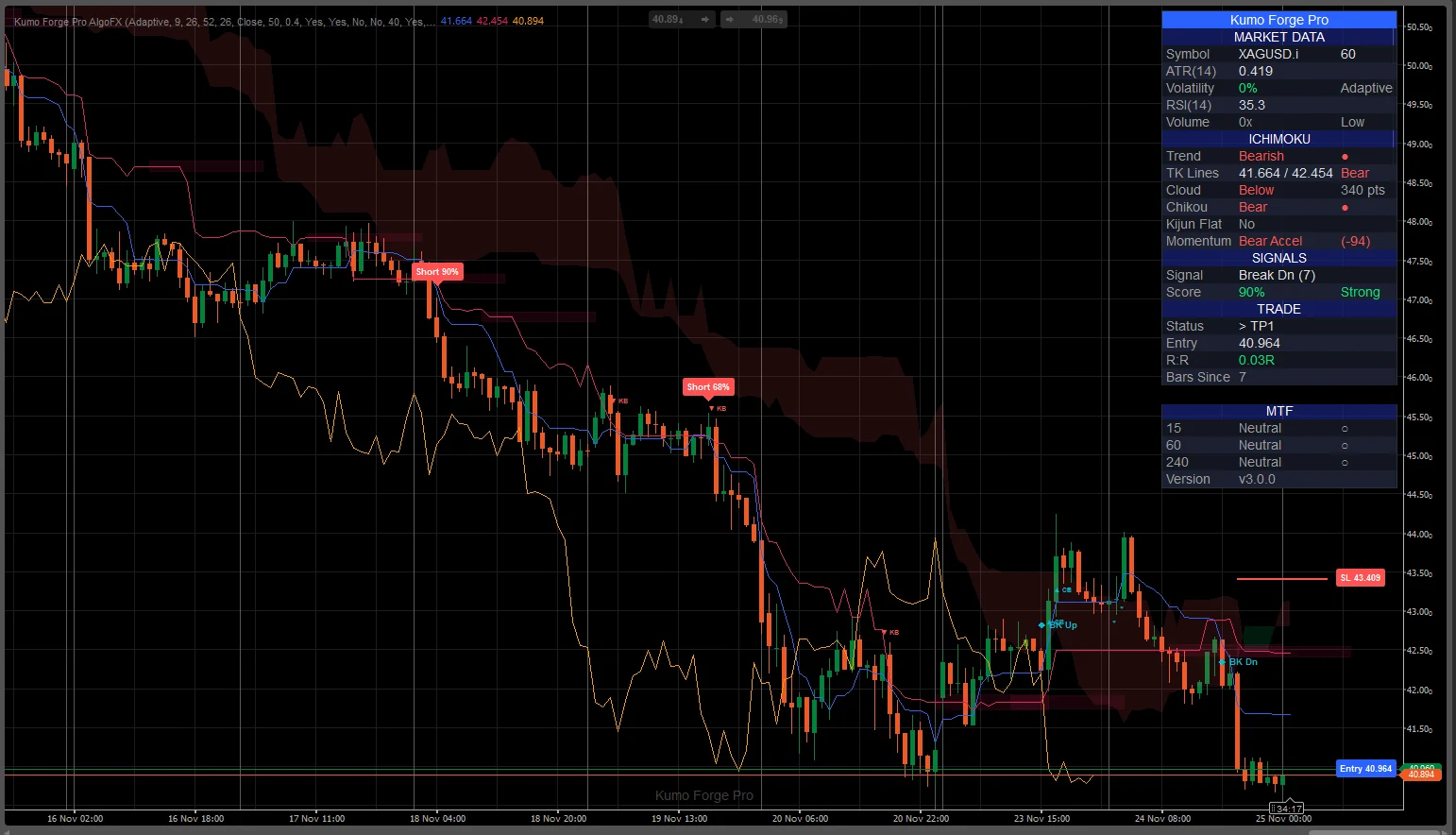
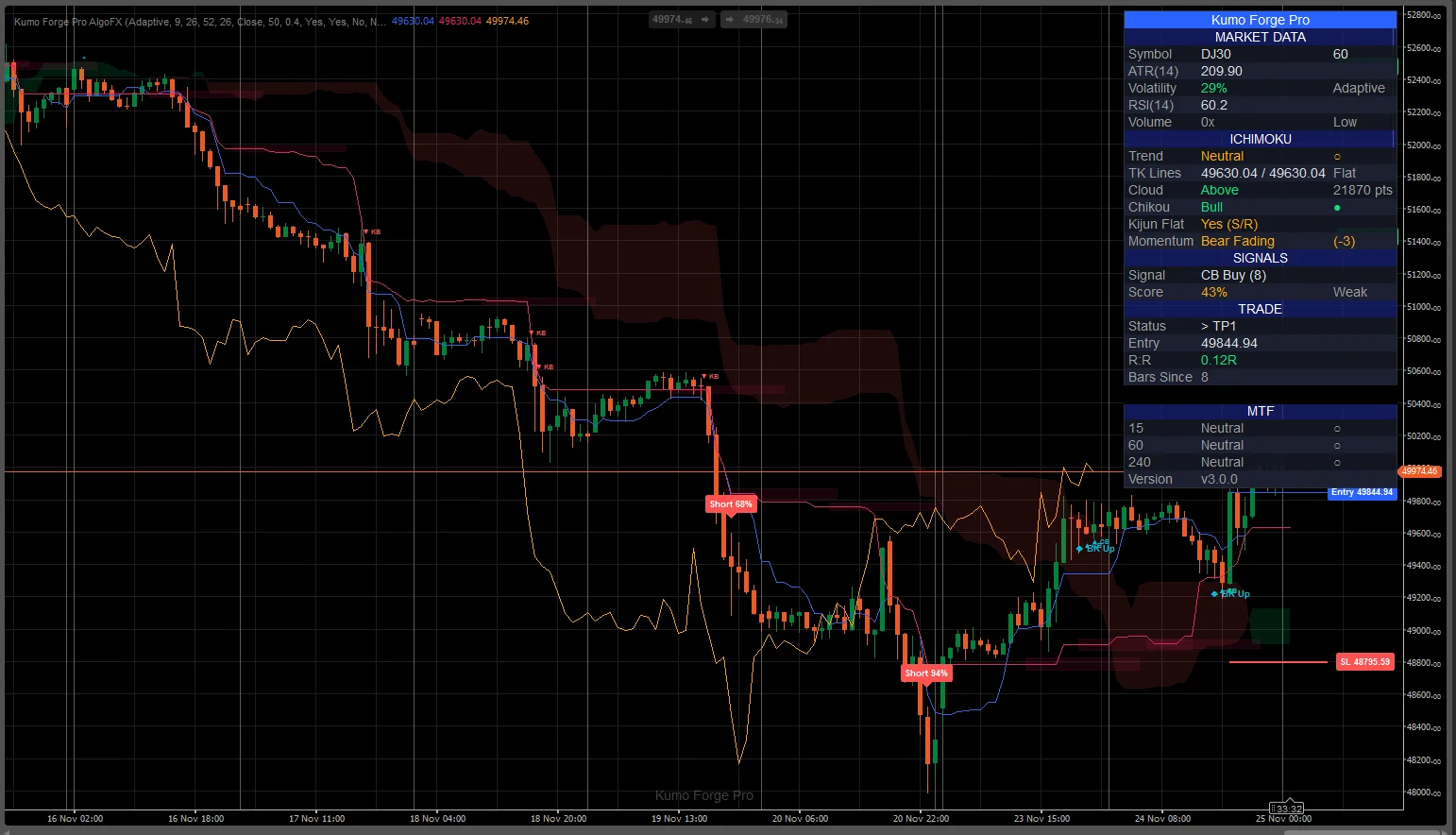
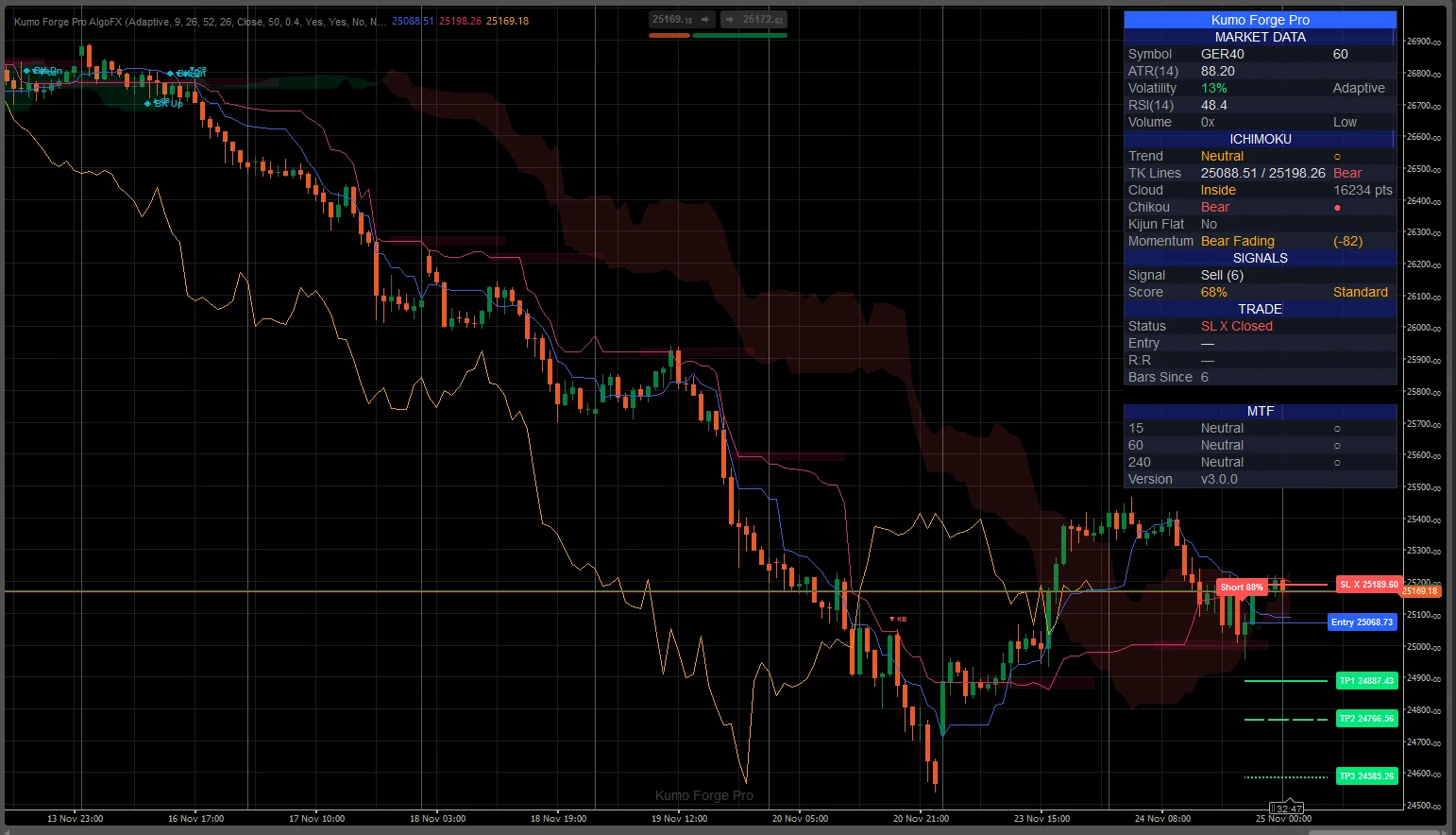
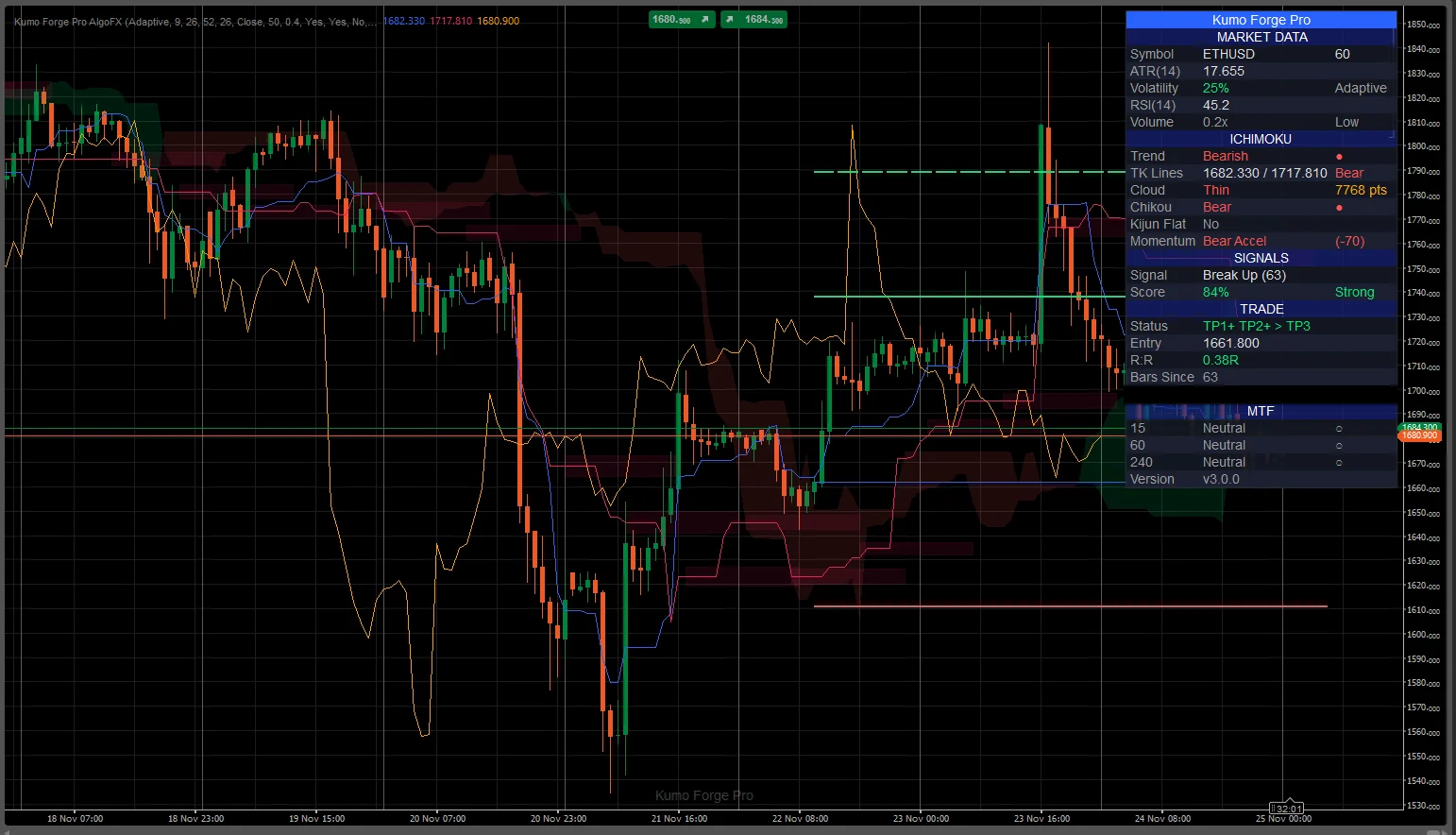
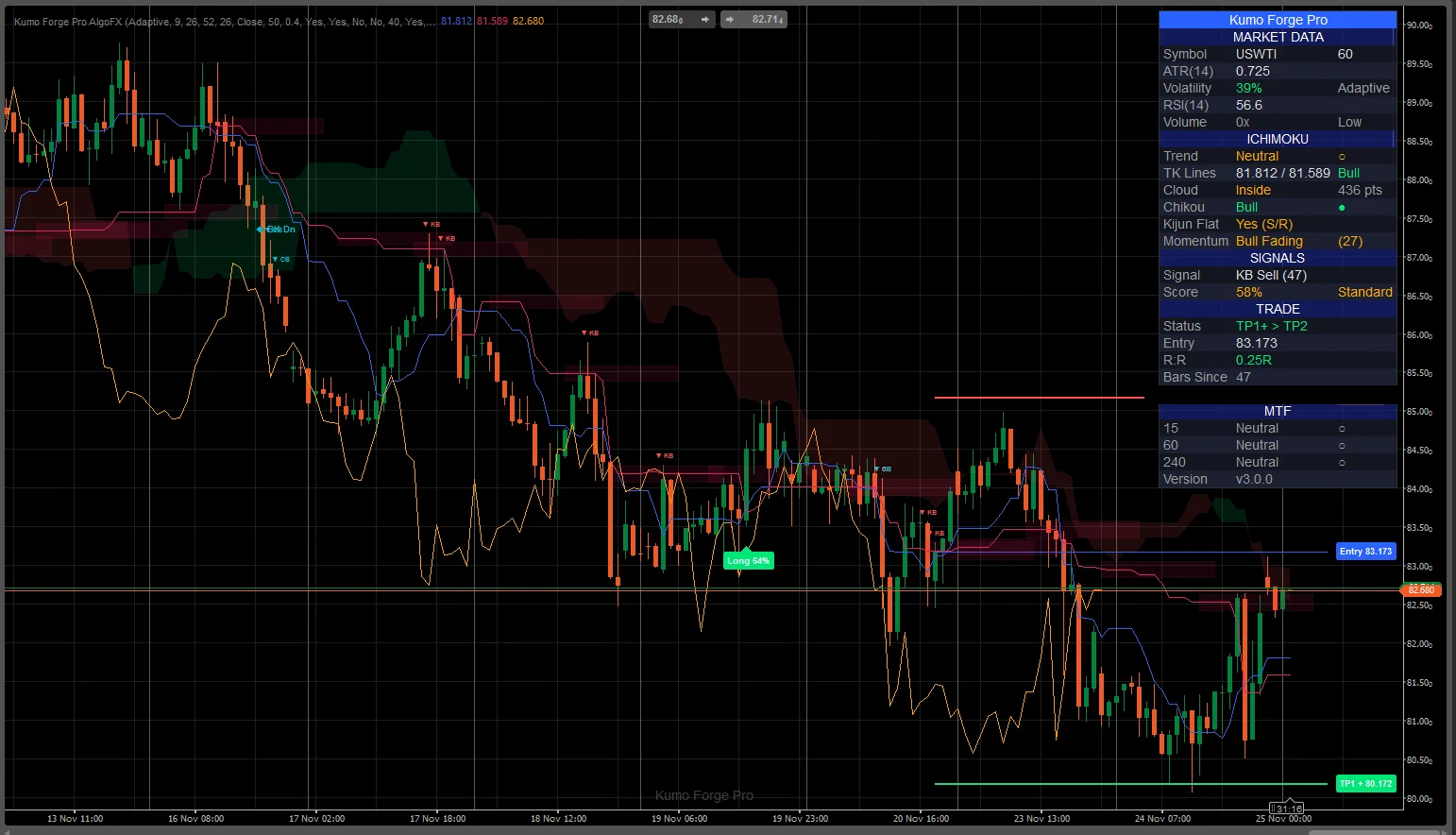
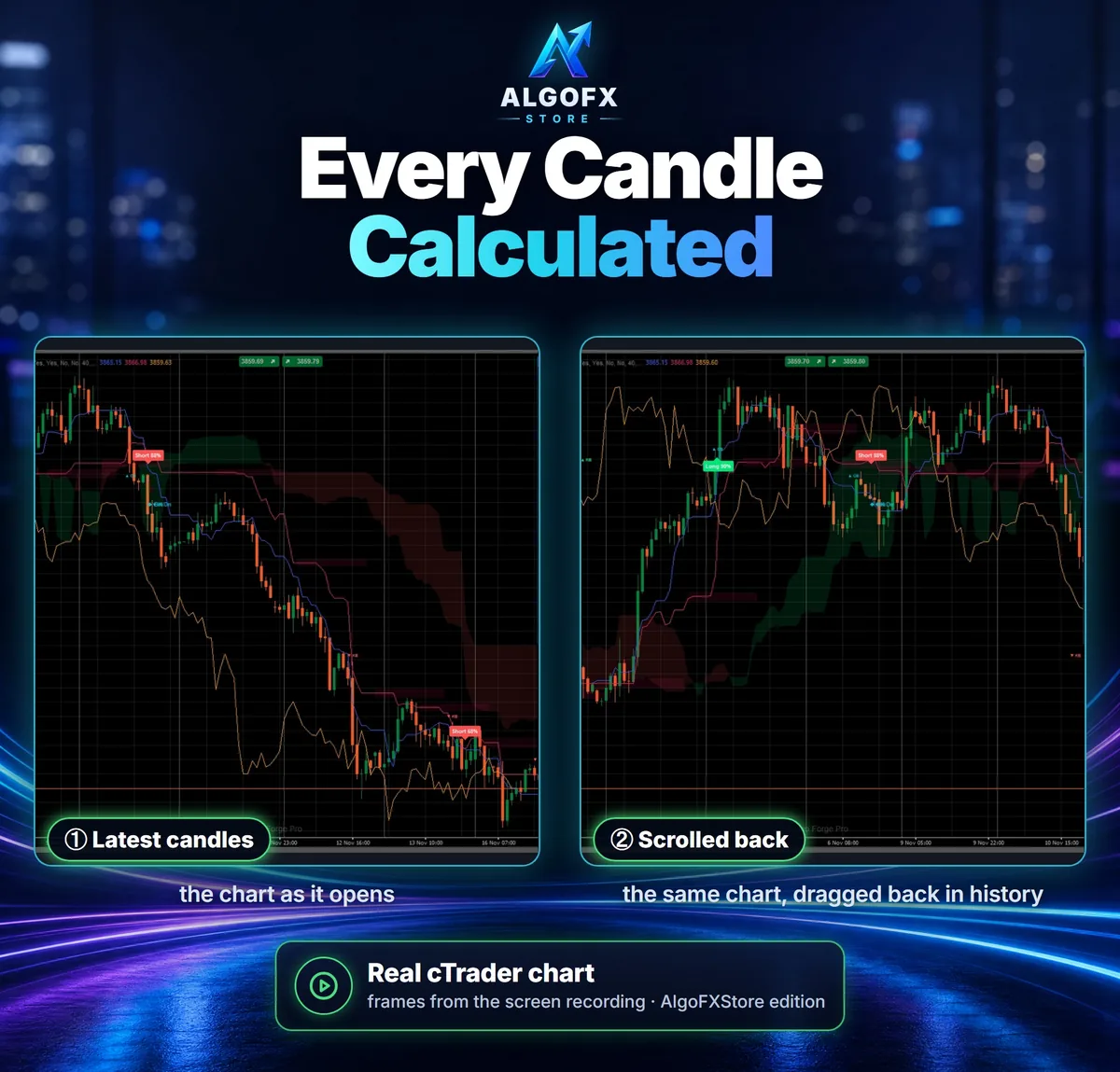
Kumo Forge Pro on a real cTrader chart
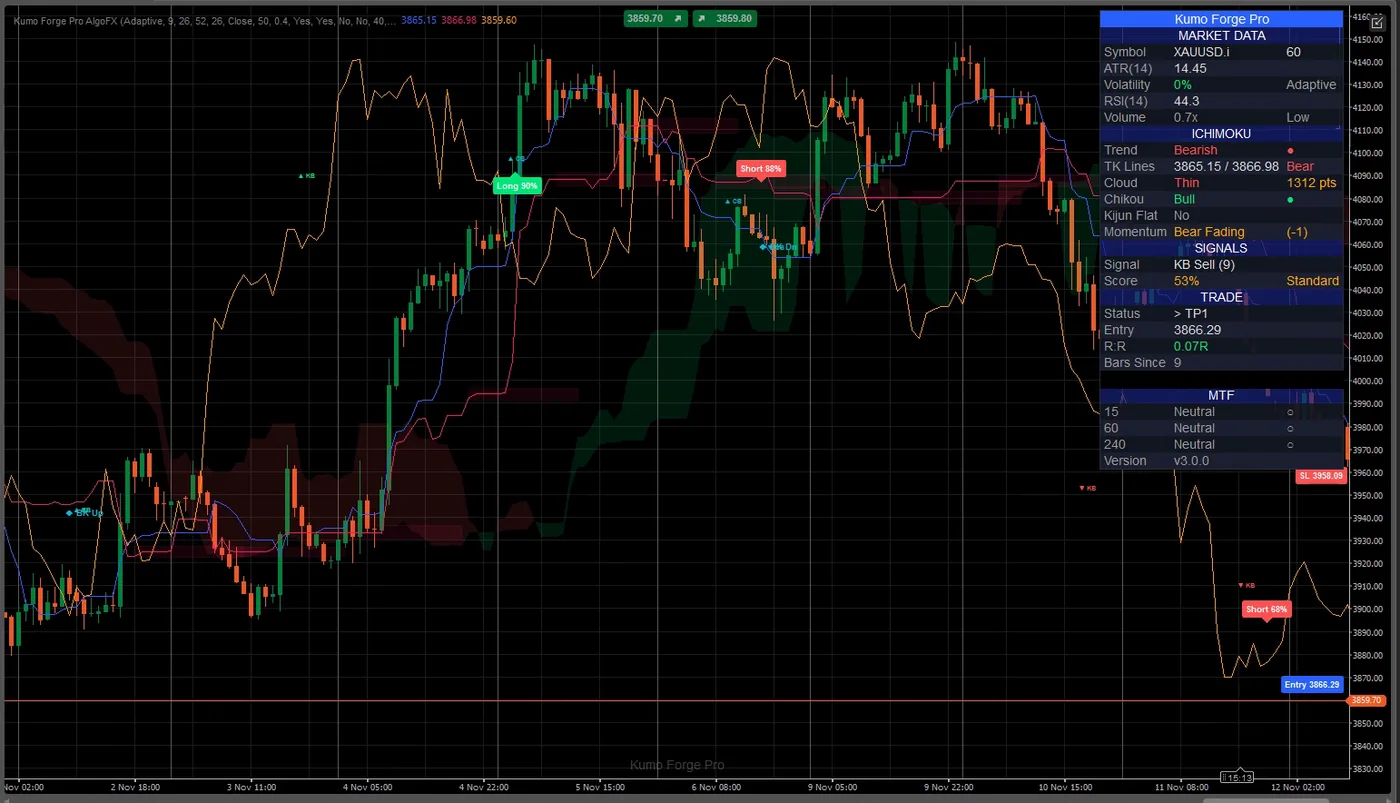
The chart as it opens and the same chart scrolled back in history, with the shipped indicator at its default settings. Nothing is edited into the chart.
How to trade it, step by step
The indicator gives you the read and the levels; the decision and the order stay yours. This is one routine written as a checklist you can follow on a live chart.
- 1
Set the chart up once
Open EURUSD or XAUUSD on m15 or h1, where the 9, 26 and 52 periods and the default M15, H1 and H4 rows fit together. On h4 or D1 raise the three MTF timeframes so they stay above the chart. Load enough history: nothing draws on the first 80 candles, and the volatility measure needs a longer window than that to settle.
- 2
Wait for a closed-candle signal
Act only on a plate or marker on a candle that has closed. For a long, the dashboard Cloud row should read Above and the grade should be Standard or Strong. A Weak grade means few components agreed on that candle. Raising 'Min Confluence Score' to 50 removes Weak setups from the chart entirely if you would rather not see them.
- 3
Confirm with the dashboard
Look for at least two of the three MTF rows on your side, the Volume row reading OK rather than Low on symbols that carry real volume, and a Momentum reading that is not fading against you. On a short, mirror every check. If the rows are split, the setup has the chart's own timeframe behind it and little else.
- 4
Check the stop before you size
The KumoEdge stop sits beyond the far cloud edge, so its distance depends on how far price is from the cloud. Measure from the entry to the red SL line and size from that, not from habit. If the cloud stop is wider than you accept, 'SL Mode' ATR gives a fixed 2 x ATR stop you can predict before the signal prints.
- 5
Manage the trade yourself
Place your own stop order as soon as you enter: the red line protects nothing by itself. The tags change to 'TP1 +' when a target is reached on a closed candle and to 'SL X' when the stop is hit, and the TRADE status row follows, for example 'TP1+ > TP2'. A new signal moves the lines to the new trade while your open order stays as it is.
- 6
Know when to stand aside
Skip signals when the Cloud row reads Inside or Thin, when the MTF rows disagree, and on candles around high-impact news. A high number in the Score row with no plate on the chart is not a signal: it shows the better of the two current scores, so conditions are lining up but nothing has fired yet.
The dashboard, row by row
- MARKET DATA: Symbol + timeframe, ATR(14), Volatility % + Adaptive/Fixed, RSI(14) (OB > 70, OS < 30), Volume x average + OK/Low
- ICHIMOKU: Trend (Bullish/Bearish/Neutral), TK Lines values + Bull/Bear, Cloud Above/Below/Inside/Thin + thickness in points, Chikou, Kijun Flat (S/R), Momentum
- SIGNALS: Signal (what fired or the last one + bars ago), Score % + grade
- TRADE: Status, Entry, R:R (live), Bars Since, (first-target counter row)
- MTF: three timeframe rows (M15, H1, H4 by default) Bull/Bear/Neutral; Version row
Everything Kumo Forge Pro does for you
Setups you can rank at a glance
Every cross plate prints its score, and the dashboard grades the newest signal Strong (80 or more), Standard (50 or more) or Weak. 'Min Confluence Score', from 0 to 110, decides how much a signal needs before it shows.
Five entries from one rule set
The Tenkan and Kijun cross, Kijun bounces and cloud-edge bounces inside a running trend, Kumo breakouts on volume with their retests, and optional Chikou breakouts. Each family has its own switch and its own mark on the chart.
Decided on closed candles
All five signal families and the target and stop hits are evaluated on closed candles. A plate or marker never appears inside a candle and then disappears, and the entry, stop and targets never change once a signal has set them.
Three ways to place the stop
KumoEdge (the far cloud edge plus 0.5 ATR, the default), Kijun (the Kijun plus the buffer) or ATR (a fixed 2 x ATR, buffer ignored). ATR mode makes the next stop predictable before the signal prints, which helps when you size from a fixed risk.
Three targets as R multiples
TP1 at 1.5R is a solid green line, TP2 at 2.5R dashed and TP3 at 4R dotted, each adjustable. The entry line is blue, the stop red for longs and shorts alike, and price tags sit on every line.
Support and resistance from a flat Kijun
Where the Kijun stops moving, a shaded zone marks the level as support or resistance, and the dashboard's Kijun Flat row tells you when it is happening now. 'S/R Box Cap' keeps up to 180 zones on the chart.
A dashboard that reads the cloud for you
MARKET DATA (ATR, volatility, RSI, volume), ICHIMOKU (trend, Tenkan and Kijun, cloud position and thickness in points, Chikou, Kijun Flat, momentum), SIGNALS, TRADE and three MTF rows, in any corner, from Tiny to Large text, with Theme Auto, Dark or Light.
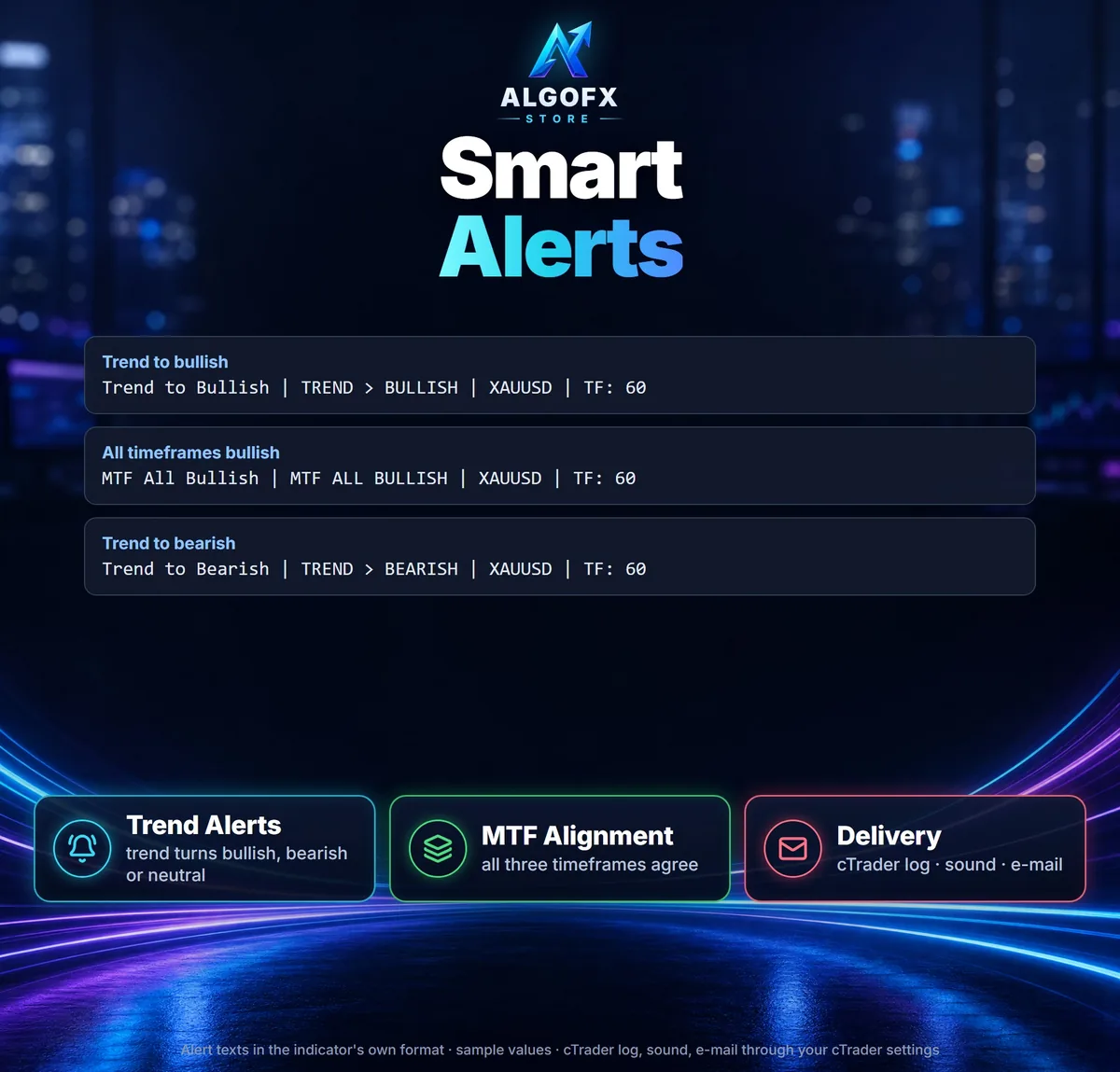
Trend and alignment alerts
Alerts for the trend turning bullish, bearish or neutral, and for all three higher timeframes agreeing bullish or bearish. Each is a line in the cTrader log, with an optional built-in or .wav sound and an optional e-mail through cTrader's own e-mail settings.
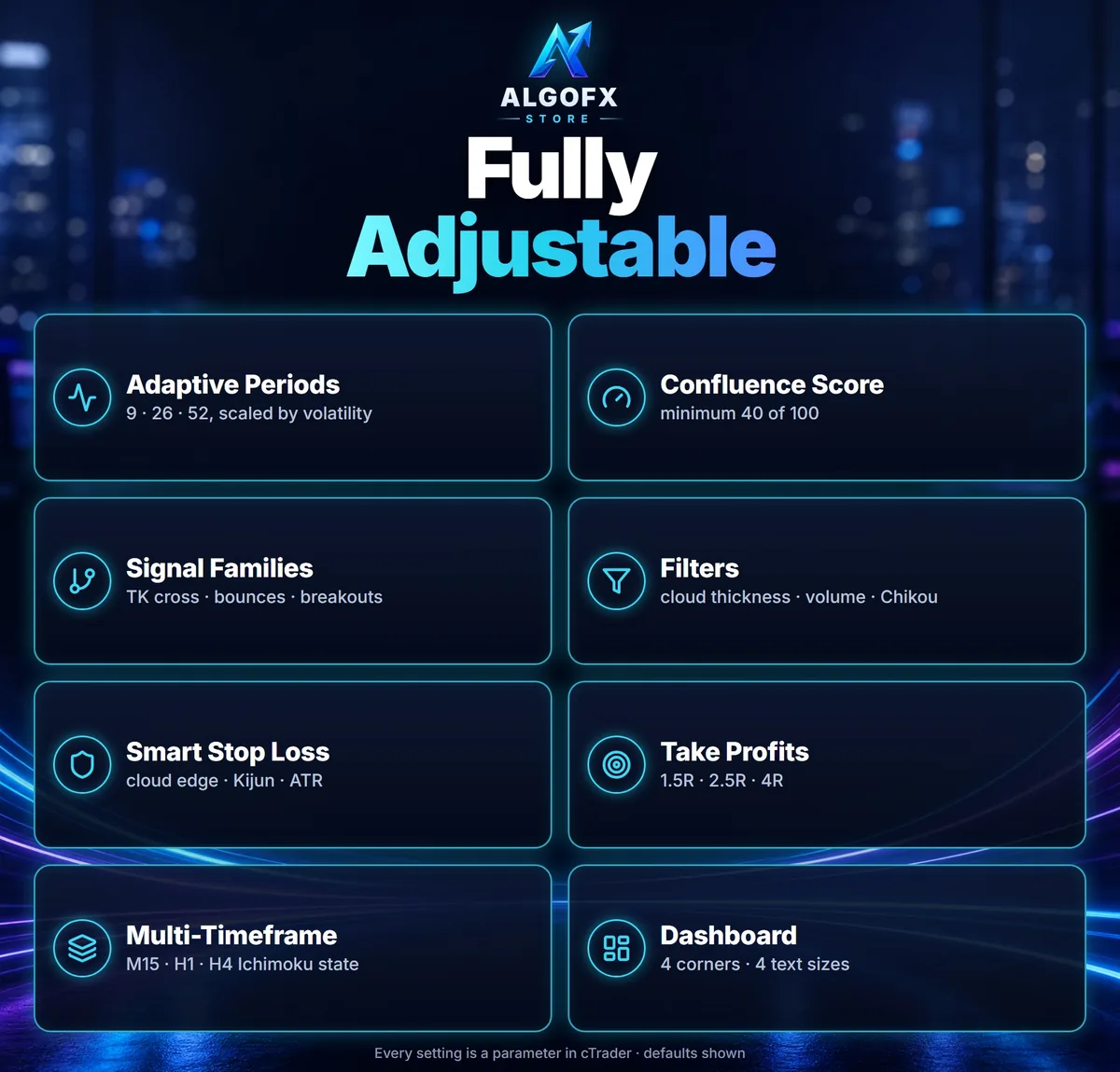
Adjustable down to the drawing
75 parameters cover the periods, the adaptive engine, the five signal families, the filters, the stop mode, the targets, the zones and every layer of the drawing. 'Max Visual History' limits how far back objects are drawn on a slow machine without changing the calculation.
Kumo Forge Pro, feature by feature
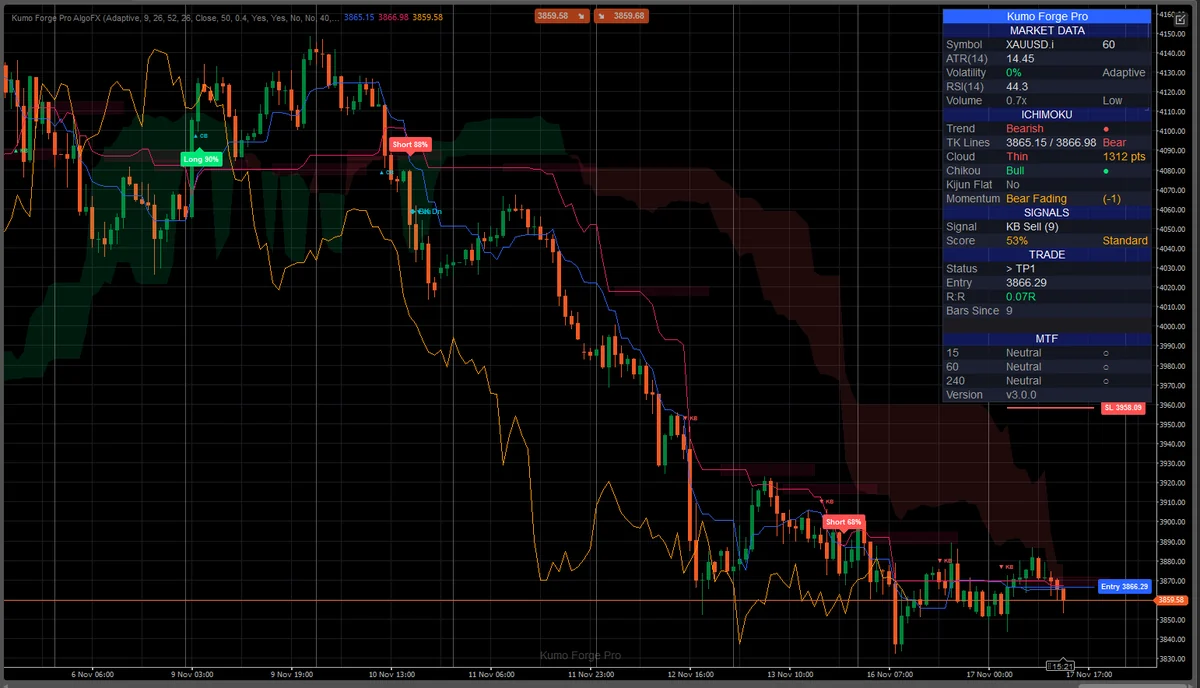
Each picture is built from real platform screenshots of the shipped indicator at its default settings, labelled so you can see what every part does. Tap any picture to open it full size.
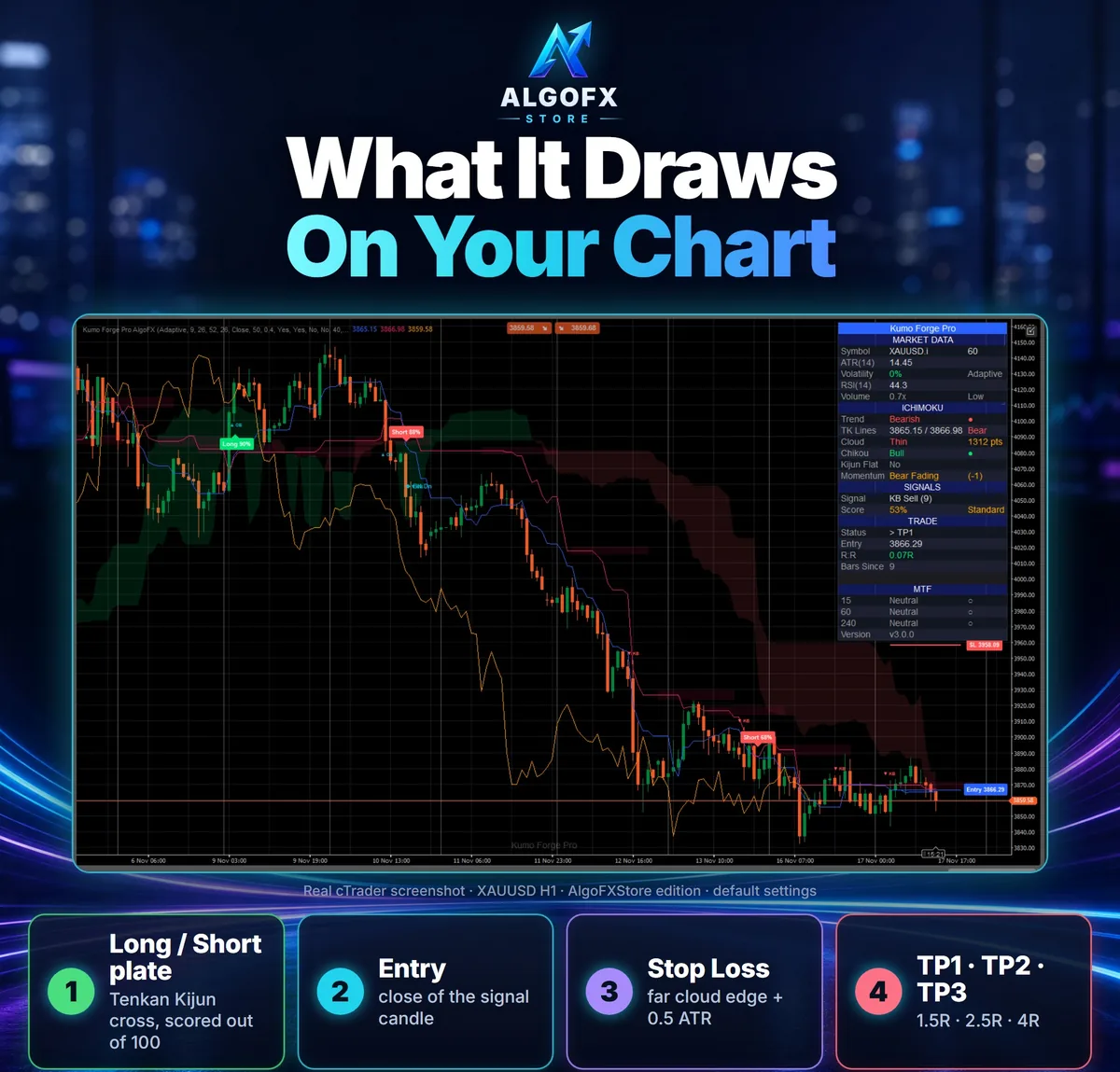
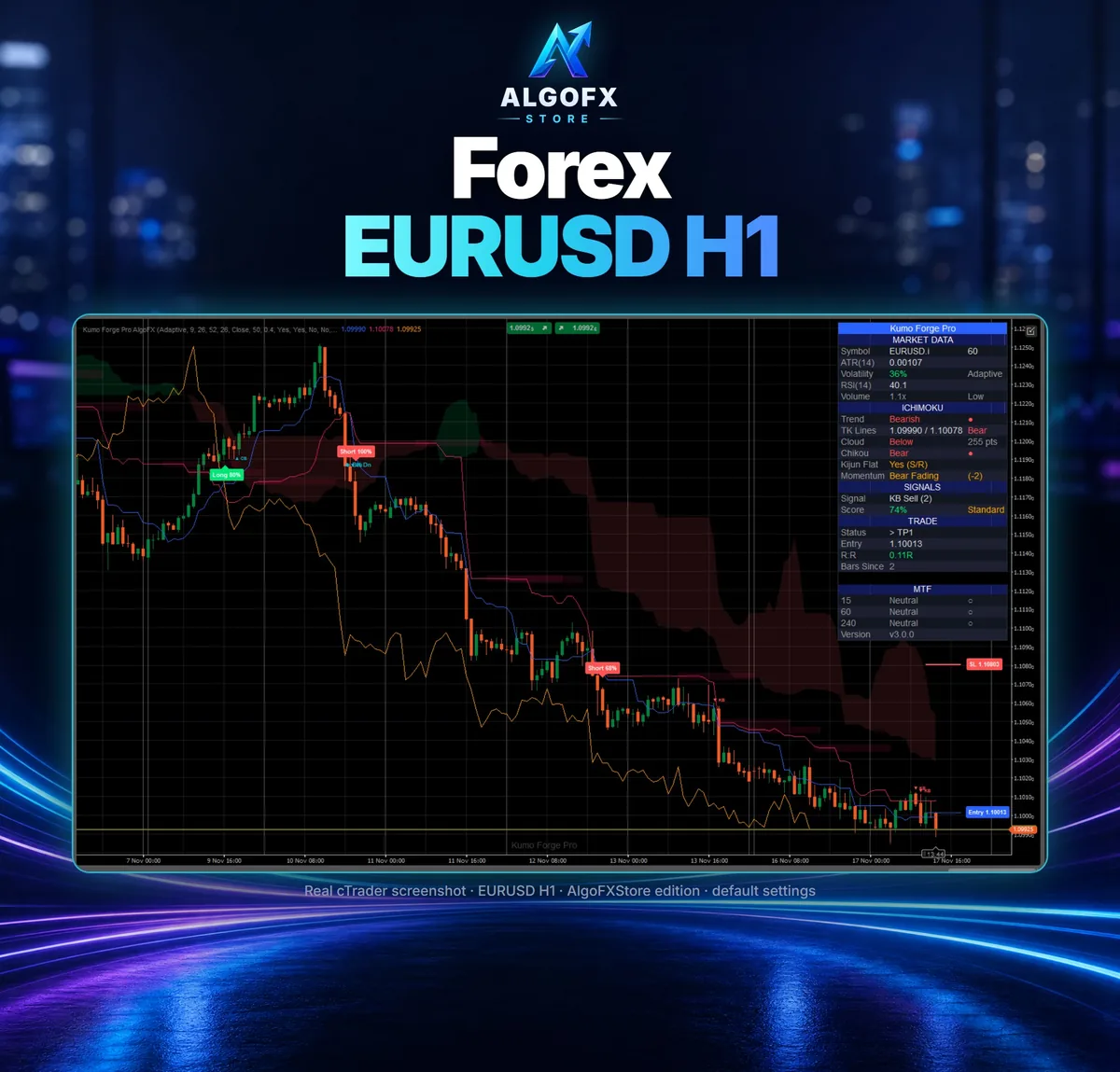
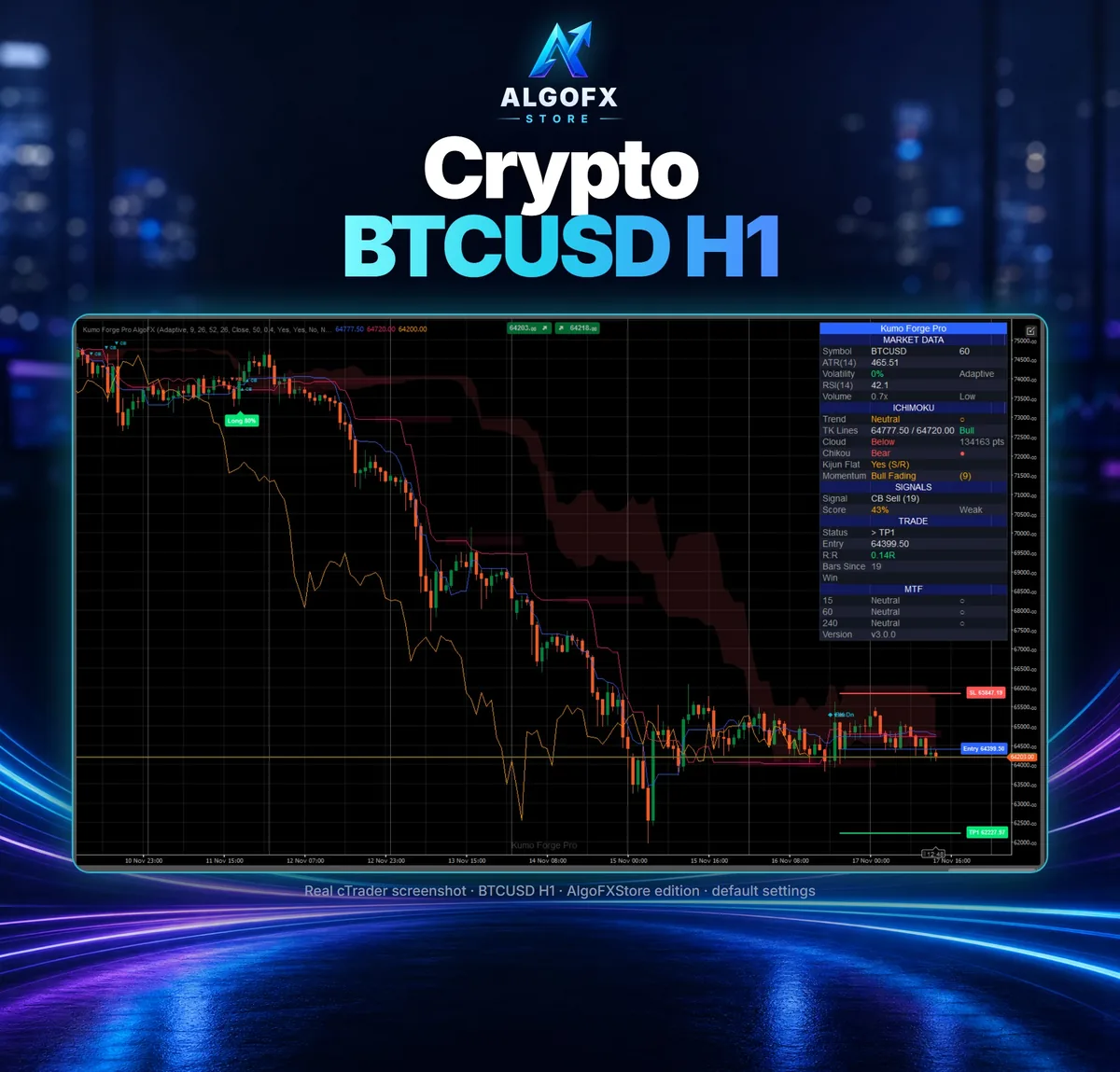
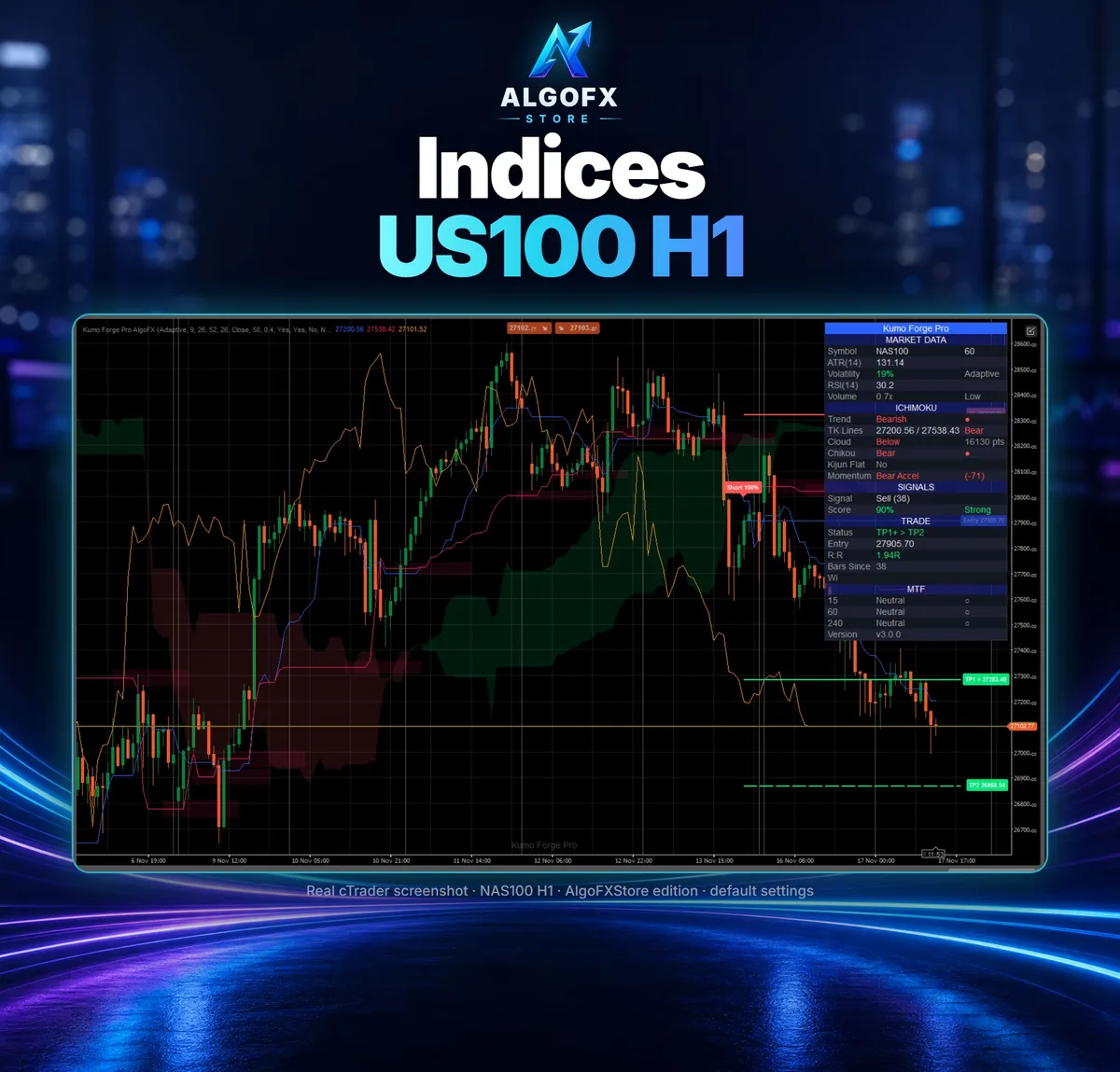
How traders put it to work
Forex on m15 and h1
This is where the defaults sit most naturally: the 9, 26 and 52 periods on the chart and M15, H1 and H4 in the MTF rows. On forex symbols the volume filter switches itself off, so the plates depend on the cross, the cloud, the Chikou and the score. The Kijun bounces are the entries to watch once a trend is already running.
Gold with a predictable stop
On XAUUSD h1 the cloud can be wide, and the KumoEdge stop with it. If you size from a fixed risk, switch 'SL Mode' to ATR so the stop is always 2 x ATR from the entry, or to Kijun for a stop that follows the base line. The targets follow the new risk automatically, because they are multiples of it.
Fast charts from m1 to m5
Low timeframes give many more signals. Raise 'Min Confluence Score' first, to 50, or to 60 to 70 for noticeably fewer, stronger setups, and consider switching 'Cloud Edge Bounce Signals' off, because every signal of any family opens a new tracked trade and replaces the levels on the chart.
Swing trading on h4 and D1
On slower charts the signals are fewer, the clouds are wide and Kijun levels hold for days, so the flat-Kijun zones become useful reference levels. Raise the three MTF timeframes, for example to D1 and above, so the rows still look upward rather than at timeframes below your chart.
Traditional Ichimoku readers
If you learned the cloud on fixed periods and want it that way, choose 'Calculation Mode' Classic. The periods stay at 9, 26 and 52 with a displacement of 26, and you still get the score, the five signal families, the levels, the flat-Kijun zones and the dashboard on top of the familiar lines.
Every setting, with its default
The names are the ones in cTrader's parameters panel; the defaults are what every chart on this page uses.
| Setting | Default | What it does |
|---|---|---|
| Calculation Mode / Conversion / Base / Span B / Displacement | Adaptive / 9 / 26 / 52 / 26 | Adaptive scales the Ichimoku periods with volatility; Classic keeps them fixed. |
| Source | Close | Price used for the lines (Open, High, Low, Close, HL2, HLC3, OHLC4, HLCC4). |
| Volatility Lookback / Adapt Strength | 50 / 0.4 | ATR window and how far (±40 %) the periods may stretch. |
| Kijun Bounce / Cloud Edge Bounce / Chikou Breakout / RSI Confluence | Yes / Yes / No / No | Extra signal families and the optional RSI score factor. |
| Min Confluence Score | 40 | Minimum score (0-110) for a signal. |
| Kumo Thickness / Volume / Chikou Confirmation filters | Yes / Yes / Yes | Vetoes on thin clouds, low volume and Chikou disagreement. |
| Show TP/SL Lines / SL Mode / SL ATR Buffer | Yes / KumoEdge / 0.5 | Trade tracking and where the stop goes. |
| TP1 / TP2 / TP3 R:R | 1.5 / 2.5 / 4.0 | Targets as multiples of the risk. |
| Show Kumo Breakouts / Breakout Vol Mult / Retest Signals | Yes / 1.3 / Yes | Cloud breakouts with a volume check and retest marks. |
| Show MTF Panel / TF 1 / TF 2 / TF 3 | Yes / M15 / H1 / H4 | Higher-timeframe Ichimoku state rows. |
| Dashboard / Position / Font Size | Yes / TopRight / Normal | Panel on or off, corner and text size. |
The alert events, one by one
You choose which alerts are on in the parameters. Alerts can go to a line in cTrader's Log tab (on by default), a built-in cTrader sound or your own .wav file (off by default) and an e-mail (off by default; cTrader's e-mail settings must be set up).
- Trend Change
- MTF Alignment
Kumo Forge Pro next to the usual options
Where it wins, and where it does not.
| Kumo Forge Pro | Typical free Ichimoku indicator | Reading it by hand | |
|---|---|---|---|
| Periods that follow volatility | Adaptive mode, up to 40 percent either way, or Classic | Fixed 9, 26, 52 | Fixed, unless you recalculate |
| How much agrees on a signal | Score from nine factors, graded Strong, Standard, Weak | Not shown | You count the components yourself on every candle |
| Entries beyond the cross | Kijun bounce, cloud bounce, Kumo breakout, retest, Chikou breakout | Usually the cross only, if any mark at all | Possible, but easy to miss on a fast chart |
| Stop and targets | Entry, stop and three targets drawn on every signal | None | You place and measure them yourself |
| Stop at swing structure | No: the stop is the cloud edge, the Kijun or 2 x ATR, plus a buffer | No | Yes, if that is how you trade |
| Simplicity of the chart | Busier: plates, markers, zones, five lines and a dashboard | Cleaner: just the lines and the cloud | As clean as you keep it |
| Cost | A one-time purchase | Free | Free, apart from your time |
Honest about who this fits
A good fit if you
- You trade on cTrader Desktop and already read the Ichimoku, or want to, and would like each setup scored instead of judged by eye.
- You want the entry, the stop and three targets on the chart the moment a signal prints, so you can measure the risk before you decide.
- You like several kinds of entry from one rule set: the first cross, the bounces in an established trend and the breakouts with their retests.
- You trade m15 to h1 charts on forex or gold and want three higher timeframes summarised in one corner.
- You prefer to tune: 75 parameters let you change the periods, the filters, the stop mode, the targets and every drawing.
Not for you if you
- You want an automated system that enters and exits for you. This indicator draws, tracks levels and alerts; you place and manage every order.
- You want stops at swing highs and lows. These stops are the cloud edge, the Kijun or two ATRs, plus a buffer.
- You need an alert for every new signal or every target hit: this version alerts on trend changes and higher-timeframe alignment, and shows signals and levels on the chart.
- You want a quiet chart with one line on it. Kumo Forge Pro draws a cloud, five lines, plates, markers, zones and a large dashboard by default.
One indicator file, one manual, installed in a minute
- 1cTrader indicatorKumo Forge Pro AlgoFX.algo (43 KB). Double-click it and it appears as “Kumo Forge Pro AlgoFX” in your Indicators list.
- 11Page PDF manualInstallation, every setting with its default and how to read the chart.
- 75Settings in the parameters panelThe main ones are explained in the table above, with the defaults the charts use.
- ✓Alert eventsYou choose which ones are on in the settings.
- 60Day money-back guaranteeIf it is not for you, request a full refund within 60 days through your Digistore24 order e-mail.
Install in four steps
- Download the zip from the page Digistore24 sends you to after checkout and unzip it.
- Double-click “Kumo Forge Pro AlgoFX.algo”: cTrader Desktop opens and installs it. You can also import the file in cTrader Automate.
- Open a chart, open the Indicators list and add “Kumo Forge Pro AlgoFX” (you find it under Custom).
- Read the manual's quick start; the defaults are the settings shown on this page.

Kestutis Balciunas
AlgoFXStore · chart indicators
Kestutis Balciunas builds and publishes chart indicators under the AlgoFXStore name. Every product page shows what the indicator draws on real charts, and every number on it comes from the shipped build.
The charts on this page were captured in cTrader from the shipped Kumo Forge Pro AlgoFX at its default settings and are shown unedited.
No get-rich claims and no quoted win rates. Every trade is uncertain, and no indicator changes that. If you want to know whether it suits the way you trade before you buy, e-mail [email protected] and you will get a straight answer.
One price, one payment
- The cTrader indicator (Kumo Forge Pro AlgoFX.algo) and the 11-page PDF manual
- Delivered as a digital download: one zip with the .algo file and the PDF manual on your download page
- Return period: 60 days, with a full refund if it is not for you
- Free updates to the current version on the same download page
60-day money-back guarantee. Install it, run it on your own charts and read the manual. If Kumo Forge Pro is not for you within 60 days of purchase, request a full refund from Digistore24, no questions asked: use the refund link in your Digistore24 order e-mail or Digistore24's order page digistore24.com/en/cancel-revoke-contract. Digistore24 refunds to your original payment method. It is a digital download: right after checkout you land on your download page, and the link to it is also in your Digistore24 order e-mail.
Also by Kestutis Balciunas: Kumo Forge Pro for MT4 and MT5 and NinjaTrader 8 and TradingView.
About the signals
Does it repaint?
Signals are fixed once the candle closes: the plates, markers and zones of a closed candle stay where they printed, and the levels of a trade never change. What moves is meant to move. The trade lines are redrawn each candle so they reach the right edge, at the same prices. The MTF rows follow the higher-timeframe candle while it forms, and the trend state is read on the live candle, so both can change before the close.
What does the number on the plate mean?
It is the confluence score in points: up to 100 from eight factors, 110 with the optional RSI factor. Long 74% means 74 points of agreement on that candle, not a 74 percent chance of anything. The score counts how much agrees at that moment; it is not a forecast of what happens next.
Why do I see few Strong plates?
Strong needs 80 points or more, which in practice means price on the right side of the cloud, Tenkan and Kijun aligned, the Chikou agreeing and most of the momentum and volume factors paying too. Thickness and volume count for both sides, so on a thin, quiet market neither the buy nor the sell score gets high.
What if a new signal prints while a trade is still tracked?
Any signal, a cross, breakout, retest, bounce or Chikou break, starts a new tracked trade from its candle's close and replaces the previous lines. Your own order does not change with them. If the replacements get in the way, raise 'Min Confluence Score' or switch off the families you do not trade, starting with Cloud Edge Bounce Signals.
Why did a trade close as 'SL X Closed' on a candle that also reached TP3?
A candle wide enough to reach both levels sets both, and the stop is checked first. It is the cautious reading of a candle whose order of highs and lows inside it is unknown from the candle alone.
Reading the chart and the dashboard
What do the colours mean?
Blue is the Tenkan and the entry line, pink the Kijun, orange the Chikou, cyan the breakouts, retests and cloud-edge bounces. Green is bullish: Long plates, bullish KB marks and all three target lines. Red is bearish: Short plates, bearish KB marks and the stop line, for longs and shorts alike. Shaded boxes mark the flat-Kijun zones.
What does Thin mean in the Cloud row?
The cloud is unusually thin compared with its own recent thickness. Thin takes precedence over Above, Below and Inside, so during a squeeze this row stops telling you the side; the Trend row still does. The Kumo Thickness Filter blocks plates while the cloud is thin.
Why did a higher-timeframe row change and then change back?
Each MTF row follows that timeframe's candle while it is still forming and settles when it closes, so an H4 row can move during its four hours. Signals do not depend on it. If you want a reading that cannot move, read the row just after the higher-timeframe candle has closed.
Why does the R:R I see differ from the targets I set?
The distance the targets are measured from is never less than half an ATR. With a very tight stop, for example a Kijun stop right next to the entry, the drawn ratio therefore differs from the one you set. Widen the stop and the two agree.
Markets, settings and alerts
Which timeframes suit the defaults?
m15 to h1 fit the 9, 26 and 52 periods and the default M15, H1 and H4 rows. h4 and D1 give fewer, slower signals with wide clouds; raise the MTF timeframes there. m1 to m5 give many more signals; raise 'Min Confluence Score' first. The first signal needs 80 candles of history.
Should I keep the defaults or tune it?
Start with the defaults to learn how it behaves on your symbol. The changes that matter most are 'Min Confluence Score' (60 to 70 for noticeably fewer, stronger signals), 'SL Mode' ATR for a predictable stop, and switching off signal families you do not trade. For more signals, turning Volume Filter and Chikou Confirmation off also helps. Change one thing at a time.
Which events send an alert?
Trend to Bullish, Trend to Bearish, Trend to Neutral, MTF All Bullish and MTF All Bearish. They are checked on the live candle, once per candle, and are not sent for history or in backtesting. New signals and trade levels are shown on the chart and in the dashboard; their switches are in the parameters, but this version sends messages for the trend and alignment events only.
How do the alerts reach me?
Every alert is written to the cTrader log, for example: Trend to Bullish | TREND > BULLISH | XAUUSD | TF: 60, where 60 is the timeframe in minutes. 'Alert Sound' plays the built-in sound or a .wav file you name, and 'Alert E-mail' sends the line through the e-mail account set up in cTrader. cTrader must be running, on your computer or a VPS.
It feels slow on a long history. What can I change?
Set 'Max Visual History' to about 5000 candles; that limits how far back objects are drawn, not the calculation. 'Signal Label Cap' and 'S/R Box Cap' keep the number of plates and zones in check, and if the dashboard shows boxes instead of dots, set 'Label Glyphs' to ASCII.
How it works
Will it place trades for me?
No. Kumo Forge Pro is an indicator: it draws on the chart and can alert you. It never sends an order.
After you buy
How do I get it after paying?
Digistore24 runs the checkout. Right after payment it takes you to your download page with one zip holding the .algo indicator file and the PDF manual; the link to that page is also in your Digistore24 order e-mail, so you can download again at any time.
How do I install it?
Double-click the .algo file: cTrader Desktop opens and installs it (you can also import the file in cTrader Automate). Then add “Kumo Forge Pro AlgoFX” to a chart from the Indicators list. The manual walks through it step by step.
Who is Digistore24?
Digistore24 is the reseller that sells Kumo Forge Pro for Kestutis Balciunas (AlgoFXStore): it runs the checkout, charges your card or PayPal, collects the VAT for your country and delivers the download. Its name is the one on your statement, and its order e-mail holds your download link and the refund link.
What is the refund policy?
A 60-day money-back guarantee, handled by Digistore24. If Kumo Forge Pro is not for you within 60 days of purchase, use the refund link in your Digistore24 order e-mail or Digistore24's order page (digistore24.com/en/cancel-revoke-contract) for a full refund, no questions asked. Digistore24 makes the refund to your original payment method.
Do I get the source code?
No. The download holds the compiled .algo indicator file and the PDF manual.
Kumo Forge Pro for cTrader.
Know how much backs a setup, and where it is wrong, before you take it on your cTrader chart. The indicator, the manual and every setting explained. Instant download for €47, one payment.
Get instant access