Trade adaptive trend flips with the stop and three targets already drawn
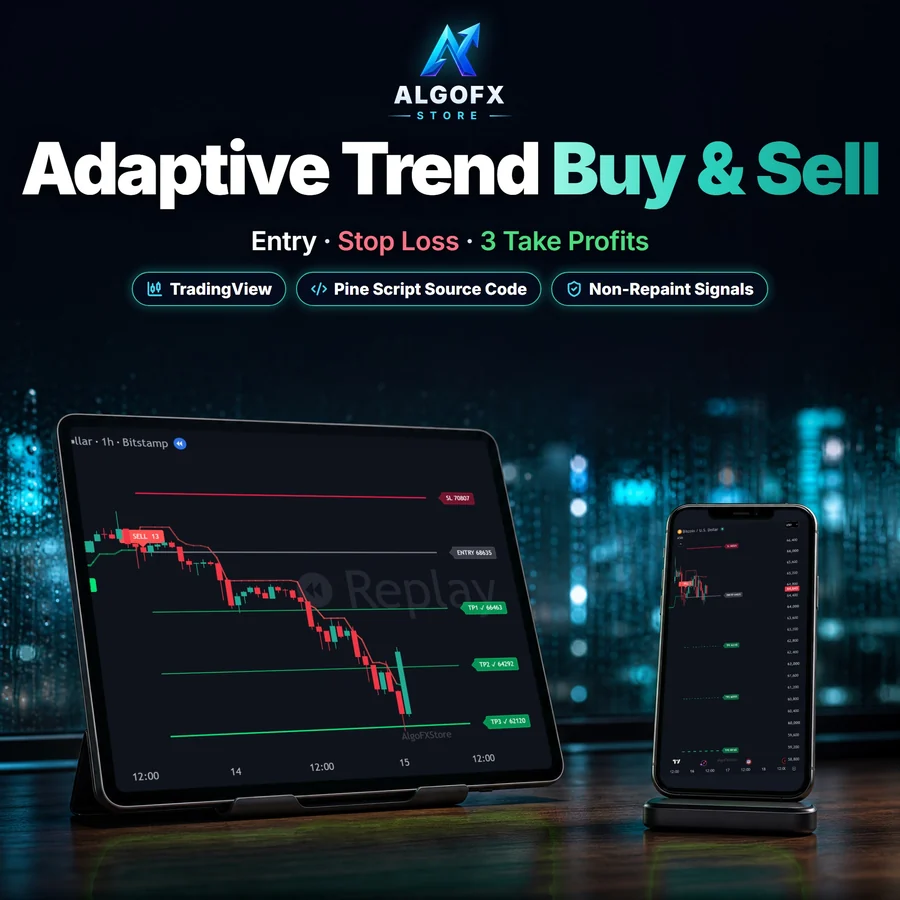
Algo Shadow Matrix draws an adaptive trend line on your TradingView chart and, when a candle closes through it, prints a scored BUY or SELL label with an entry, a stop loss and three take profit levels.
- Adaptive trend line: green under price in an uptrend, red above it in a downtrend, brighter when trend quality is high.
- BUY and SELL labels print only when a candle closes, each with a score out of 102 you can hover.
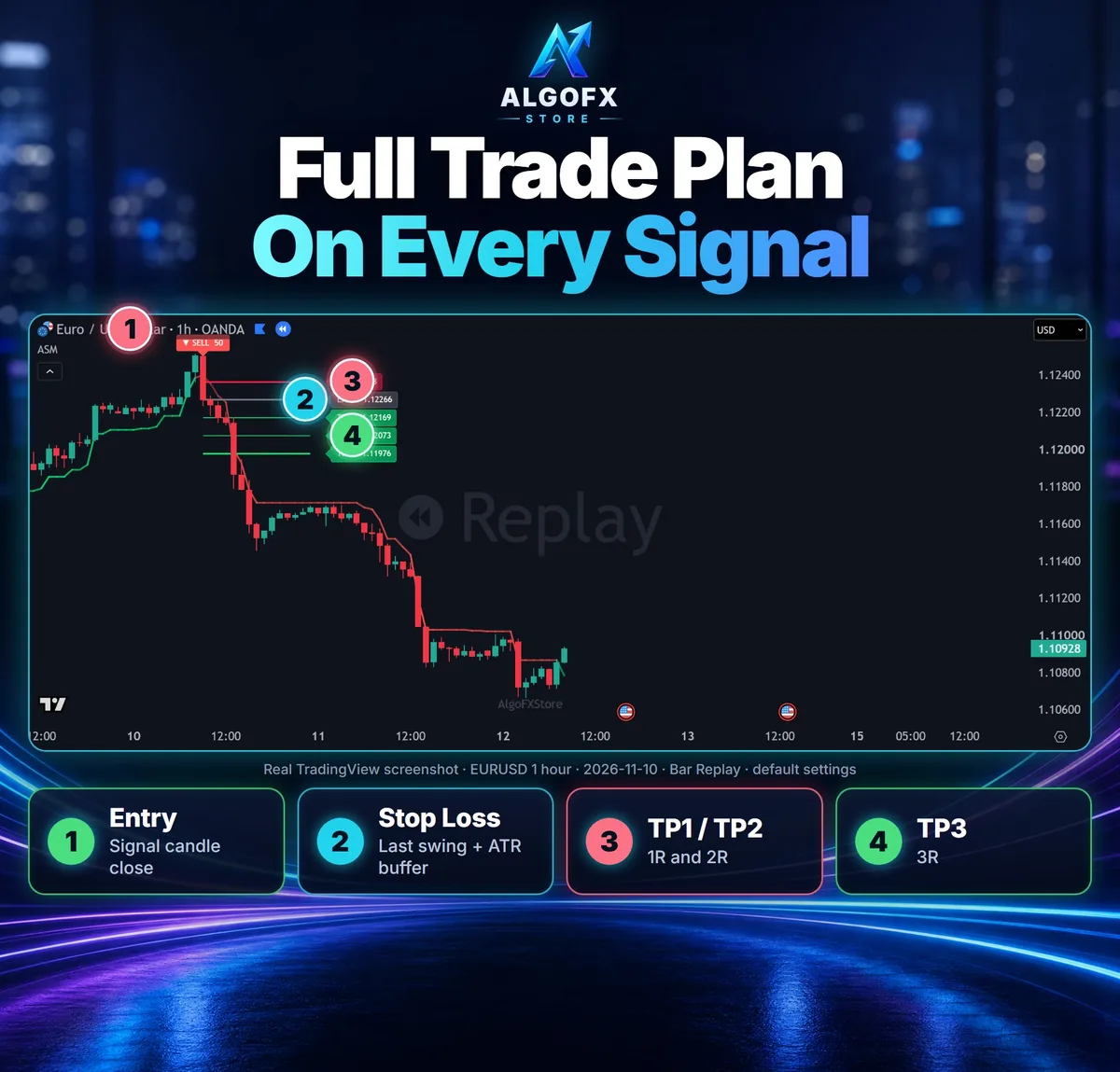
- Entry at the signal close, stop beyond the last swing plus an ATR buffer, targets at 1R, 2R and 3R.
- Five alert conditions, plus a detailed alert message with price, score, stop and all three targets.
- The full Pine Script source code. Paste it into the Pine Editor, save, and add “Algo Shadow Matrix [AlgoFXStore]” to your chart.
- A 5-page PDF guide with installation, every setting and how to read the chart. One-time €47.
See Algo Shadow Matrix on a real chart
Press play; use the full-screen button to see every detail.
A fixed band width treats a clean trend and a choppy range the same
A classic supertrend sits a fixed multiple of ATR away from price. That one number has to work in a smooth trend and in a sideways session at the same time, and it cannot. Set it tight and the line flips every few candles in a range, each flip a fresh entry against you. Set it wide and the line trails so far behind a clean trend that the exit hands back much of it.
The second gap comes after the flip. A plain supertrend tells you the direction changed, then leaves you to work out where the stop belongs, how far away the first target is and whether the flip happened in a trending market or in noise. So traders draw the same lines by hand on every signal, or trade the label alone.
Algo Shadow Matrix changes both parts. The band width follows a Trend Quality Index built from efficiency, participation, range position and momentum, so the line hugs a clean move and backs off in noise. And every flip on a closed candle arrives with the entry, the stop, three targets and a dashboard that says whether the market reads Trending, Mixed or Choppy before you decide.
What Algo Shadow Matrix draws, and what each mark means
Read from the shipped TradingView edition.
| What you see | What it means |
|---|---|
| Green / red trend line, bright or faded | The adaptive trend line; brighter means higher trend quality (TQI). |
| Green BUY label with a number | The trend flipped up on a closed candle; the number is the six-part score (hover for the score out of 102 and its inputs). |
| Red SELL label with a number | The trend flipped down on a closed candle; the number is the score. |
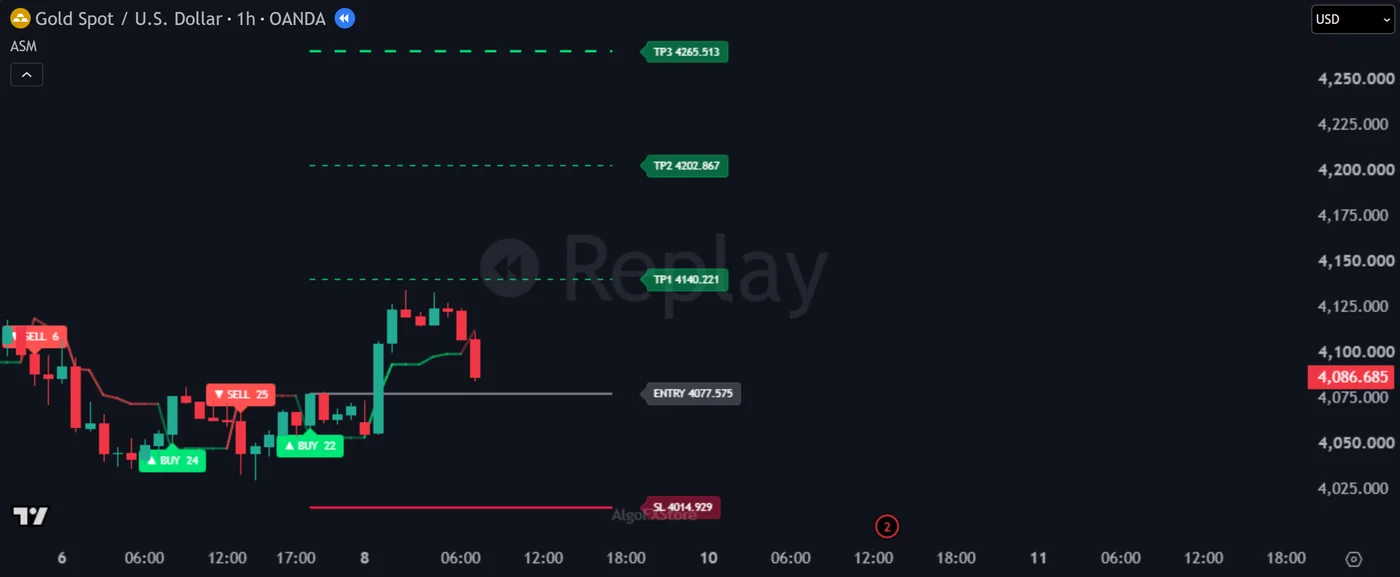
| Grey line, ENTRY label | Entry: the close of the signal candle. |
| Red line, SL label | Stop beyond the last swing plus an ATR buffer, never closer to the entry than that buffer. |
| Green dashed lines, TP1, TP2 and TP3 labels | Targets at 1R, 2R and 3R of the risk. |
| Target line turned solid, label with a check mark | That target was reached on a closed candle; it stays green. |
| Dashboard Direction LONG, SHORT or WAITING | The plan being tracked and its age; WAITING once it ended at TP3, the stop or the timeout. |
How the line, the labels and the plan are decided
Everything is calculated from the chart's own candles; the script requests no other symbol or timeframe. The steps below follow the shipped Pine Script code at its default settings.
- 1
An efficiency-weighted ATR
The indicator takes the ATR of the active preset (14 on the Default preset) and scales it by the efficiency ratio: ATR x (0.5 + 0.5 x ER). The efficiency ratio compares the net move of the last 20 closes with the total distance travelled. A straight move keeps the full ATR, a pure zig-zag counts it half, so noisy volatility pushes the bands less than clean volatility.
- 2
A Trend Quality Index from four readings
Every candle gets a TQI between 0 and 1. It weighs efficiency (0.35), participation (0.20: the volume z-score over 20 candles, or ATR against its 100-candle average when the symbol has no volume data), range position (0.25: how far the close sits from the middle of the 20-candle high-low range) and momentum persistence (0.20: how many of the last 10 candles moved with the 10-candle direction).
- 3
Bands reshaped by trend quality
The band starts at the preset base width, 2.0 x ATR on Default. It widens when efficiency is low, and Quality Influence (0.4) bends it with the TQI on a curve: a mild drop in quality changes little, a sharp drop widens it more. With Asymmetric Bands on, the trend-side band tightens and the opposite band widens as quality rises. Both are smoothed, then ratchet like any supertrend.
- 4
Closed-candle flips print the label
When a candle closes above the previous upper band while the trend was down, the trend turns up and a green label with an up triangle, BUY and the score prints under the low. A close below the previous lower band in an uptrend prints the red SELL label above the high. Labels appear only on confirmed candles after the 60-candle warm-up, and every flip prints: the score never hides one.
- 5
A six-part score on every label
The number adds six readings taken at the flip: the move of the last three candles against ATR, the efficiency ratio, the volume z-score, how deep RSI went beyond 30 or 70 in the last 20 candles, how close the last swing point is, and how far the previous close sat from the band it then broke. Hover the label for the score out of 102 with the TQI, ER, RSI and volume z-score.
- 6
The plan: entry, stop and three targets
Entry is the flip candle's close (grey line, ENTRY label). The stop goes beyond the last swing low or high, found with 3 candles on each side, plus 1.5 x the efficiency-weighted ATR on Default, and it is never closer to the entry than that buffer (red line). TP1, TP2 and TP3 sit at 1R, 2R and 3R (green dashed lines). Tracking ends at TP3, at the stop or after 100 candles.
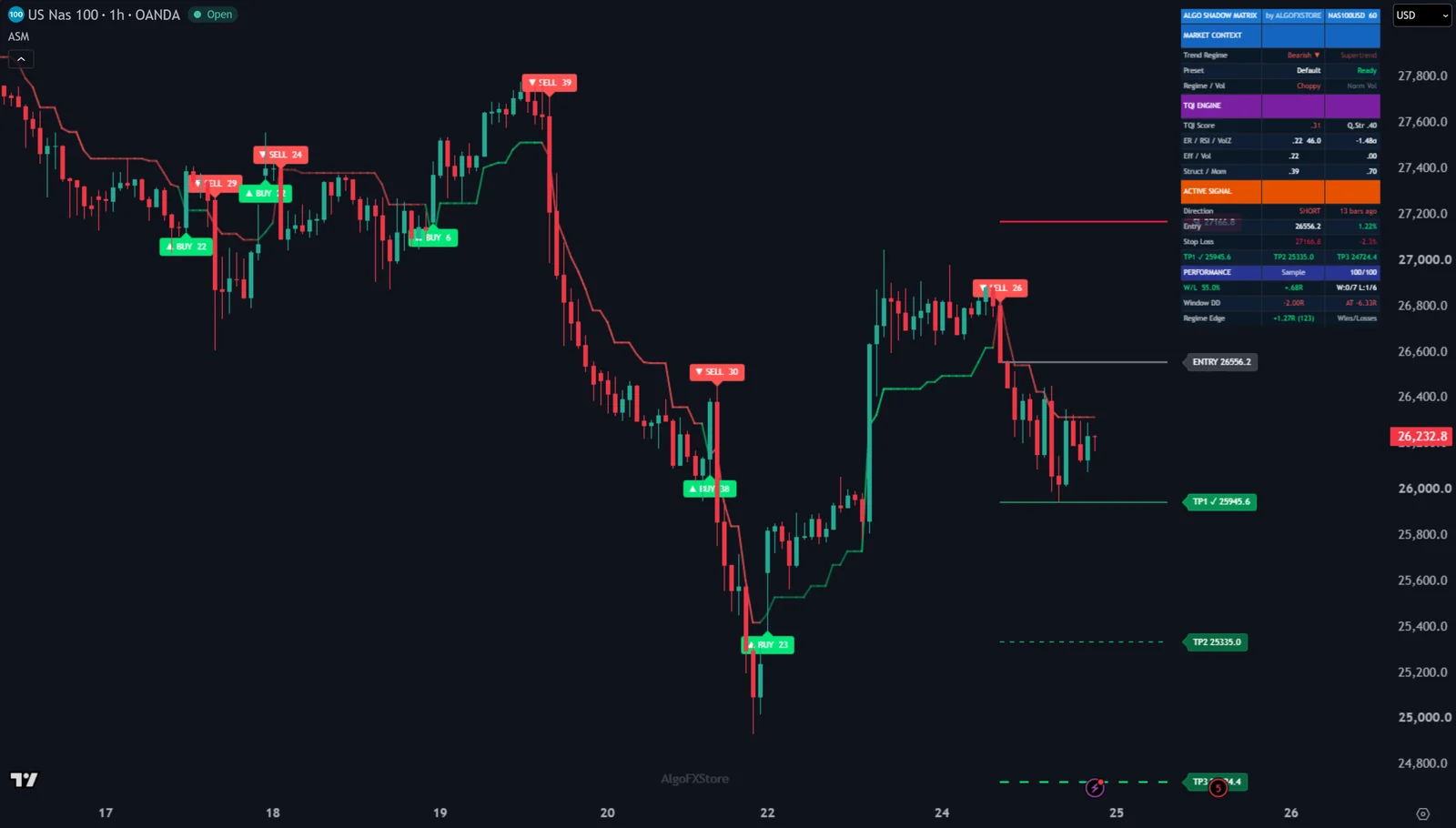
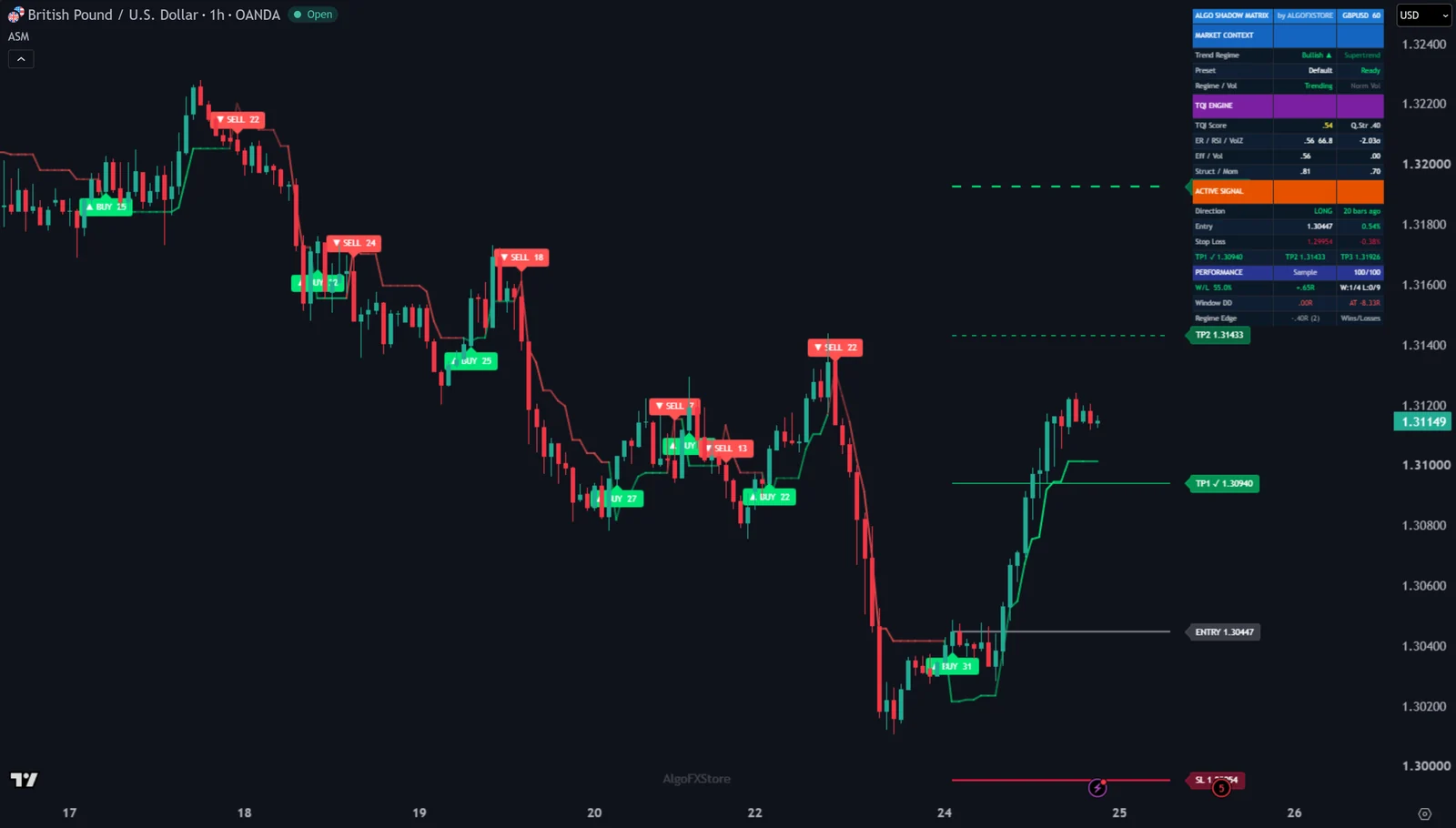
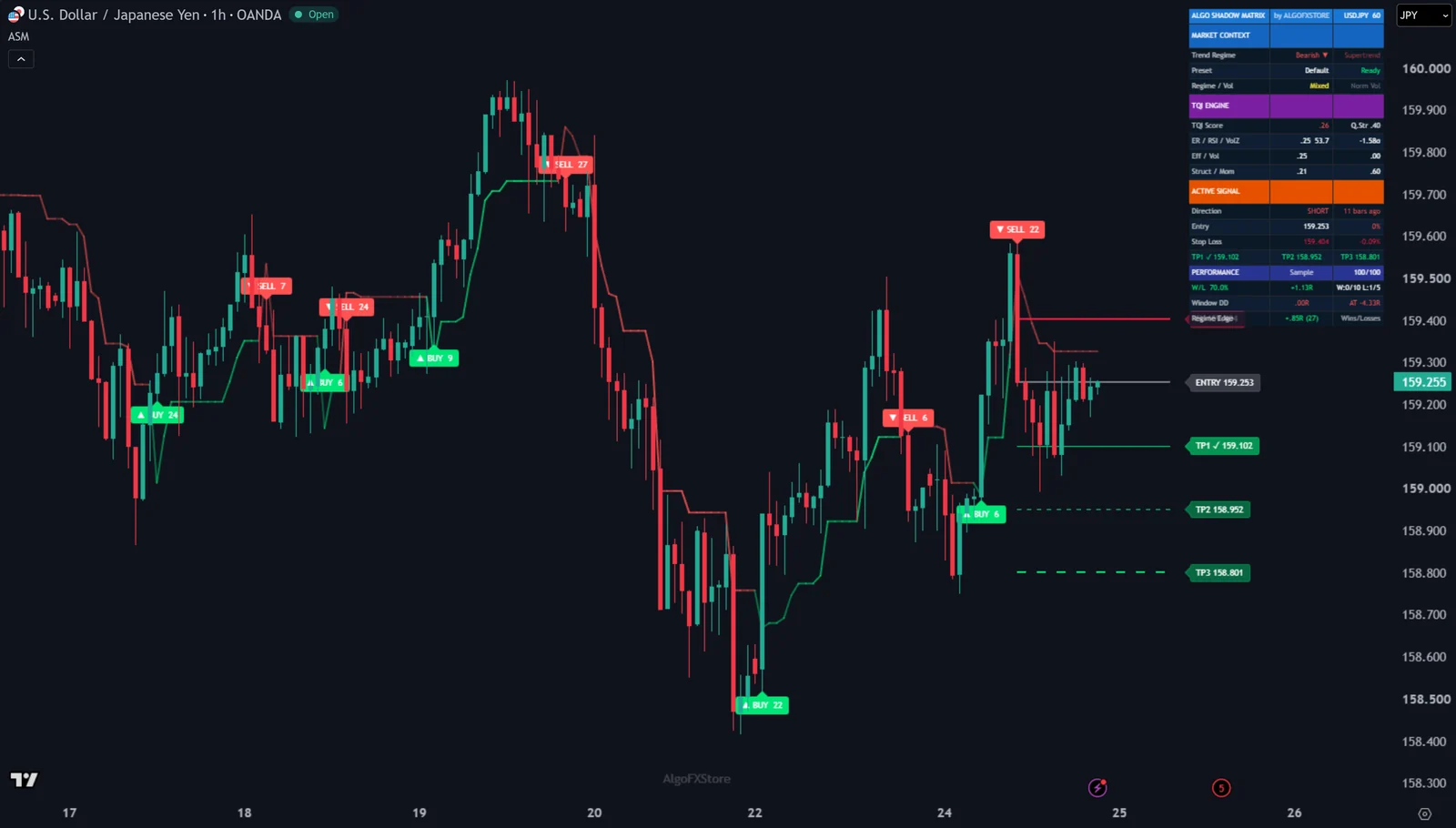
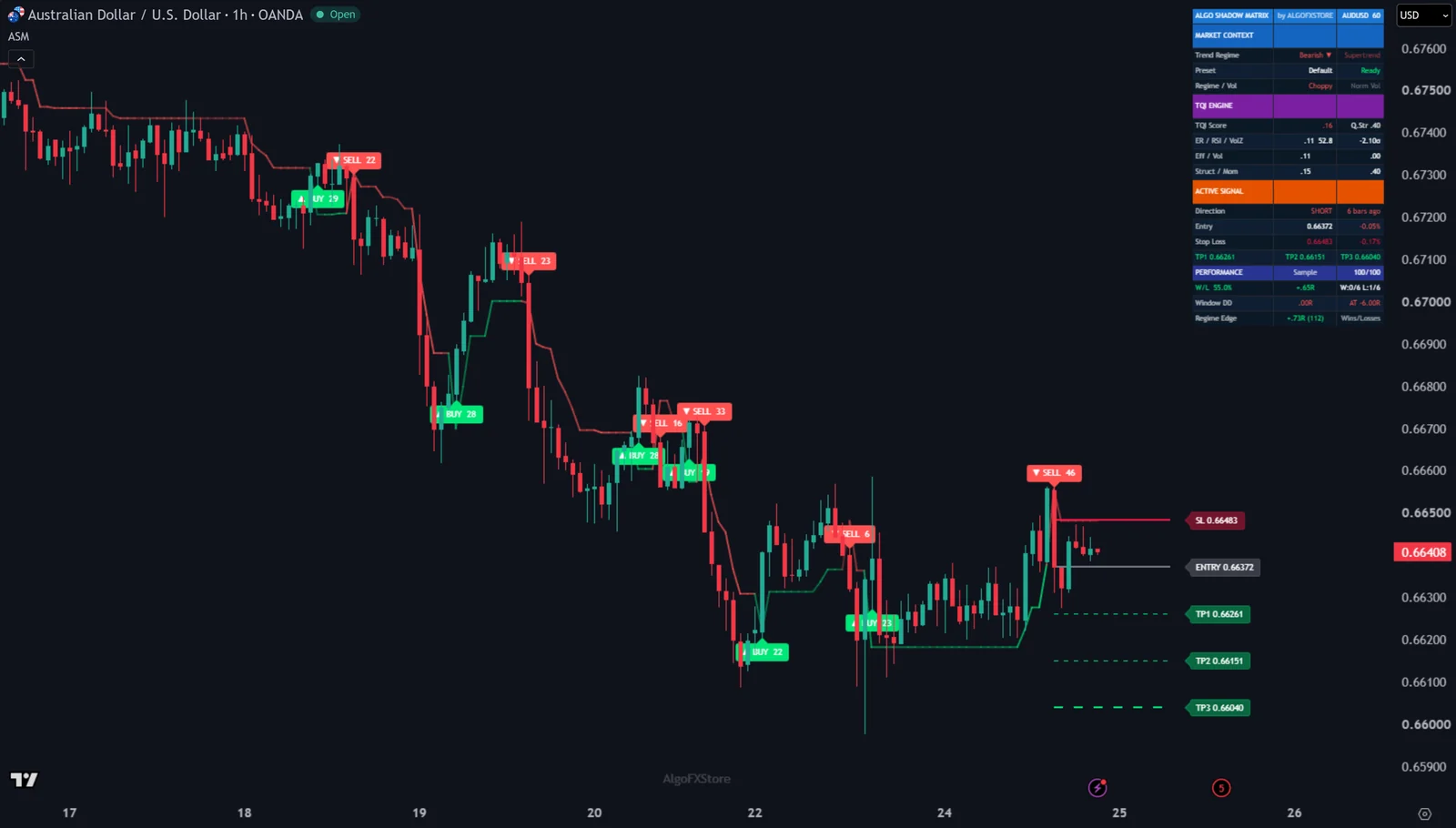
Algo Shadow Matrix on 12 different markets
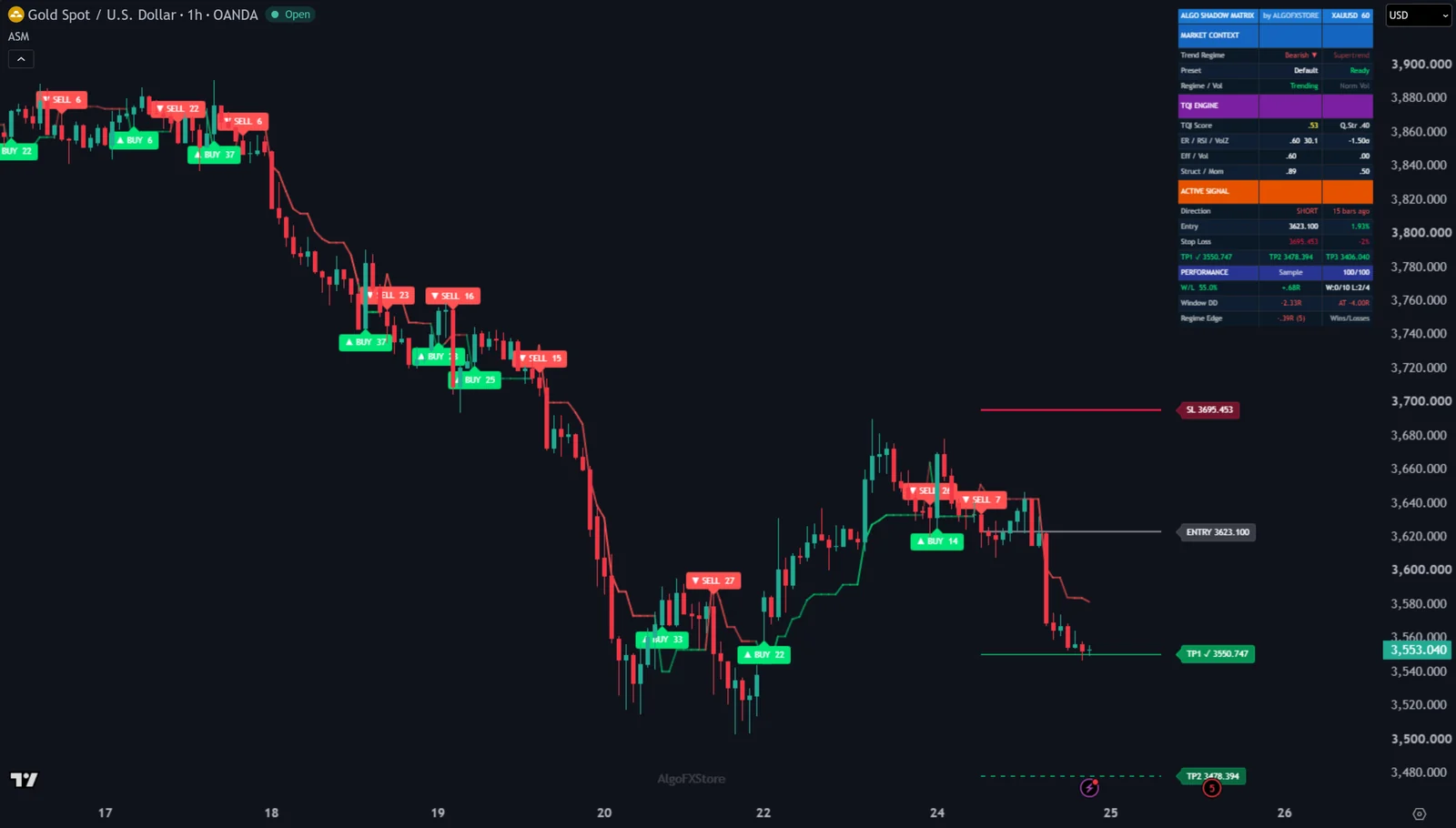
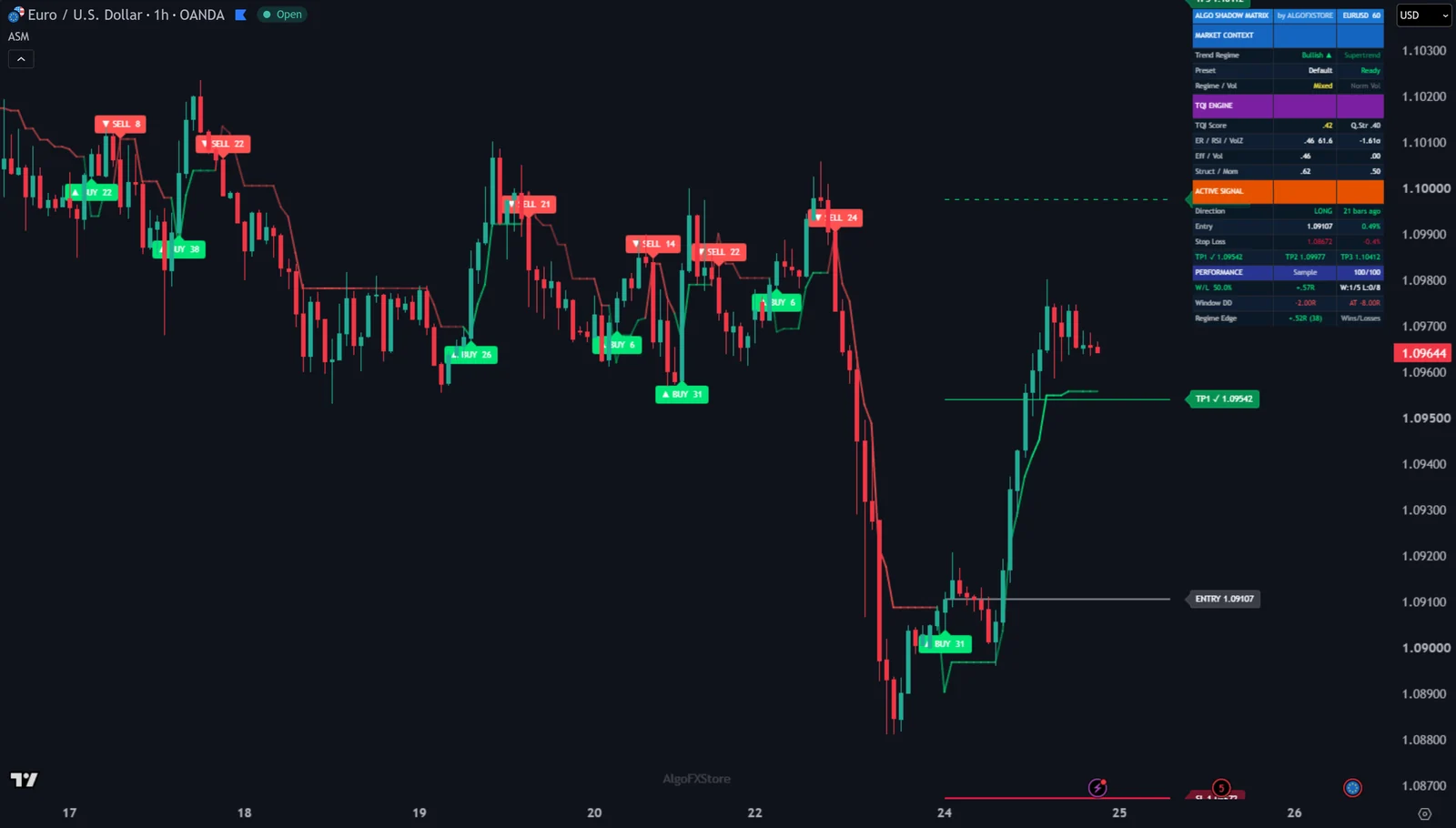
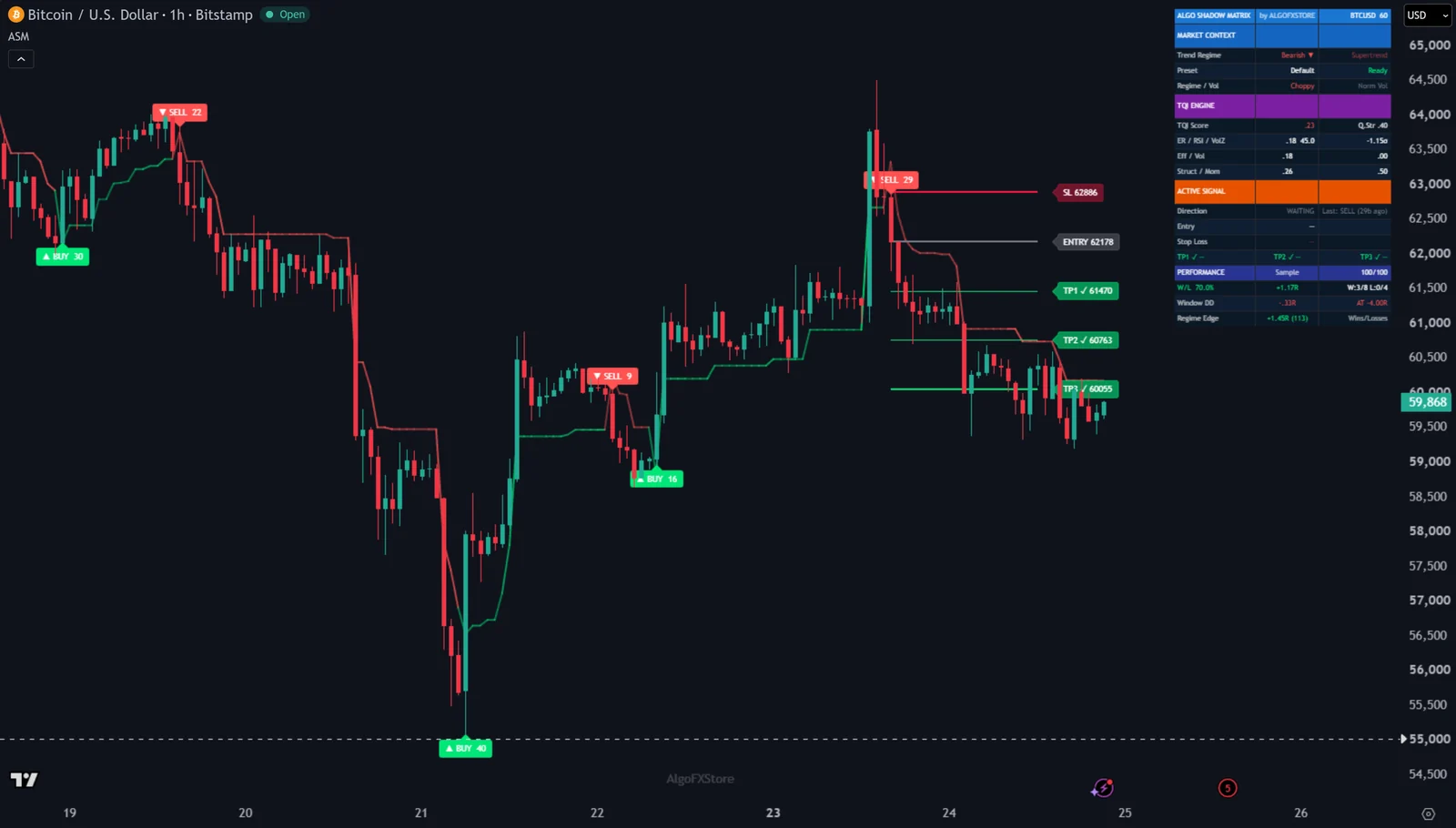
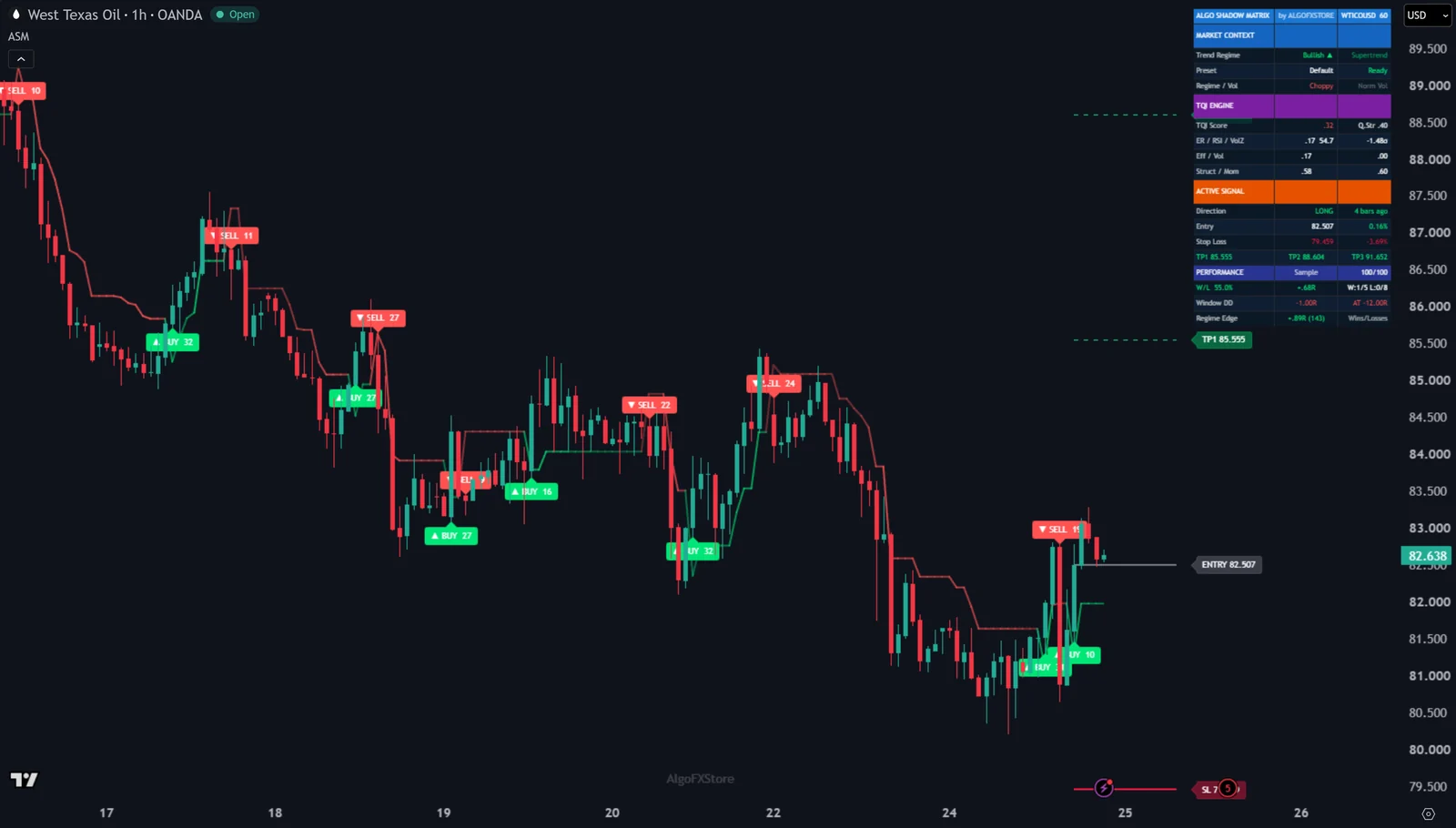
Every chart below is a screenshot of TradingView itself with the shipped Algo Shadow Matrix [AlgoFXStore] attached at its default settings. Forex, metals, indices, energy and crypto, so you can see how it reads each kind of market. They show what the indicator draws; they are not trading results. Tap or click any chart to open it full size.
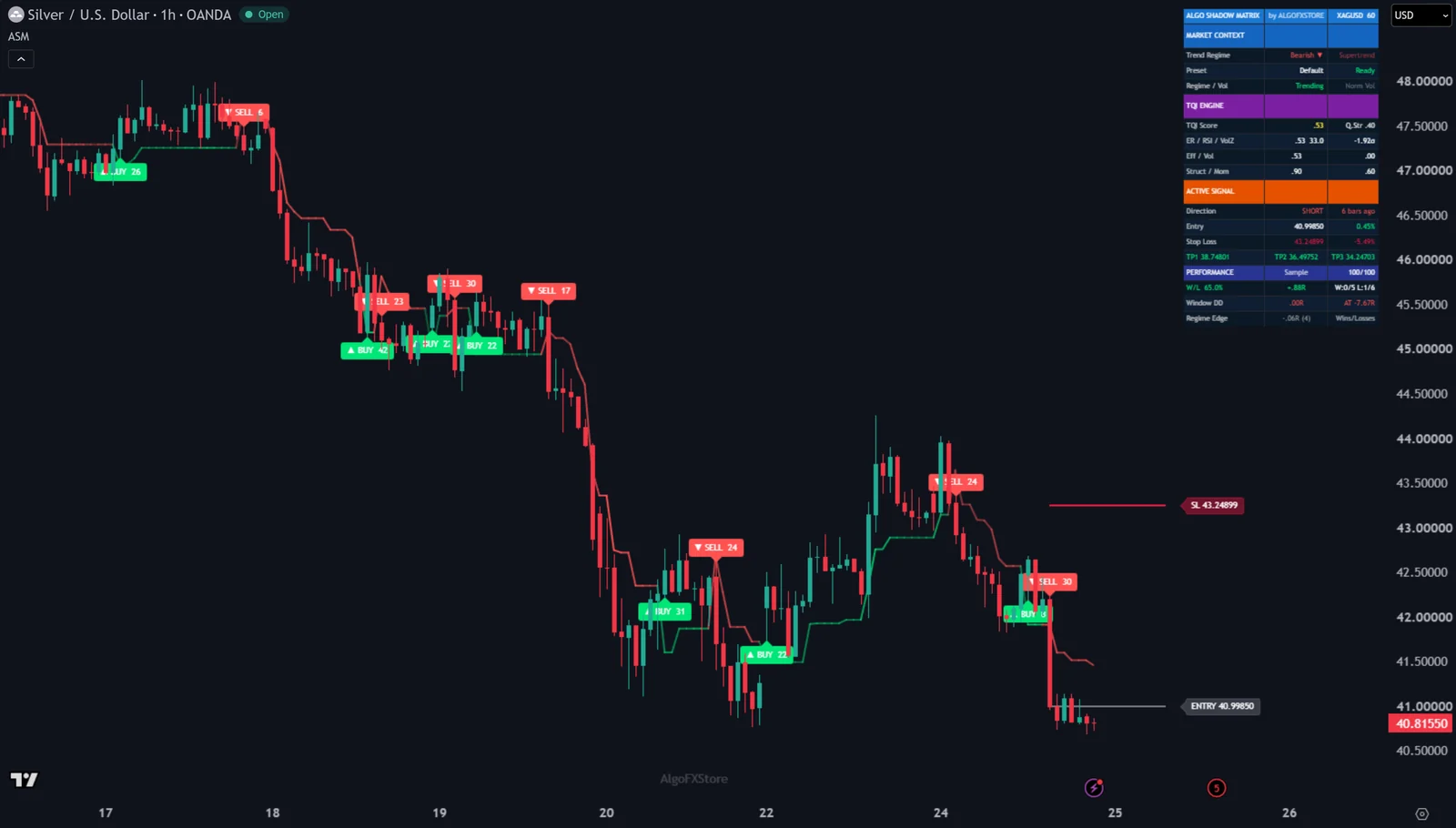
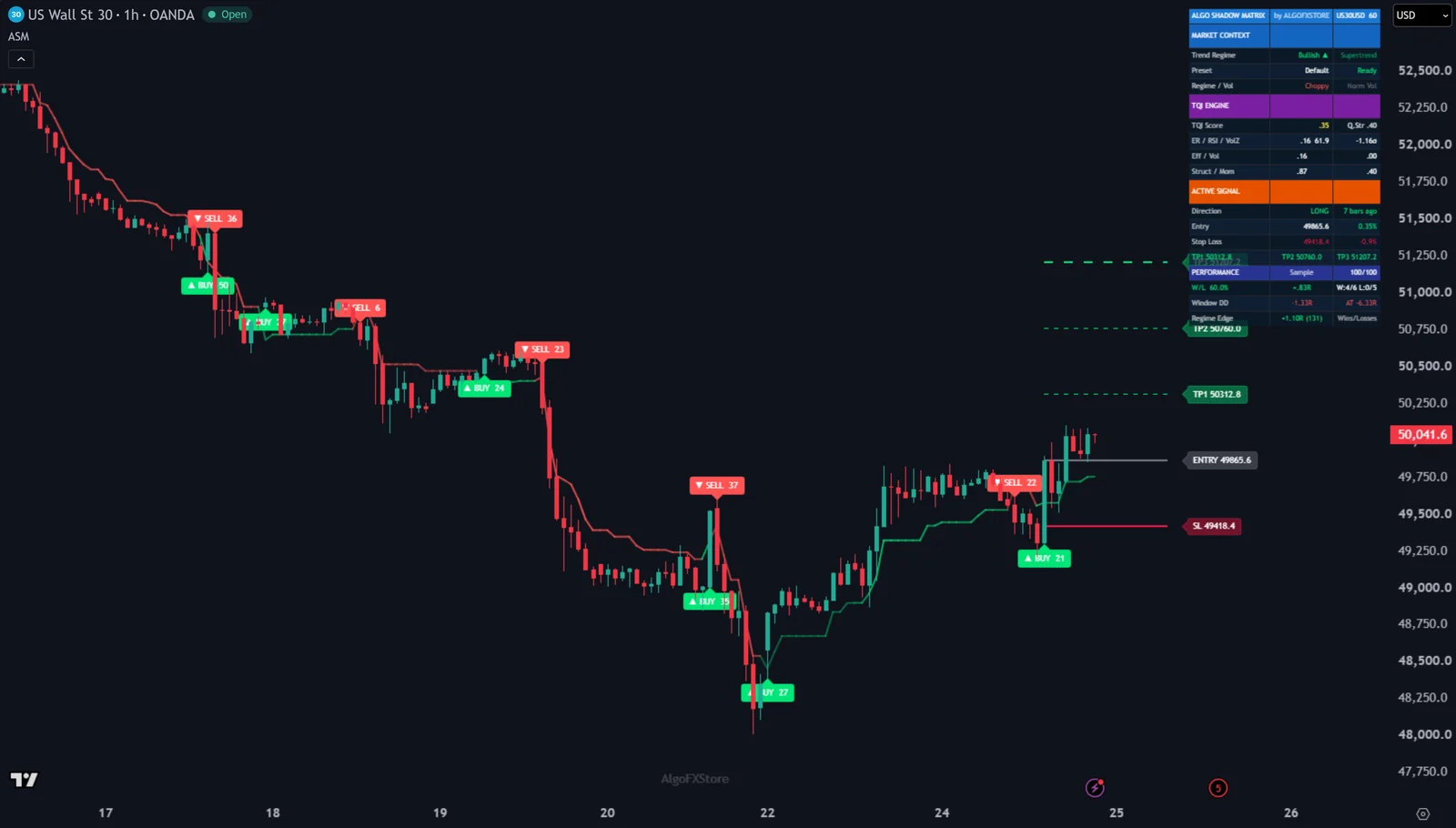
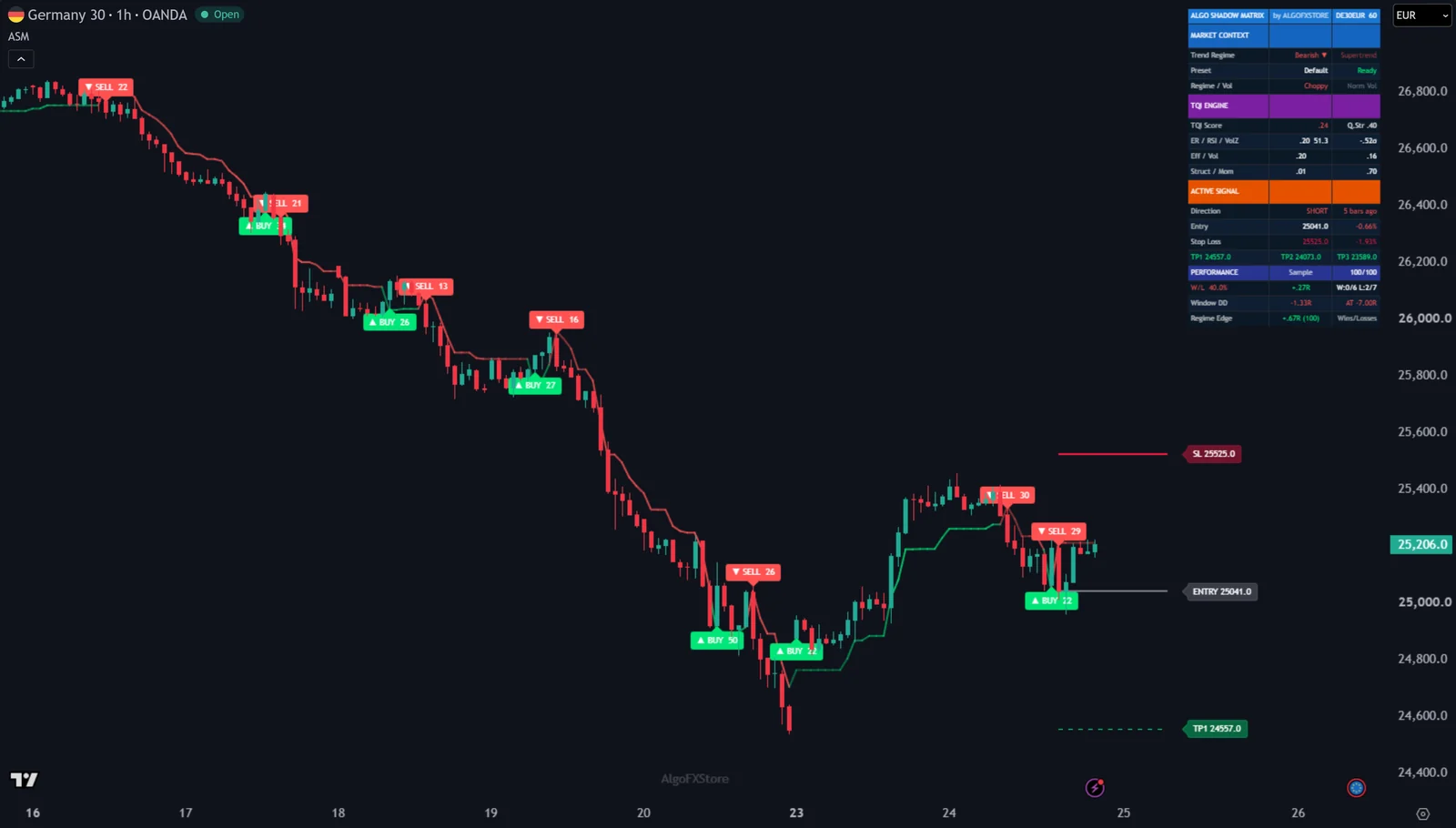
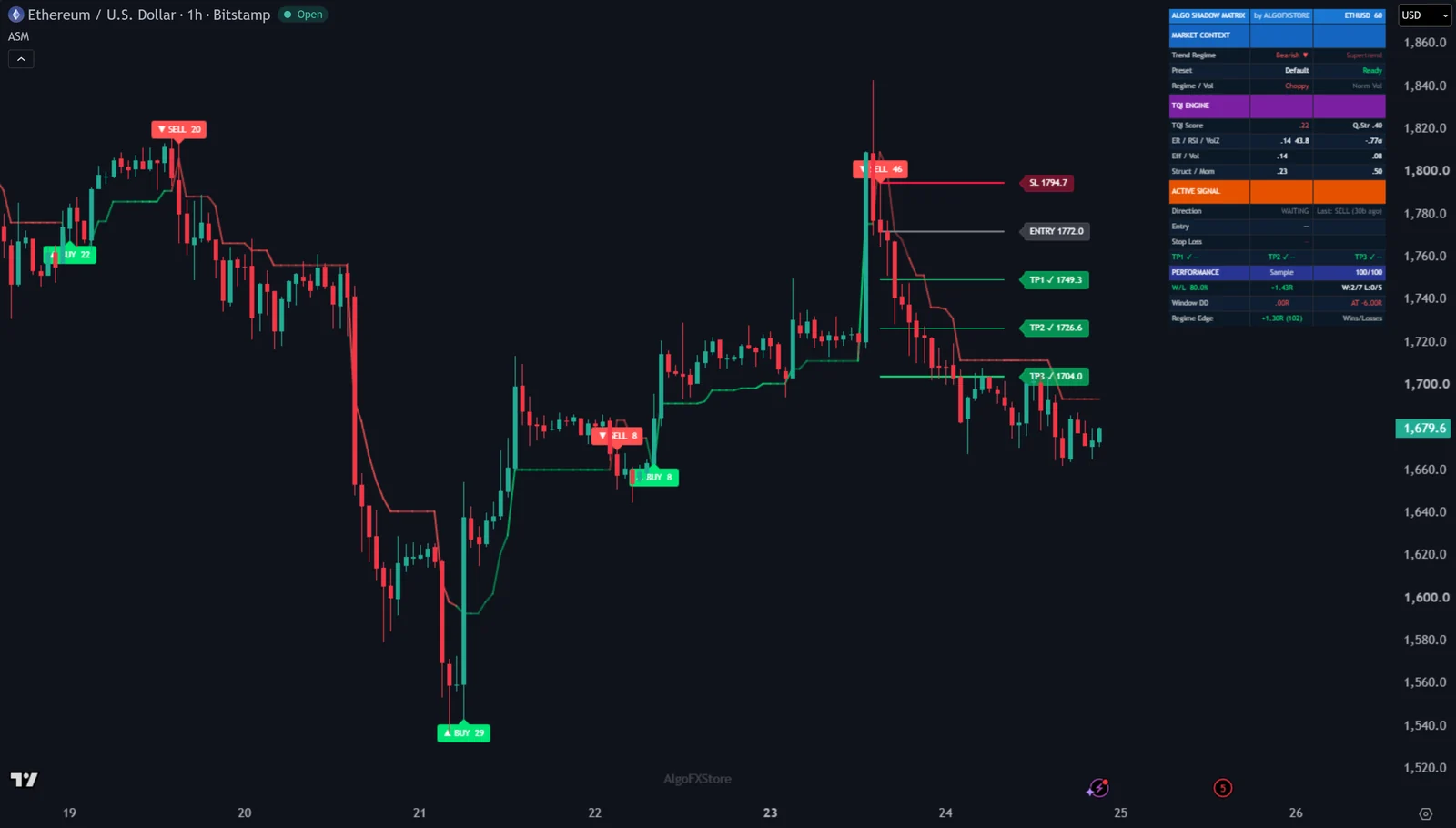
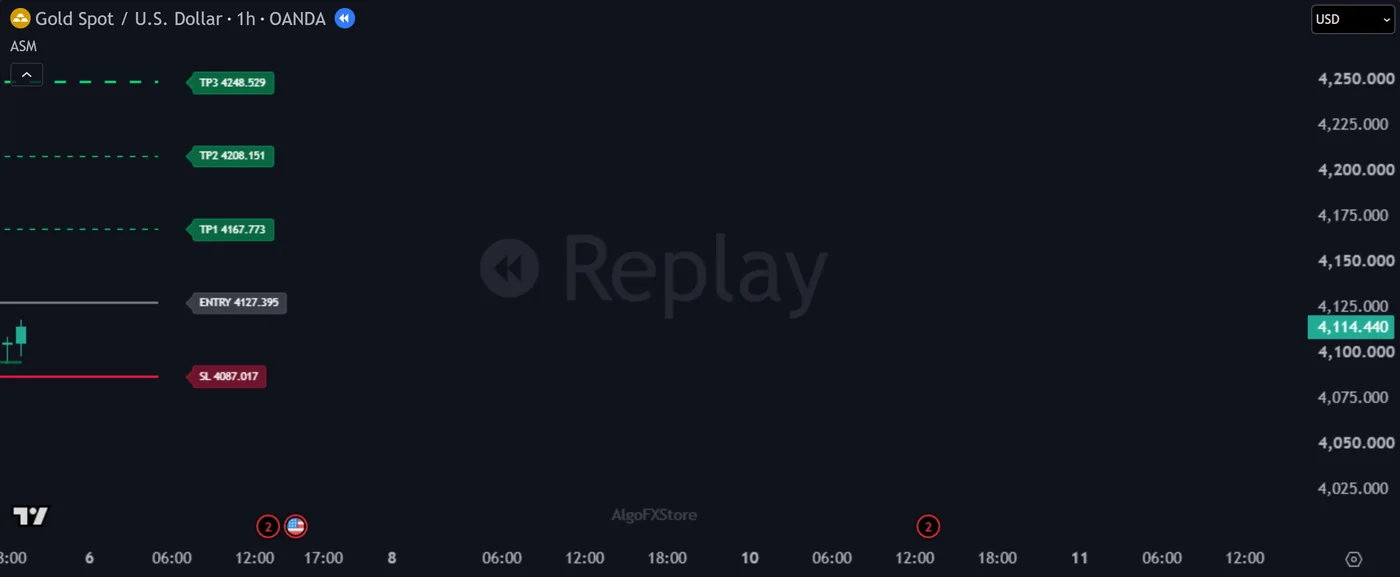
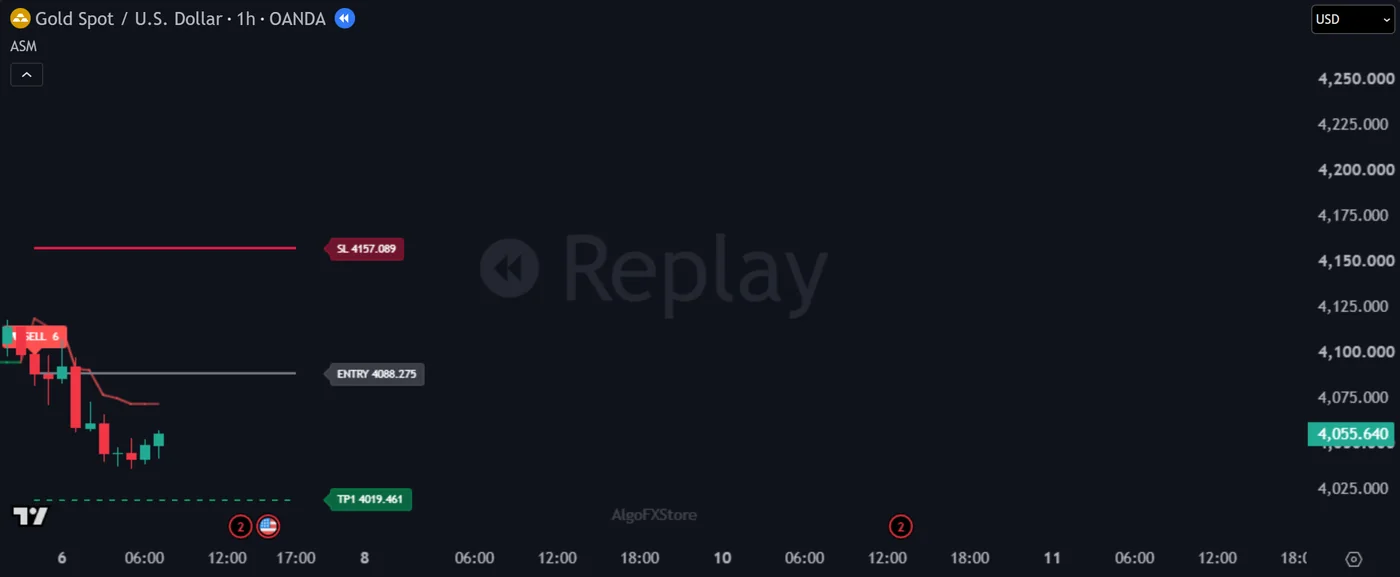
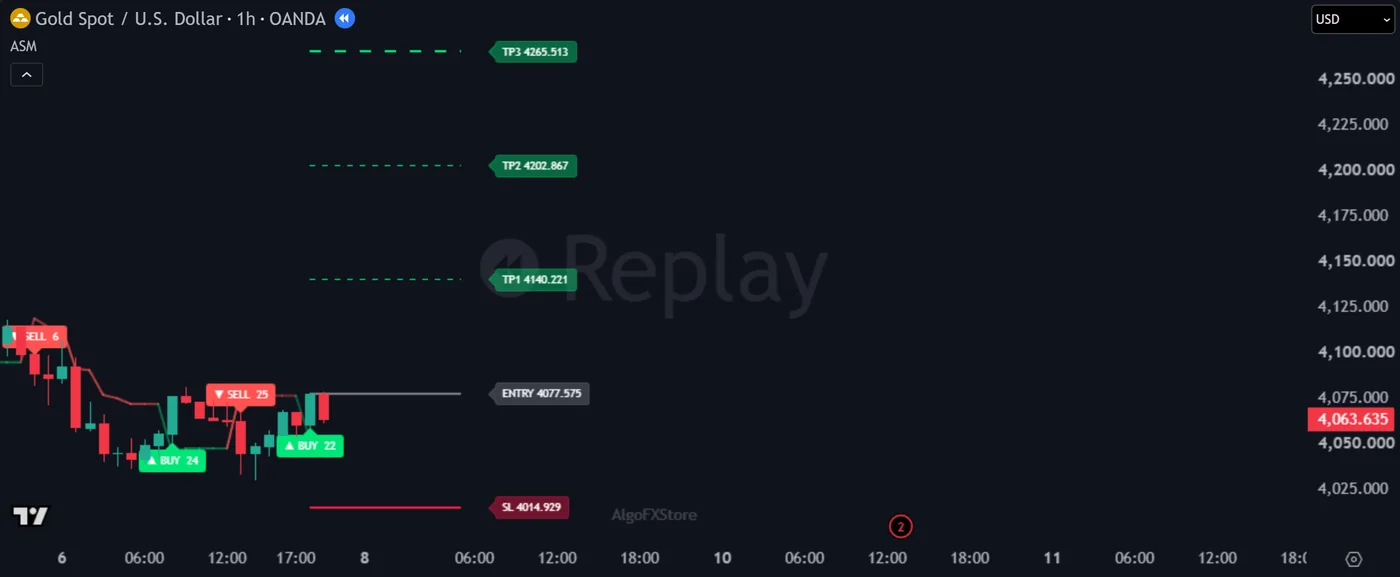
Algo Shadow Matrix on a real TradingView chart, frame by frame
Frames of a screen recording of the shipped indicator at its default settings, as the chart updates. Nothing is edited into the chart.
A step-by-step way to use it on your charts
The indicator decides where the line flips and where the levels sit. Whether you take a signal, and with what size, stays your decision. A routine to start from:
- 1
Let it warm up and check the preset
Add it to the chart, then look at the Preset row of the dashboard. It names the active preset (Scalping up to 5 minute charts, Default up to 4 hours, Swing above, when Preset is Auto) and reads Ready once the 60-candle warm-up is done. Until then it shows how many candles are still needed, and neither the line nor any label is drawn.
- 2
Wait for the closed-candle label
Do nothing while the line is simply following price. Act only when a candle closes and a BUY or SELL label prints, or when the alert arrives. The detailed alert message already carries the price, the TQI, the score, the stop and all three targets, so you can start planning before you open the chart.
- 3
Read the context before the levels
Check the dashboard. Regime / Vol shows Trending, Mixed or Choppy and Low, Norm or High Vol; the TQI Score is green above 0.6, yellow above 0.35 and red below. A personal filter worth testing on a paper account is to skip flips while the regime reads Choppy, or while the TQI is red. Compare the label score with your recent signals and set your own minimum.
- 4
Size from the stop, skip wide ones
The Stop Loss row shows the stop price and its distance from the entry in percent. Work out your position size from that distance and your risk per trade. After a large impulse candle the last swing can sit far away and the stop gets wide; if the size this allows is too small for you, skip the signal rather than moving the stop closer.
- 5
Place and manage your own orders
The indicator places nothing. Put your stop at the SL price and your targets at TP1, TP2 and TP3, for example taking part off at TP1 and TP2. When a later candle reaches a target, that line turns solid and its label gains a check mark, and the TP row of the dashboard marks it too. A stop touch ends the tracking without a mark on the chart.
- 6
Treat an opposite label as a decision point
If the line flips the other way while a plan is open, the new signal replaces the old plan on the chart and the dashboard switches direction. Decide in advance what that means for you: close, tighten or keep your original stop. Once a plan ends at TP3, at the stop or at the 100-candle timeout, its lines stay frozen and Direction reads WAITING until the next label.
The dashboard, row by row
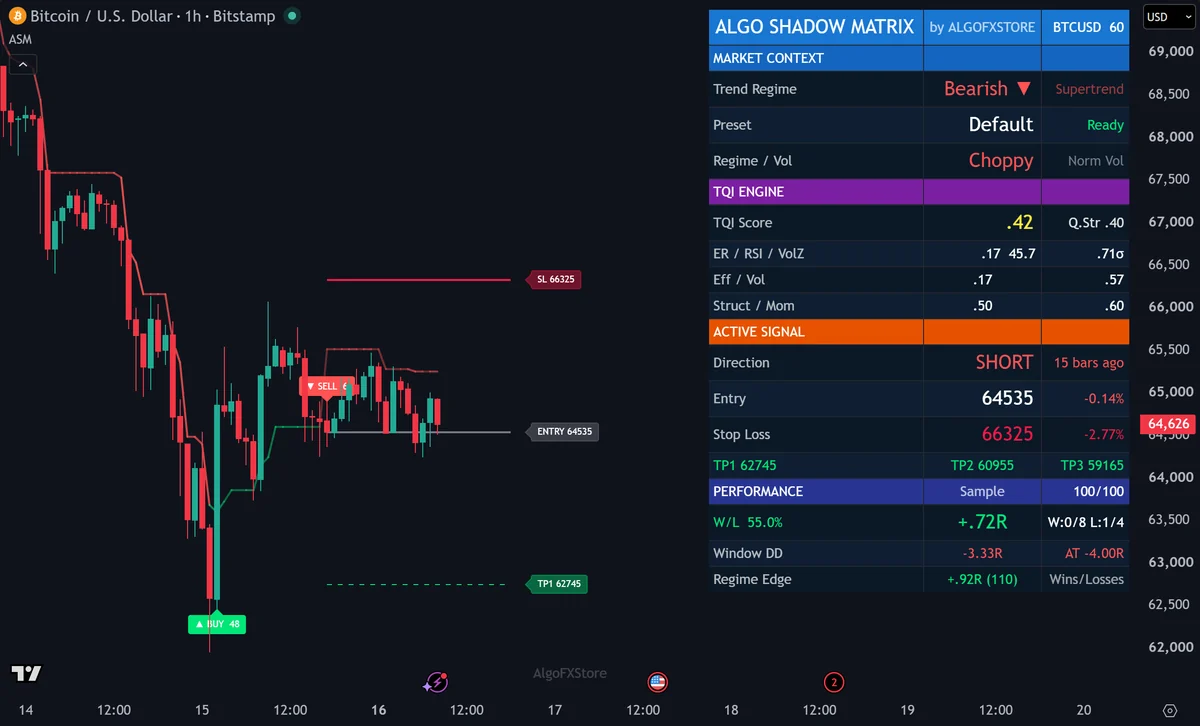
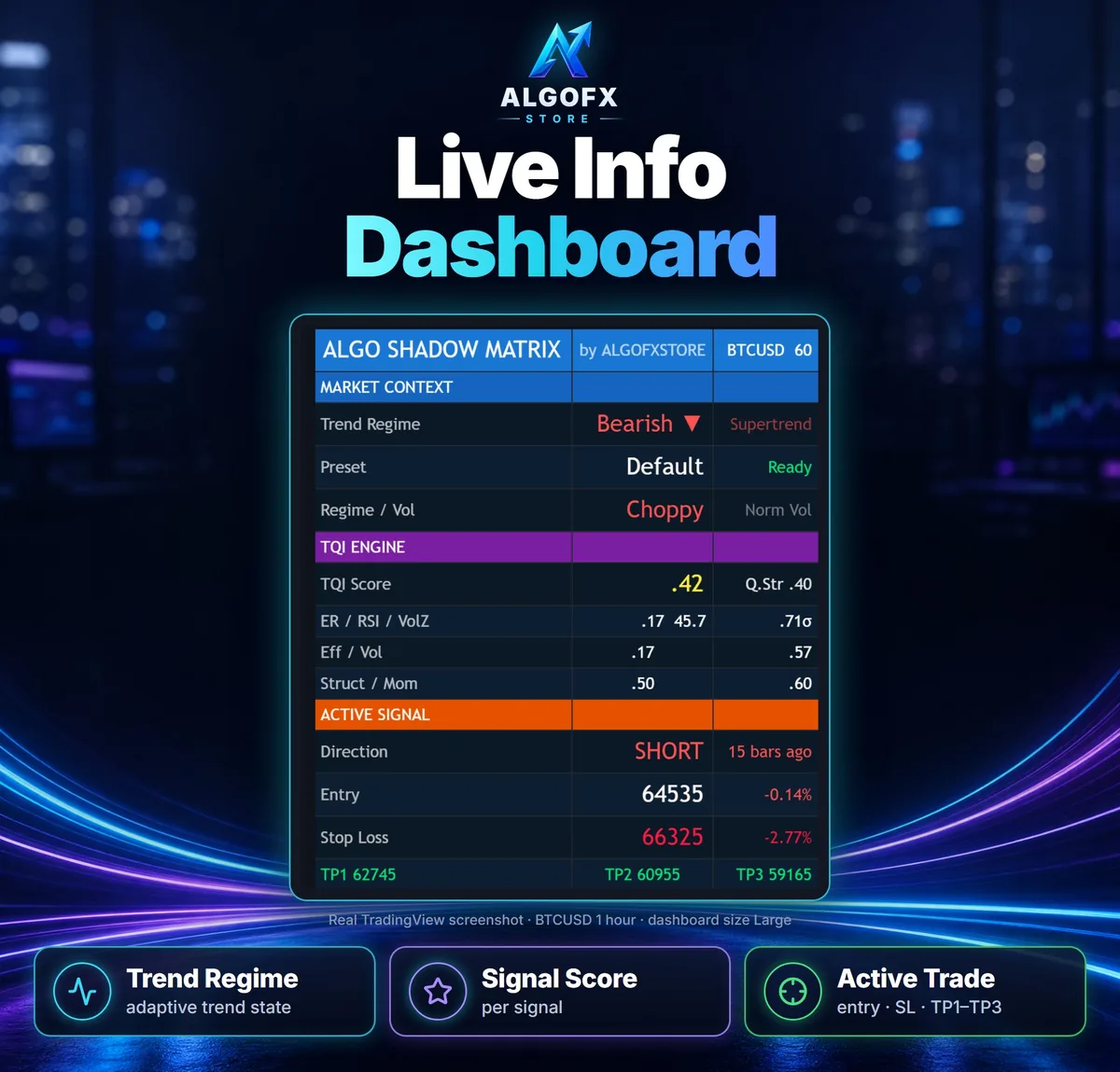
- ALGO SHADOW MATRIX | by ALGOFXSTORE | symbol and timeframe
- MARKET CONTEXT
- Trend Regime: Bullish or Bearish, Supertrend
- Preset: the active preset, then Ready or the candles still needed for the warm-up
- Regime / Vol: Trending, Mixed or Choppy, and Low, Norm or High Vol
- TQI ENGINE
- TQI Score: 0.00 to 1.00 (green, yellow or red) and the quality strength Q.Str
- ER / RSI / VolZ: efficiency ratio, RSI and volume z-score (n/a without volume data)
- Eff / Vol and Struct / Mom: the four TQI parts (Show TQI Breakdown, on by default)
- ACTIVE SIGNAL
- Direction: LONG, SHORT or WAITING, with the candles since the signal
- Entry: the entry price and the move since entry in percent
- Stop Loss: the stop price and its distance from the entry in percent
- TP1, TP2, TP3: the target prices, each with a check mark once reached
- PERFORMANCE (on by default): four rows of hindsight bookkeeping of the indicator's own past plans on the loaded candles in R; not a forecast, removed with Show Performance Stats off
- SCORE BREAKDOWN (off by default): the six score parts of the last signal
Everything Algo Shadow Matrix does for you
Bands that adapt every candle
The band multiplier is recalculated on each candle from the preset base, the efficiency ratio and the Trend Quality Index, then smoothed. In clean trends the line stays closer to price; in noise it backs off, so it flips less often there.
Tighter on the trend side
With Asymmetric Bands on (Asymmetry Strength 0.5), the band that follows the trend tightens as quality rises and the band on the other side widens, so a pullback has more room before it counts as a break.
Line brightness shows trend quality
With Color Line by TQI on, the line is fully bright when the TQI is high and fades as it drops, so you can judge the current trend without opening the dashboard. A green and red trend background is available as an option.
A ready plan on every flip
Each signal draws ENTRY, SL, TP1, TP2 and TP3 lines with price labels. The lines start at the signal candle and, while the plan is tracked, keep reaching 10 candles past the current candle, with the labels 2 candles further right.
Stops placed at structure
The stop uses the last swing point (Pivot Strength 3) plus an ATR buffer that depends on the preset: 1.0 on Scalping, 1.5 on Default, 2.0 on Swing and 2.5 on Crypto 24/7, and it never sits closer to the entry than one buffer.
Presets that follow the timeframe
On Auto the preset changes with the chart: Scalping up to 5 minutes (ATR 10, base width 1.5), Default up to 4 hours (ATR 14, width 2.0), Swing above that (ATR 21, width 2.5). Crypto 24/7 and Custom are picked by hand.
A dashboard that explains the flip
Market context (trend, preset and warm-up, regime and volatility), the TQI engine with its four parts, and the active signal with direction, entry, stop distance and the three targets. Five positions, four sizes and a header colour input.
Alerts that carry the levels
The BUY and SELL alert messages include the symbol, timeframe, price, TQI, score, stop and TP1 to TP3, sent once per candle close. A Webhook JSON Format switch turns the same message into structured JSON for webhook alerts.
Algo Shadow Matrix, feature by feature
Each picture is built from real platform screenshots of the shipped indicator at its default settings, labelled so you can see what every part does. Tap any picture to open it full size.



How traders put it to work
Scalping on 1 to 5 minute charts
Up to 5 minute charts the Auto preset switches to Scalping: ATR 10, base width 1.5, efficiency window 14, RSI 9 and a 1.0 x ATR stop buffer. Stops are tighter and the line flips more readily, so the regime row and the score do more of your filtering. Keep your own skip rules strict.
15 minute to 4 hour charts on forex, gold and indices
Above 5 minutes and up to 4 hours Auto uses the Default preset: ATR 14, base width 2.0, efficiency window 20 and a 1.5 x ATR stop buffer. This is the middle setting for symbols such as EURUSD, XAUUSD or a Nasdaq 100 index. Gold and index symbols can show wide swing-based stops after fast candles, so check the Stop Loss row before sizing.
Swing trading on charts above 4 hours
Above 4 hours Auto selects Swing: ATR 21, base width 2.5, efficiency window 30, RSI 21 and a 2.0 x ATR stop buffer. The line sits further from price and flips less often, and the 100-candle Trade Timeout covers a long stretch of time on daily candles. Lower it if you want a stale plan to end sooner.
Crypto that trades all week
For symbols such as BTCUSD that trade through the weekend you can pick Crypto 24/7 by hand: ATR 14, base width 2.8 and a 2.5 x ATR stop buffer, the widest of the presets. The dashboard Preset row confirms which one is active. Without volume data, the participation reading falls back to ATR against its 100-candle average.
Every setting, with its default
The names are the ones in the script's Settings dialog in TradingView (Inputs tab); the defaults are what every chart on this page uses.
| Setting | Default | What it does |
|---|---|---|
| Preset | Auto | Picks the settings by timeframe: Scalping up to 5 min, Default up to 4 h, Swing above (Custom uses your own values) |
| Enable Trend Quality Engine | On | Rates each candle 0-1 from efficiency, volume, structure and momentum and adapts the line width |
| Quality Influence | 0.4 | How strongly trend quality widens or tightens the line (0 = no effect) |
| Asymmetric Bands | On | The side in the trend's direction tightens, the other widens |
| Efficiency-Weighted ATR | On | Scales ATR by efficiency so noisy volatility counts less |
| SL Buffer (xATR) | 1.5 | ATR buffer beyond the swing for the stop (used by Custom; the Default preset also uses 1.5) |
| TP1 (R-multiple) | 1.0 | First target in multiples of the risk (TP2 2.0, TP3 3.0) |
| Mark TP Hits (visual) | On | Adds tick to a reached target and makes its line solid |
| Trade Timeout (bars) | 100 | Stops tracking a trade that has neither hit TP3 nor the stop after 100 bars |
| Show Performance Stats | On | Statistics section of the dashboard (turn off for a cleaner panel) |
The alert events, one by one
In TradingView: Create alert, choose “Algo Shadow Matrix [AlgoFXStore]” as the condition and pick the event. TradingView then notifies you the way you set in that dialog: a pop-up in TradingView, a sound, the TradingView app on your phone or an e-mail.
- ASM • BUY Signal
- ASM • SELL Signal
- ASM • Any Signal
- ASM • Bullish Trend Shift
- ASM • Bearish Trend Shift
Algo Shadow Matrix next to the usual options
Where it wins, and where it does not.
| Algo Shadow Matrix | Typical free supertrend indicator | Reading it by hand | |
|---|---|---|---|
| Band width | Recalculated every candle from efficiency and a four-part Trend Quality Index, asymmetric and smoothed | One fixed ATR multiplier in every market condition | Your judgement of whether the market is trending |
| When a signal is decided | Only on a closed candle, after a 60-candle warm-up | Varies; some mark the forming candle | Whenever you decide |
| After the flip | Entry, swing-based stop and TP1 to TP3 at 1R to 3R drawn with prices | Usually only the line or a marker | You measure and draw every level yourself |
| Context for each signal | Six-part score on the label and a dashboard with regime, volatility and TQI | None | Your own checklist, if you apply it every time |
| Alerts | Five alert conditions and a detailed message with the stop and targets | Often a basic flip alert or none | You watch the chart |
| Simplicity | 71 inputs and a full dashboard to learn, though the defaults work as shipped | A handful of inputs | No software to learn |
| Cost | A one-time payment | Free | Free, paid for in screen time |
Honest about who this fits
A good fit if you
- You already trade trend flips or supertrend-style signals and want the stop and targets planned the moment the flip prints.
- You chart on TradingView and want to read the full Pine Script logic behind every label.
- You want a reason to skip a signal as much as a reason to take one, and you will read a regime row and a score before acting.
- You size positions from the stop distance and like having that distance shown as a price and a percent.
- You trade forex, gold, indices or crypto on anything from 1 minute to daily charts and want presets that adjust with the timeframe.
- You prefer alerts that already contain the entry price, the stop and all three targets.
Not for you if you
- Traders who want software that places, moves or closes orders: it is an indicator and never sends an order.
- Anyone looking for a filter that hides weak signals: every flip after the warm-up prints, and judging the score is up to you.
- Range and mean-reversion traders: a supertrend-style line is built to follow trends, and in a long sideways market it will flip against you more than once.
- Traders who want a short settings list: there are 71 inputs and a full dashboard, even if the defaults are meant to be used as they are.
The full code, one guide, installed in two minutes
- 1Pine Script source codeAlgo_Shadow_Matrix_TradingView_Code.txt (65 KB): the full code. Paste it into the Pine Editor and it appears as “Algo Shadow Matrix [AlgoFXStore]”.
- 5Page PDF guideInstallation, every setting with its default and how to read the chart.
- ✓Every main setting explainedThe table above lists the main settings with the defaults the charts use.
- ✓Alert eventsYou choose which ones are on in the settings.
- 60Day money-back guaranteeIf it is not for you, request a full refund within 60 days through your Digistore24 order e-mail.
Install in five steps
- Download the zip from the page Digistore24 sends you to after checkout and unzip it.
- Open Algo_Shadow_Matrix_TradingView_Code.txt in a text editor, select all and copy the whole code.
- In TradingView, open the Pine Editor, paste the code over everything that is there and click Save.
- Click Add to chart: “Algo Shadow Matrix [AlgoFXStore]” appears on your chart.
- Read the PDF guide; the defaults are the settings shown on this page.

Kestutis Balciunas
AlgoFXStore · chart indicators
Kestutis Balciunas builds and publishes chart indicators under the AlgoFXStore name. Every product page shows what the indicator draws on real charts, and every number on it comes from the shipped build.
The charts on this page were captured in TradingView from the shipped Algo Shadow Matrix [AlgoFXStore] at its default settings and are shown unedited.
No get-rich claims and no quoted win rates. Every trade is uncertain, and no indicator changes that. If you want to know whether it suits the way you trade before you buy, e-mail [email protected] and you will get a straight answer.
One price, one payment
- The full Pine Script source code of Algo Shadow Matrix and the 5-page PDF guide
- Delivered as a digital download: one zip with the code file and the PDF guide on your download page
- Return period: 60 days, with a full refund if it is not for you
- Free updates to the current version on the same download page
60-day money-back guarantee. Install it, run it on your own charts and read the guide. If Algo Shadow Matrix is not for you within 60 days of purchase, request a full refund from Digistore24, no questions asked: use the refund link in your Digistore24 order e-mail or Digistore24's order page digistore24.com/en/cancel-revoke-contract. Digistore24 refunds to your original payment method. It is a digital download: right after checkout you land on your download page, and the link to it is also in your Digistore24 order e-mail.
Also by Kestutis Balciunas: Algo Shadow Matrix for cTrader and MT4 and MT5 and NinjaTrader 8.
About the signals
Does it repaint?
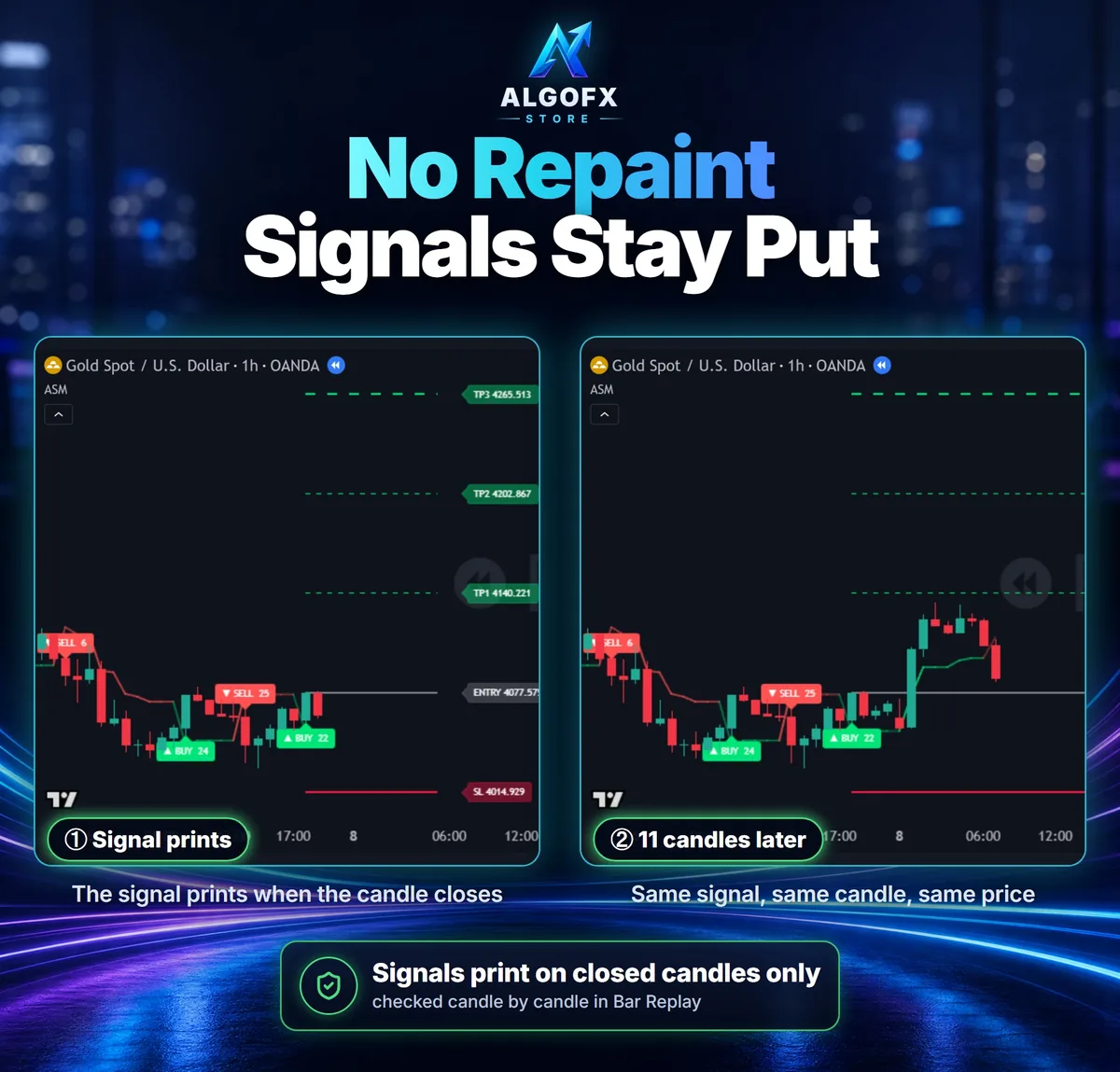
The BUY and SELL labels do not repaint at the default settings: they are decided only once a candle has closed, after the warm-up, and the script never moves or deletes them. Nothing comes from another timeframe. In a Bar Replay check on a gold 1 hour chart over 120 candles, the 12 signals matched the 12 drawn from history. What does move: the line and the dashboard follow the forming candle until it closes, and the two Trend Shift alert conditions can fire on a flip that reverses before the close. With the experimental Auto-Calibration switched on, signals can change with how much history is loaded.
What does the number on a label mean?
It is the signal score, the sum of six readings at the flip: recent move, efficiency, volume, RSI depth, distance to the last swing and break depth. Hover the label to see it out of 102, together with the TQI, ER, RSI and volume z-score behind it. Higher means more readings agreed. It describes the flip and is not a probability, so compare it with your own recent signals.
Why did a signal print with a low score?
Because nothing is filtered out. The Use Structure, Use RSI and Use Volume switches only change how the score is calculated, and Min Signal Score (display only) has no effect on what prints. Every flip after the warm-up gets a label and a plan. That is deliberate: you see every flip and decide yourself which scores you act on.
What happens when an opposite signal prints while a plan is open?
The new flip replaces the open plan: the ENTRY, SL and TP lines are redrawn at the new signal and the dashboard switches direction. The older label stays where it printed, and the replaced plan is not recorded as won or lost. Decide in advance how you handle an opposite label in your own position.
Why is the stop sometimes very wide?
The stop anchors to the last swing low or high, adds the ATR buffer and is never closer to the entry than that buffer. After a large impulse candle the last swing can be far from the entry, so the stop is wide and the targets, being multiples of that risk, are far away too. That is often a signal to skip or trade smaller.
What happens on the chart when the stop is reached?
Tracking ends quietly. There is no stop-hit label: the plan's lines stop stretching and stay frozen where they are, the Direction row changes to WAITING with the last signal and how many candles ago it printed, and nothing else changes until the next BUY or SELL. The same happens at TP3 and after the 100-candle Trade Timeout.
Settings, markets and the dashboard
Which symbols and timeframes does it work on?
Any symbol and any chart timeframe on TradingView: forex, gold, indices, stocks and crypto. It reads only the chart's own candles and requests no other symbol or timeframe, so it runs on every TradingView plan, including the free one. On Auto the preset follows the timeframe: Scalping up to 5 minutes, Default up to 4 hours, Swing above. It needs the 60-candle warm-up before anything is drawn.
Should I keep the defaults or tune it?
Start with the defaults on Auto. ATR Length, Base Band Width, Efficiency Window, RSI Length and SL Buffer only act when Preset is Custom, because every other preset sets its own values. Leave the experimental Auto-Calibration off. With the default Source of close, Character-Flip Detection cannot trigger, so the line flips only on a price break; it acts only if you change Source, for example to hl2.
What does the dashboard show and can I move it?
Market context (trend regime, preset and warm-up status, Trending, Mixed or Choppy, and Low, Norm or High Vol), the TQI engine (score, efficiency ratio, RSI, volume z-score and the four parts) and the active signal (direction, candles since the signal, entry, stop with its distance, and TP1 to TP3 with a check mark once reached). It has five positions and four sizes.
What is the PERFORMANCE section of the dashboard?
With Show Performance Stats on, which is the default, four extra rows keep bookkeeping of the indicator's own past plans on the loaded candles, in R. It is hindsight: entries at the signal close, exits at the drawn levels, no spread, commission or slippage, and the figures change with how much history is loaded. It is not a forecast. Switch Show Performance Stats off for a cleaner panel.
What does each colour and mark mean?
Green line or label: uptrend or BUY. Red line or label: downtrend or SELL. A faded line means low trend quality. Grey line with an ENTRY label: the entry. Red SL line: the stop. Green dashed lines: TP1 to TP3, turning solid with a check mark in the label once reached. The Bull, Bear, SL and TP colours can be changed in the inputs.
Alerts and running it
Which alerts can I create?
Open Create alert, choose Algo Shadow Matrix as the condition and pick BUY Signal, SELL Signal, Any Signal, Bullish Trend Shift or Bearish Trend Shift. The two Trend Shift events follow the line itself and can fire on a forming candle, so use the other three for closed-candle alerts. For the detailed message with price, TQI, score, stop and all three targets, choose Any alert() function call; it is sent once per candle close.
Can I run it on several charts at once?
Yes. Each chart runs its own copy with its own settings and preset. An alert belongs to the symbol and timeframe of the chart you create it on, so create one for every chart you want to follow. On a long history TradingView keeps up to 500 labels per script, so the oldest BUY and SELL labels drop off the far left first.
Can I change the logic in the code?
Yes, for your own use. You receive the complete Pine Script v6 source, so every rule on this page, from the preset table to the score and the plan levels, can be read and changed in the Pine Editor. Try the 71 inputs first: they already cover presets, bands, quality weights, risk levels, dashboard and colours.
How it works
Will it place trades for me?
No. Algo Shadow Matrix is an indicator: it draws on the chart and can alert you. It never sends an order.
After you buy
How do I get it after paying?
Digistore24 runs the checkout. Right after payment it takes you to your download page with one zip holding the Pine Script source code file and the PDF guide; the link to that page is also in your Digistore24 order e-mail, so you can download again at any time.
How do I install it?
Open the code file, open the Pine Editor in TradingView, paste the whole code, click Save and then Add to chart: “Algo Shadow Matrix [AlgoFXStore]” appears on your chart. The guide walks through it step by step.
Who is Digistore24?
Digistore24 is the reseller that sells Algo Shadow Matrix for Kestutis Balciunas (AlgoFXStore): it runs the checkout, charges your card or PayPal, collects the VAT for your country and delivers the download. Its name is the one on your statement, and its order e-mail holds your download link and the refund link.
What is the refund policy?
A 60-day money-back guarantee, handled by Digistore24. If Algo Shadow Matrix is not for you within 60 days of purchase, use the refund link in your Digistore24 order e-mail or Digistore24's order page (digistore24.com/en/cancel-revoke-contract) for a full refund, no questions asked. Digistore24 makes the refund to your original payment method.
Do I get the source code?
Yes. You get the full Pine Script source code as a text file for your own use; the licence line at the top of the code does not allow resale, sharing or republishing.
Algo Shadow Matrix for TradingView.
Put an adaptive trend line with a planned stop and three targets on your TradingView charts today. The full code, the guide and every setting explained. Instant download for €47, one payment.
Get instant access