A supertrend that widens in chop, tightens in clean trends and plans every flip
Algo Shadow Matrix is an adaptive supertrend for cTrader: a Trend Quality Index sets the band width on every candle, and each flip on a closed candle prints a scored BUY or SELL pill with an entry, a stop loss and three take profit levels.
- Supertrend bands that adapt on every candle to a four-factor Trend Quality Index from 0 to 1.
- BUY and SELL pills printed when the flip candle closes, each carrying a six-part score.
- Entry at the signal close, stop beyond the last swing plus an ATR buffer, targets at 1R, 2R and 3R.
- Auto presets by timeframe, a dashboard in five positions, and alerts to the Log tab, a sound or e-mail.
- A cTrader indicator. Double-click the .algo file and “Algo Shadow Matrix AlgoFX” appears in your Indicators list.
- A 13-page PDF manual with installation, every setting and how to read the chart. One-time €47.
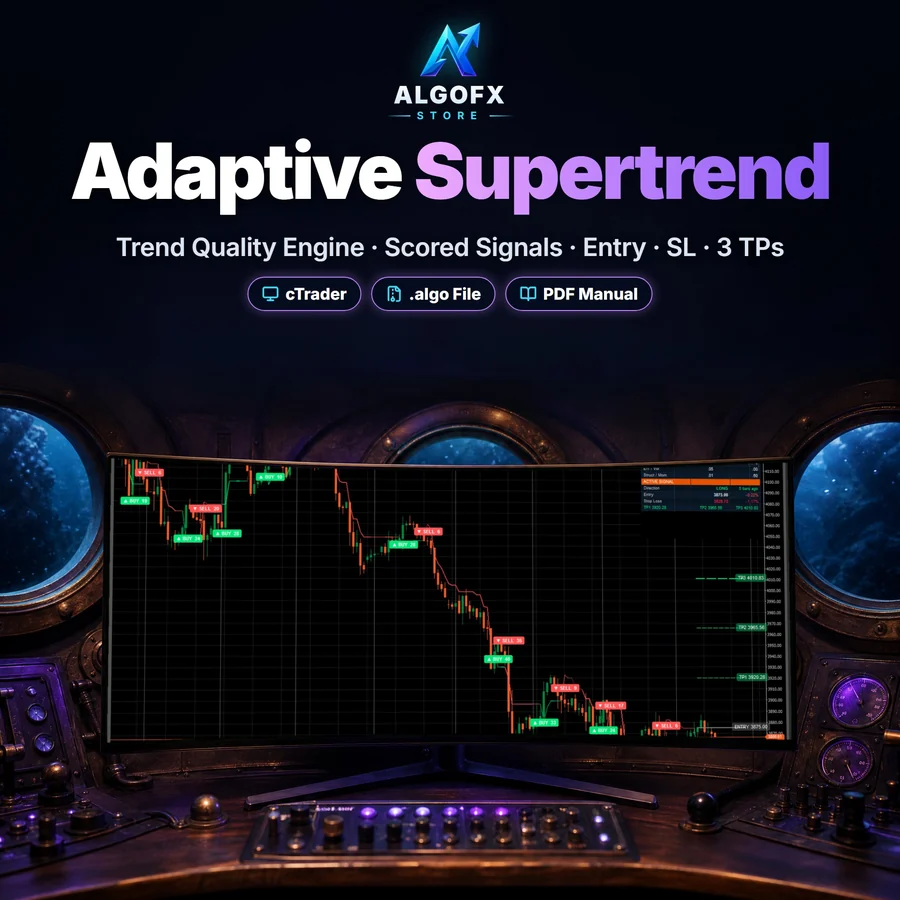
See Algo Shadow Matrix on a real chart
Press play; use the full-screen button to see every detail.
Why a plain supertrend keeps flipping in ranges and lagging in trends
A classic supertrend keeps one fixed distance from price, ATR times a multiplier, whatever the market is doing. That one number cannot fit both a clean trend and a slow, choppy range. Set tight, it flips again and again inside the range, and every flip is a fresh stop-out. Set wide, it lags so far behind a real trend that the exit gives most of the move back.
The second problem comes after the flip. Before you take a signal you need a stop and a target, and a plain supertrend gives you a colour change and nothing else. You end up measuring every stop by hand, often after price has already moved. And every flip looks the same, so a flip after a clean, efficient move and a flip in the middle of chop get the same treatment.
Algo Shadow Matrix answers all three. The band width follows a Trend Quality Index built from efficiency, participation, range position and momentum persistence, so the line follows clean moves closely and backs off in noise. Every flip carries a score that describes how many conditions agreed. And every flip draws ENTRY, SL and three targets as prices, also shown on the dashboard and in the alert.
What Algo Shadow Matrix draws, and what each mark means
Read from the shipped cTrader edition.
| What you see | What it means |
|---|---|
| Green line under price / red line over price | Adaptive Supertrend: bullish / bearish. Brighter = higher trend quality. |
| Green 'BUY 48' pill | Trend flipped up on that closed candle; 48 = the signal's score. |
| Red 'SELL 39' pill | Trend flipped down; 39 = score. |
| ENTRY <price> | Close of the signal candle. |
| Red SL <price> | Stop beyond the last pivot plus an ATR buffer. |
| Green TP1 / TP2 / TP3 <price> | Targets at 1R, 2R, 3R; a reached target shows tick and turns cyan. |
| Dashboard top right | Trend regime, preset, efficiency/volatility regime, TQI factors and the active signal. |
How the bands, the pills and the plan are calculated
Each step below is worked out per candle. Pills, levels and alerts are created only when a candle closes; the line and its shading on the live candle keep updating until that candle closes.
- 1
An efficiency-weighted ATR
The indicator takes the ATR length of the active preset (14 on Default, 10 on Scalping, 21 on Swing) and, with Efficiency-Weighted ATR on, scales it by the efficiency ratio: ATR x (0.5 + 0.5 x ER). The ratio compares the net move over the efficiency window with the path price travelled. A straight move keeps the full ATR, a zig-zag counts it half. The same ATR sets the stop buffer.
- 2
A Trend Quality Index from four factors
Every candle gets a TQI between 0 and 1 from efficiency (weight 0.35), participation (0.20: the broker's tick volume against its 20-candle average, or ATR against its 100-candle baseline when there is no volume), range position (0.25: how far the close sits from the middle of the 20-candle range) and momentum persistence (0.20: the share of the last 10 candles that moved with the 10-candle direction).
- 3
Bands reshaped on every candle
The band width starts from the preset base (2.0 x ATR on Default), widens when efficiency is low through Adaptation Strength 0.5, and changes again with the TQI through Quality Influence 0.4 and Quality Curve Power 1.5. With Asymmetric Bands on, the trend-side band tightens and the other side widens as quality rises. Smooth Adaptive Multipliers stops it from jumping, and the bands ratchet like any supertrend.
- 4
A flip on a closed candle prints the pill
When a candle closes above the previous upper band while the trend was down, the line turns up and a green BUY pill with its score is placed under the candle. A close below the previous lower band in an uptrend places a red SELL pill above it. Every flip after the warm-up prints: the score switches change only the score, and 'Min Signal Score (display only)' has no effect.
- 5
A six-part score on every pill
The number on the pill adds six parts: the move of the last three candles against ATR, the efficiency ratio, the volume z-score, how deep RSI went beyond 30 or 70 in its recent memory, how close the last swing pivot is, and how far the close broke through the band. It runs roughly from 0 to 100. Higher means more parts agreed; it describes the flip and is not a probability.
- 6
The plan: entry, stop and three targets
ENTRY is the signal candle's close. SL sits beyond the last swing low or high (Pivot Strength 3 candles each side) plus k x ATR, and never closer to the entry than k x ATR; k is 1.0 on Scalping, 1.5 on Default, 2.0 on Swing and 2.5 on Crypto 24/7. TP1, TP2 and TP3 sit at 1R, 2R and 3R. The plan ends at TP3, at the stop, after 100 candles or at the next signal.
Algo Shadow Matrix on 12 different markets
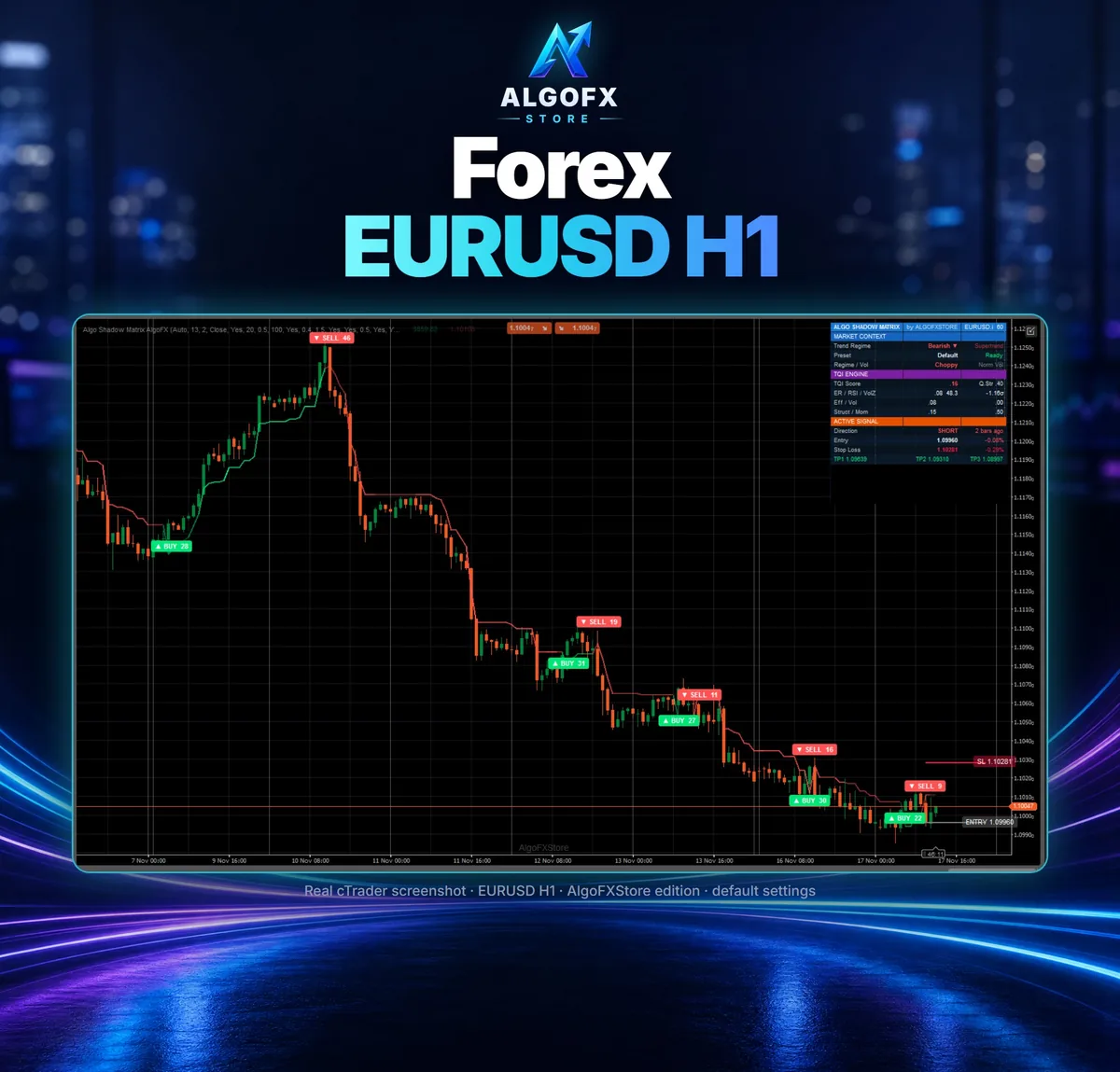
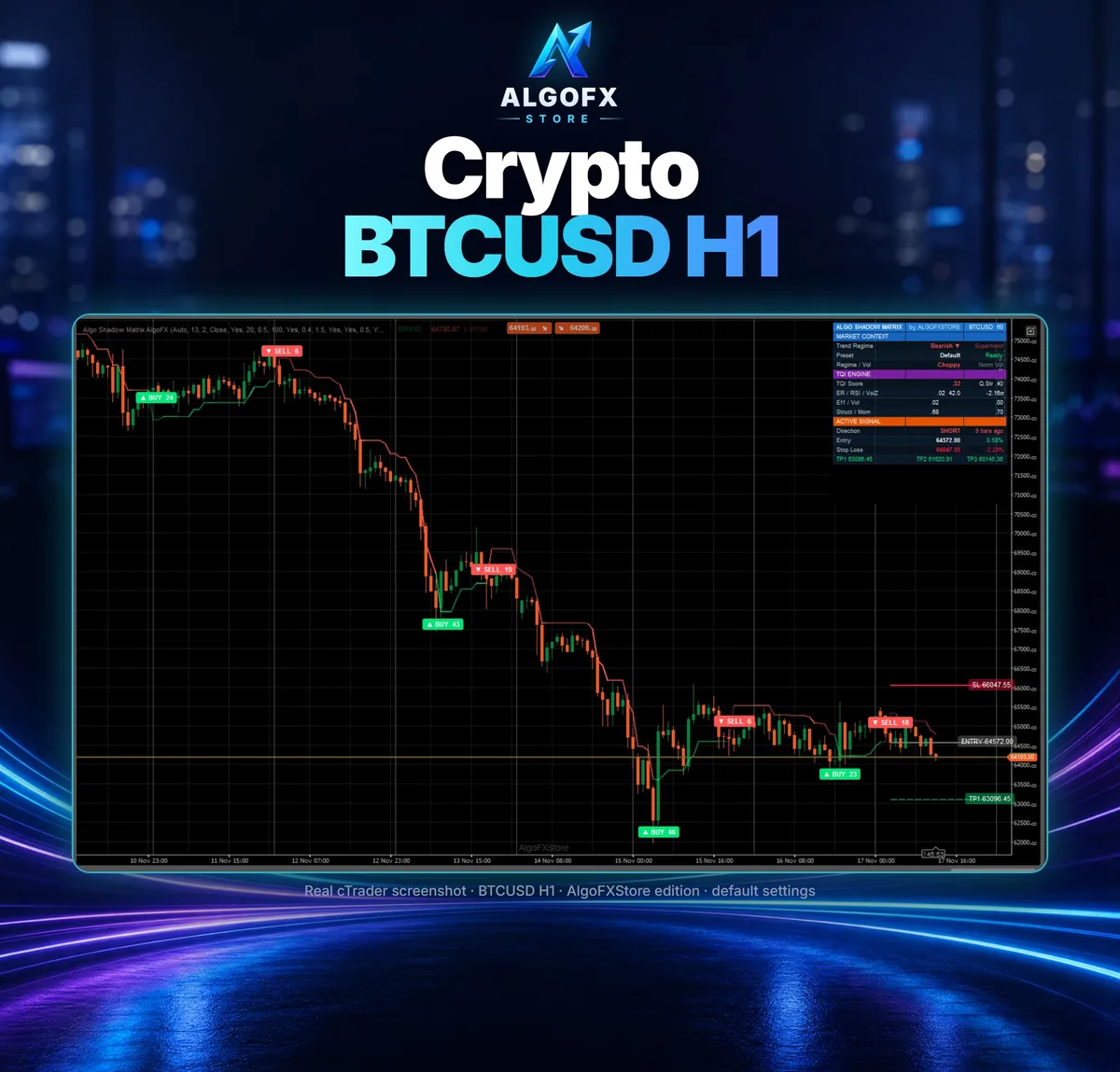
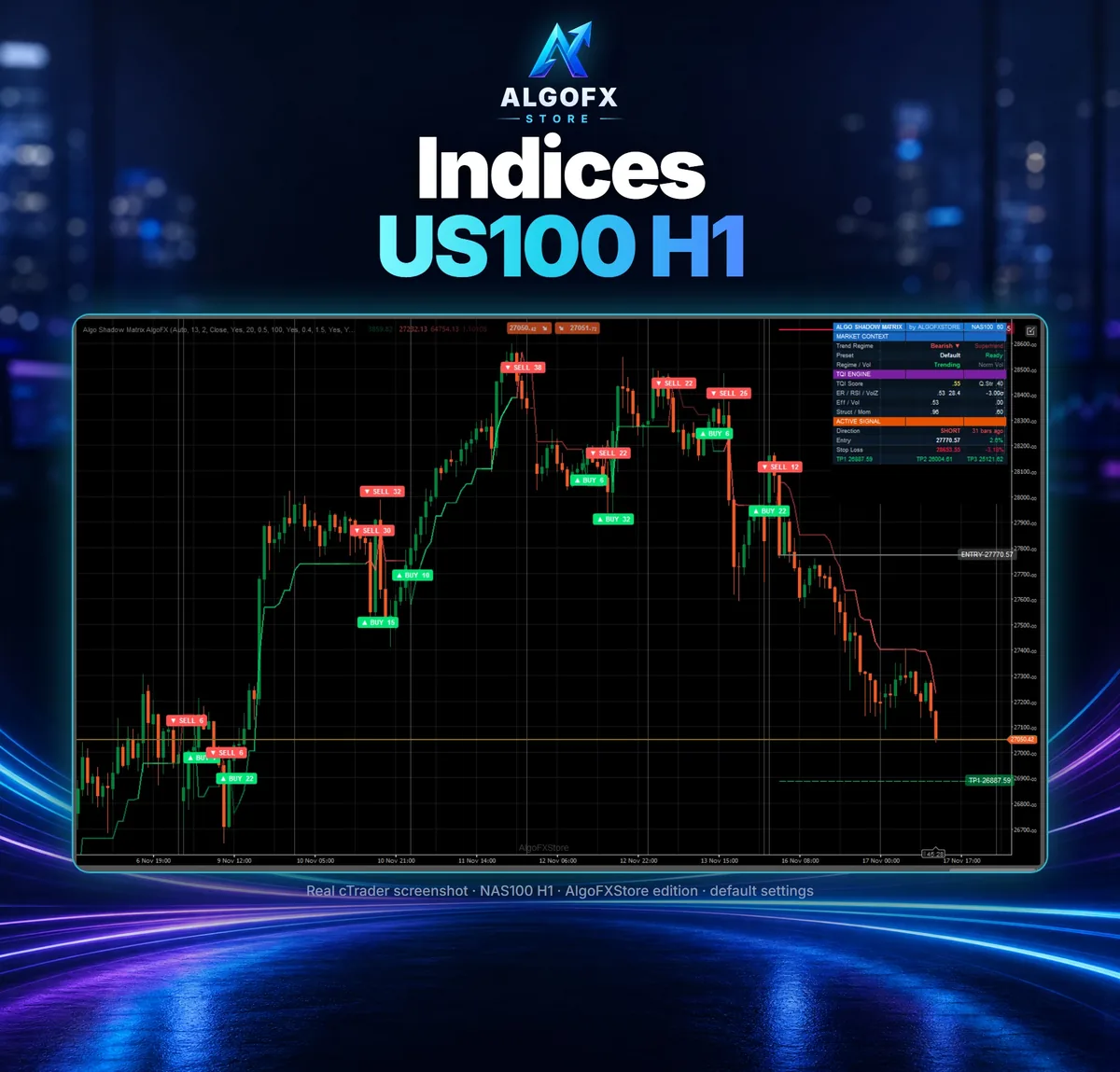
Every chart below is a screenshot of cTrader itself with the shipped Algo Shadow Matrix AlgoFX attached at its default settings. Forex, metals, indices, energy and crypto, so you can see how it reads each kind of market. They show what the indicator draws; they are not trading results. Tap or click any chart to open it full size.
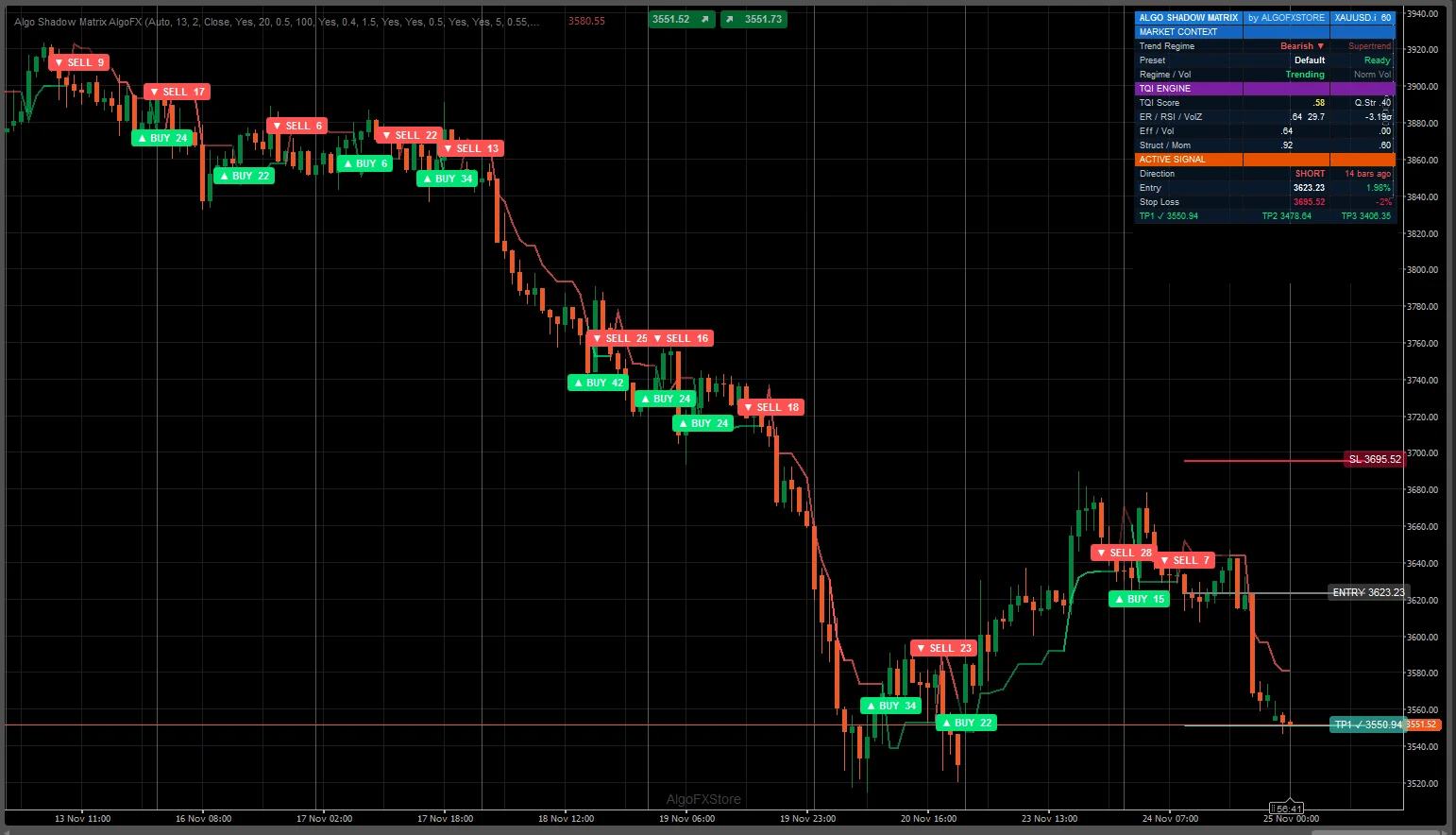
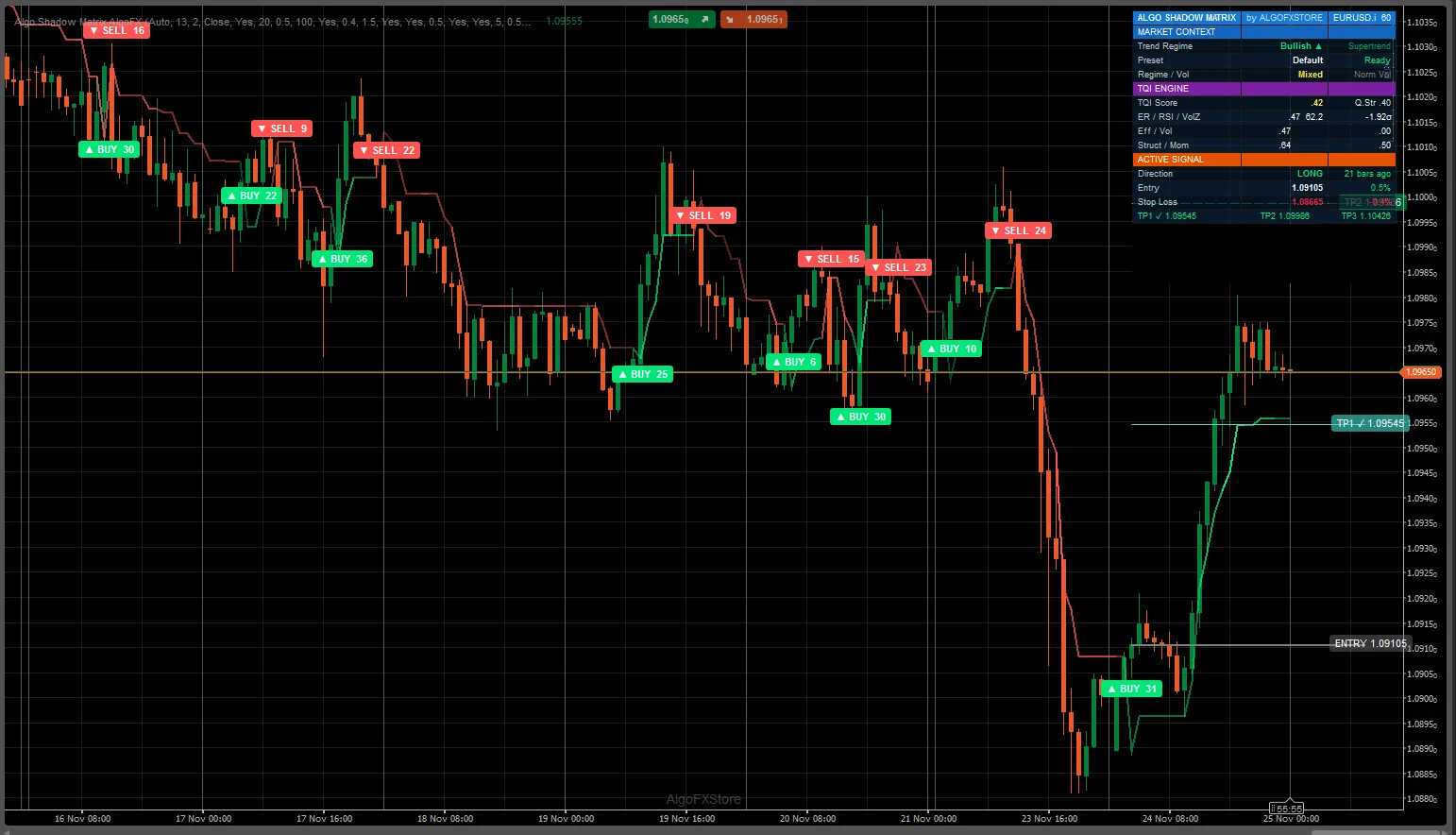
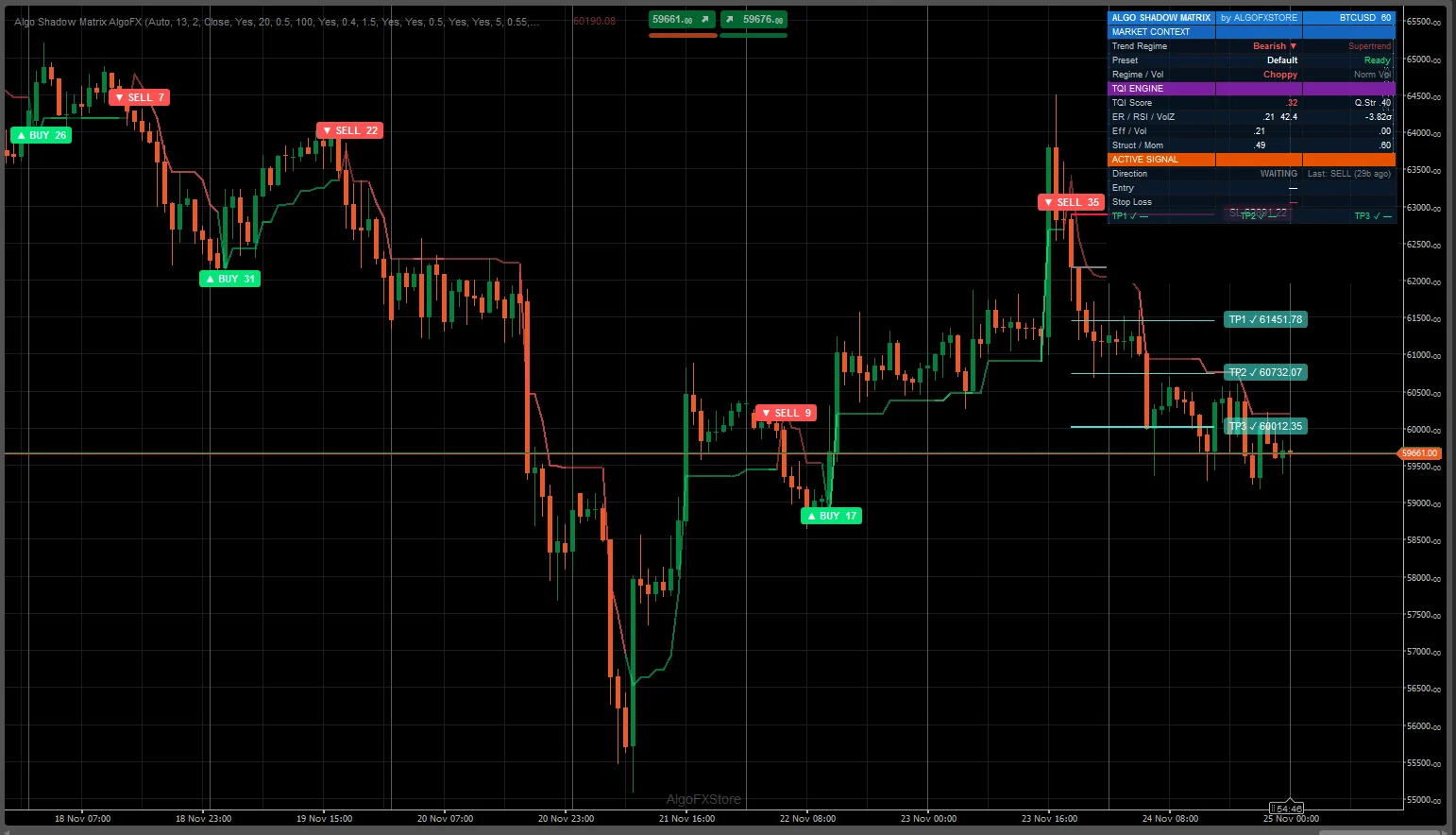
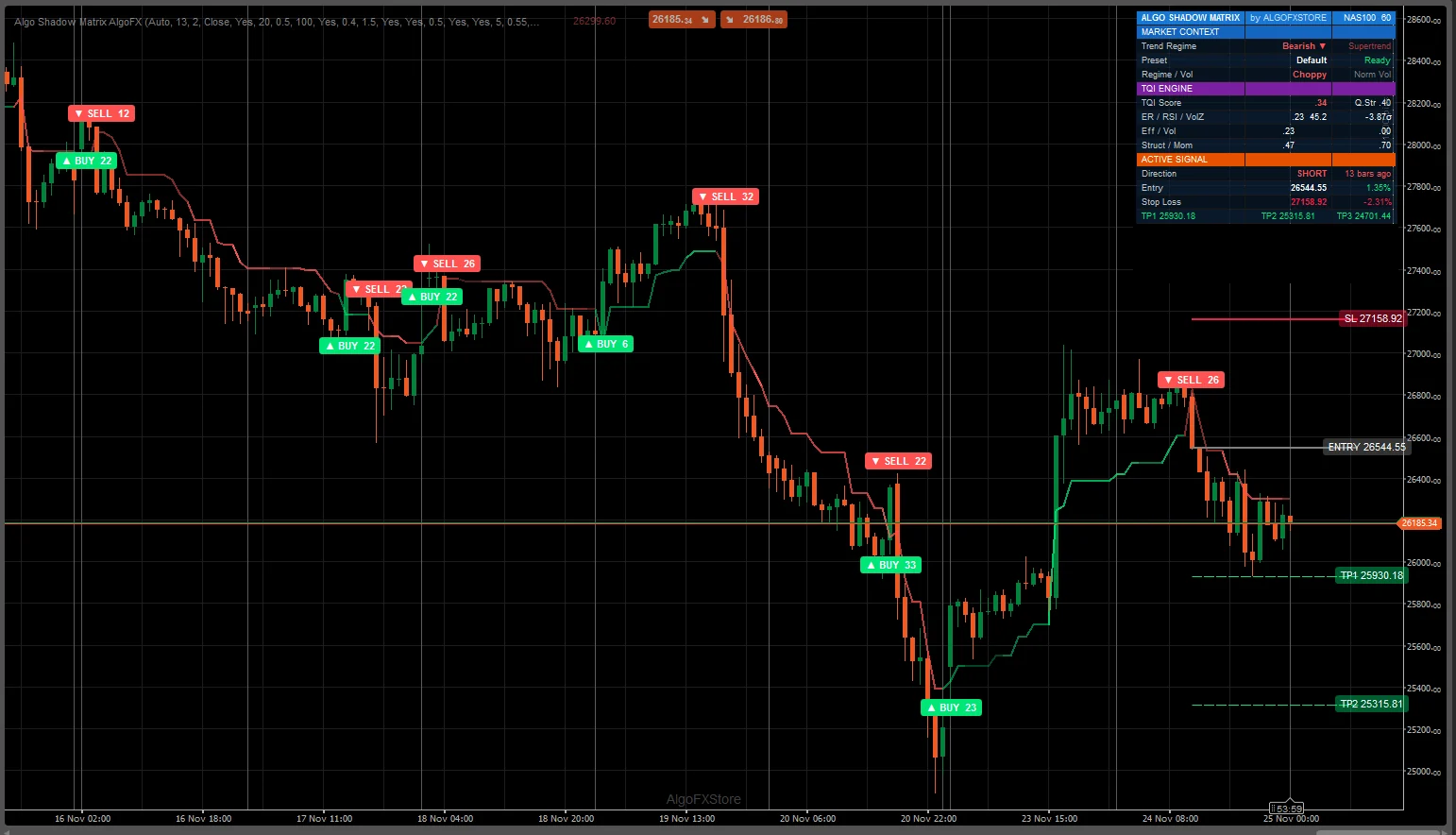
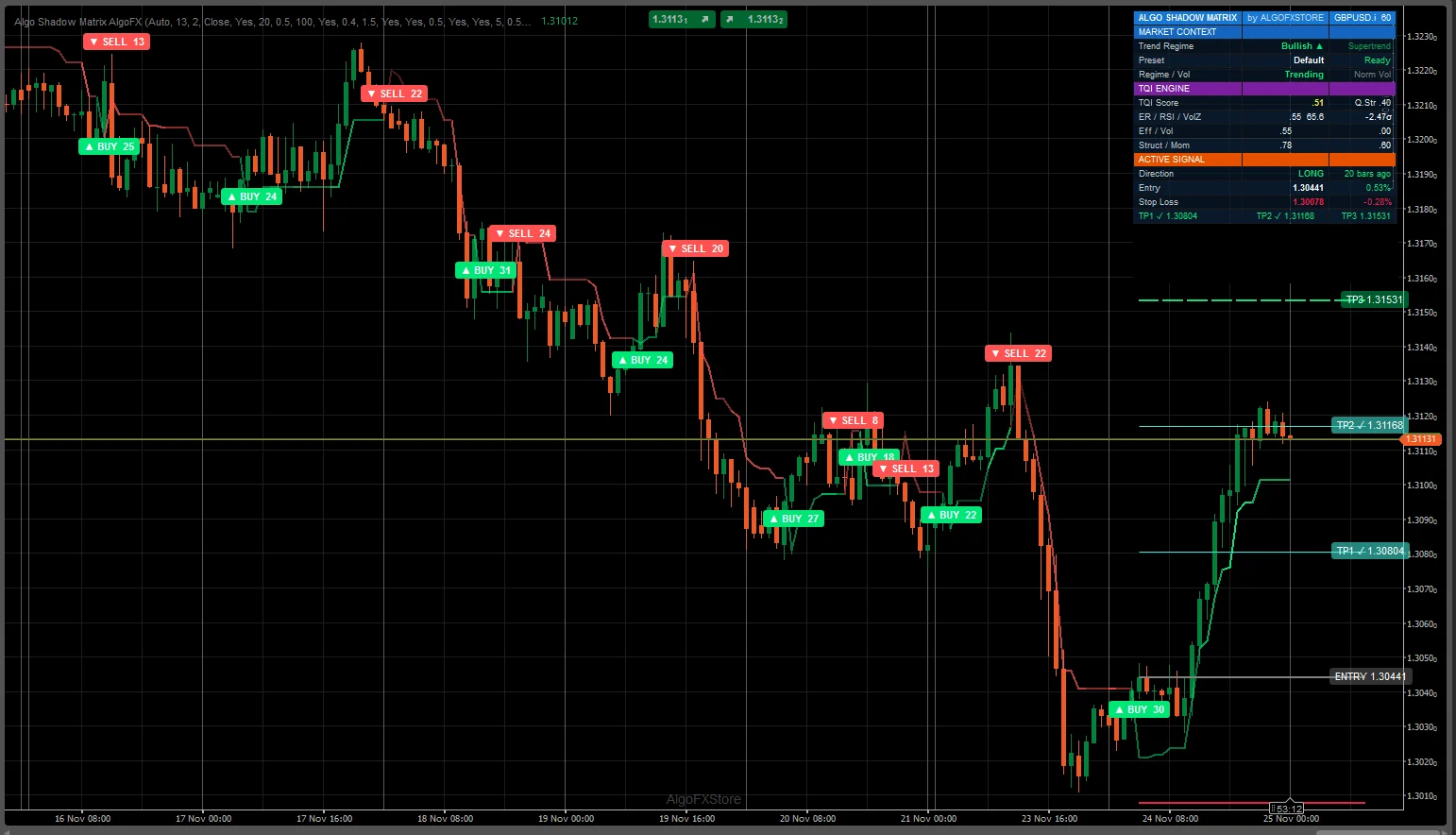
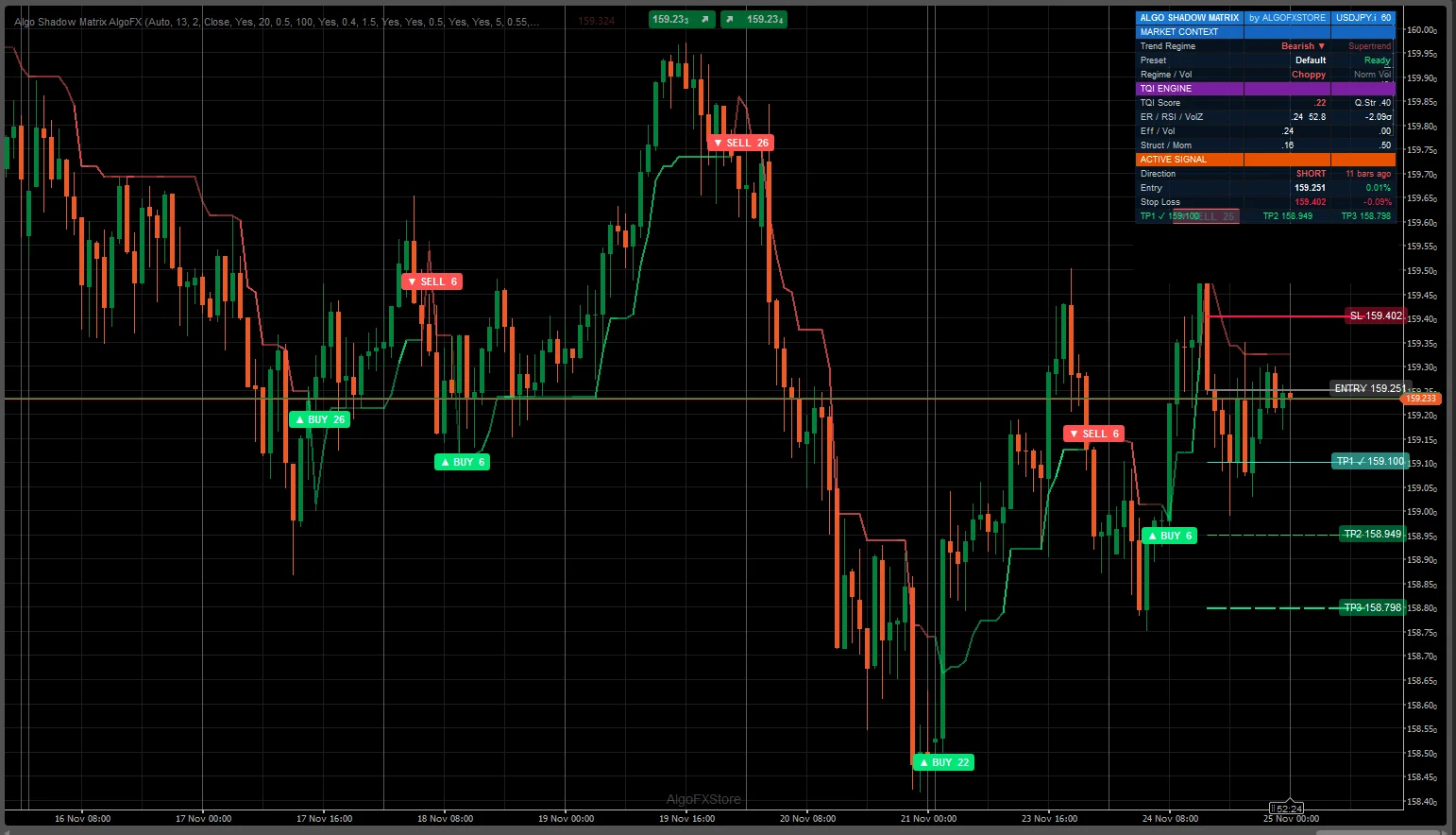
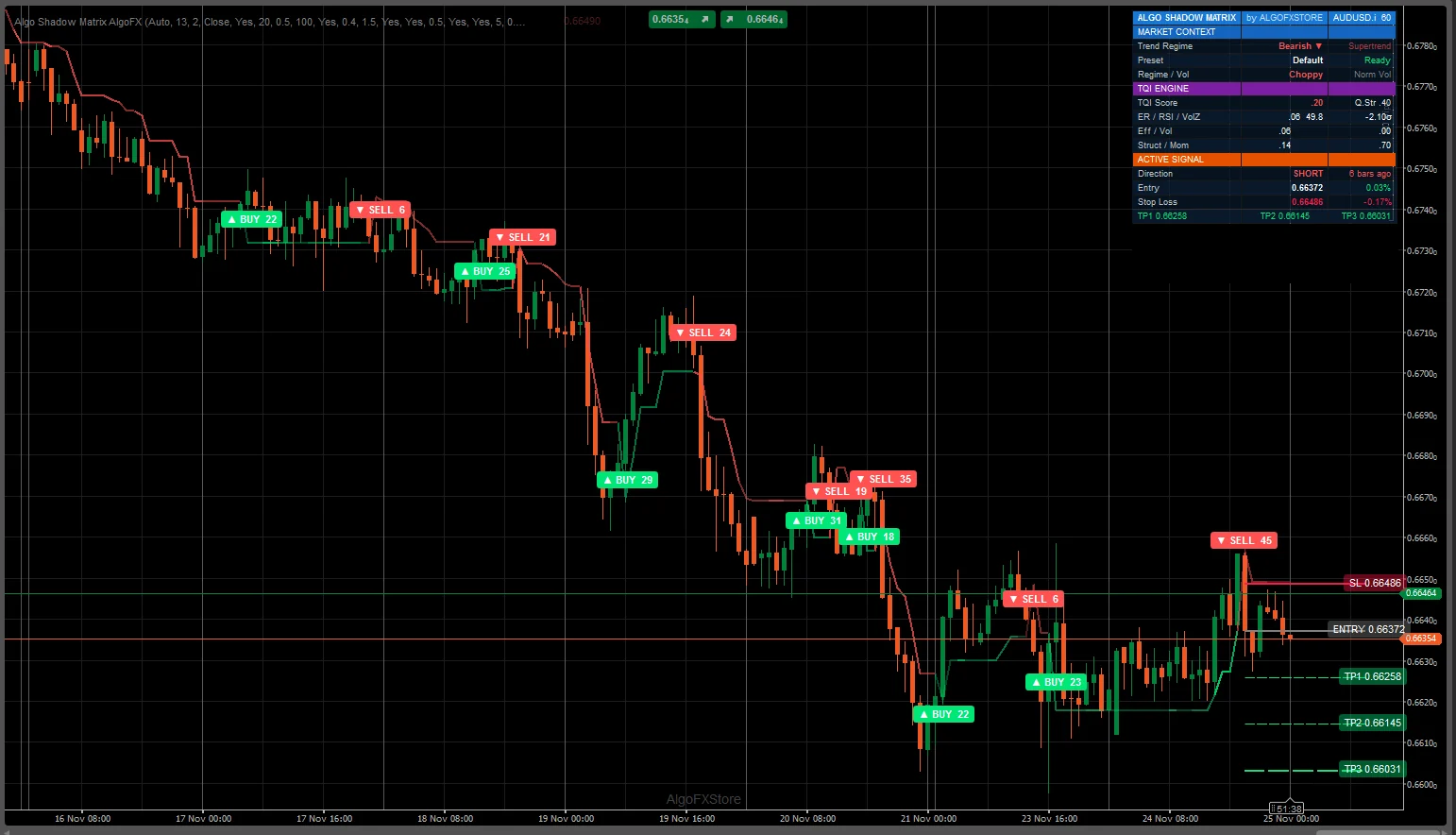
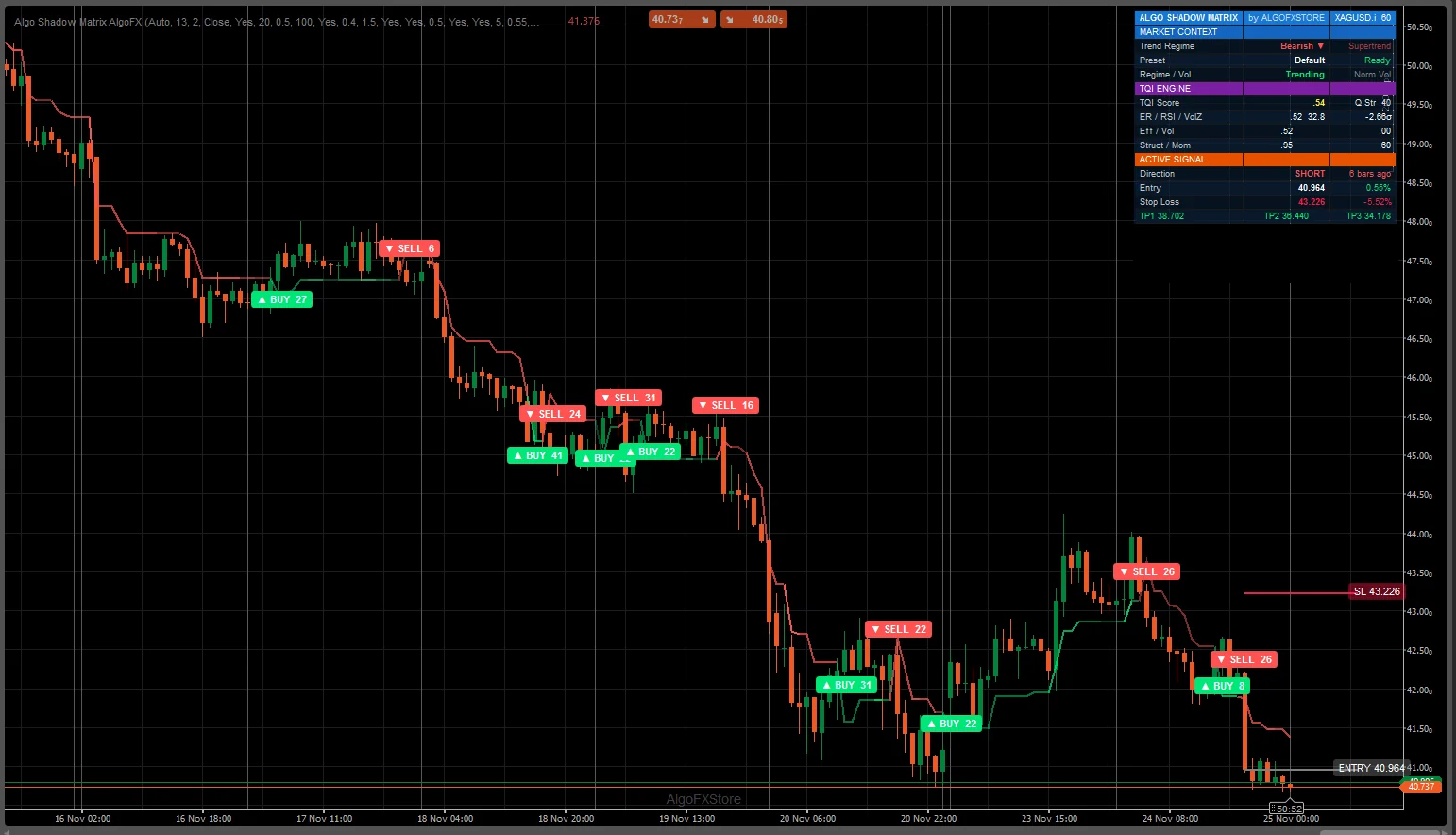
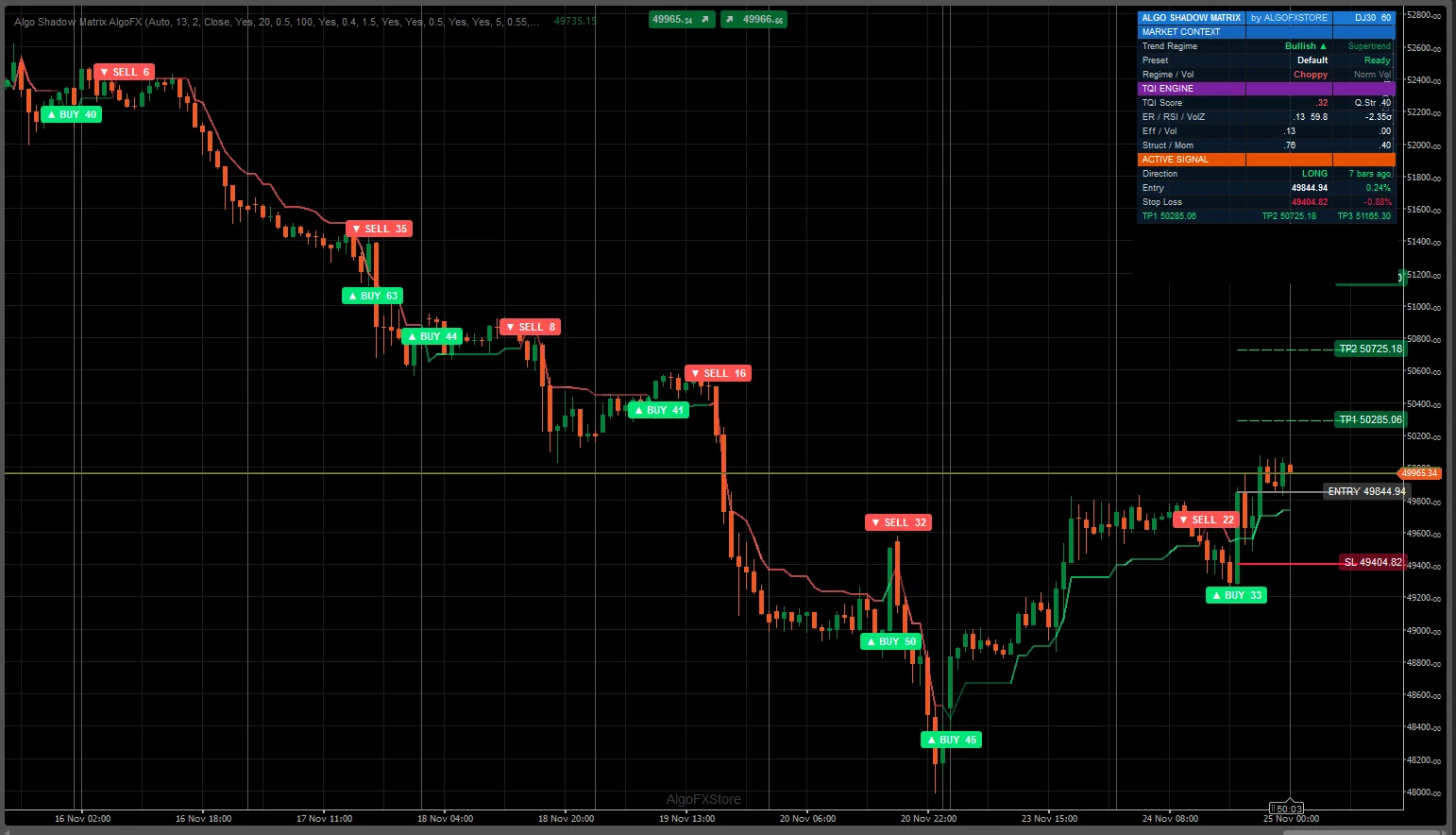
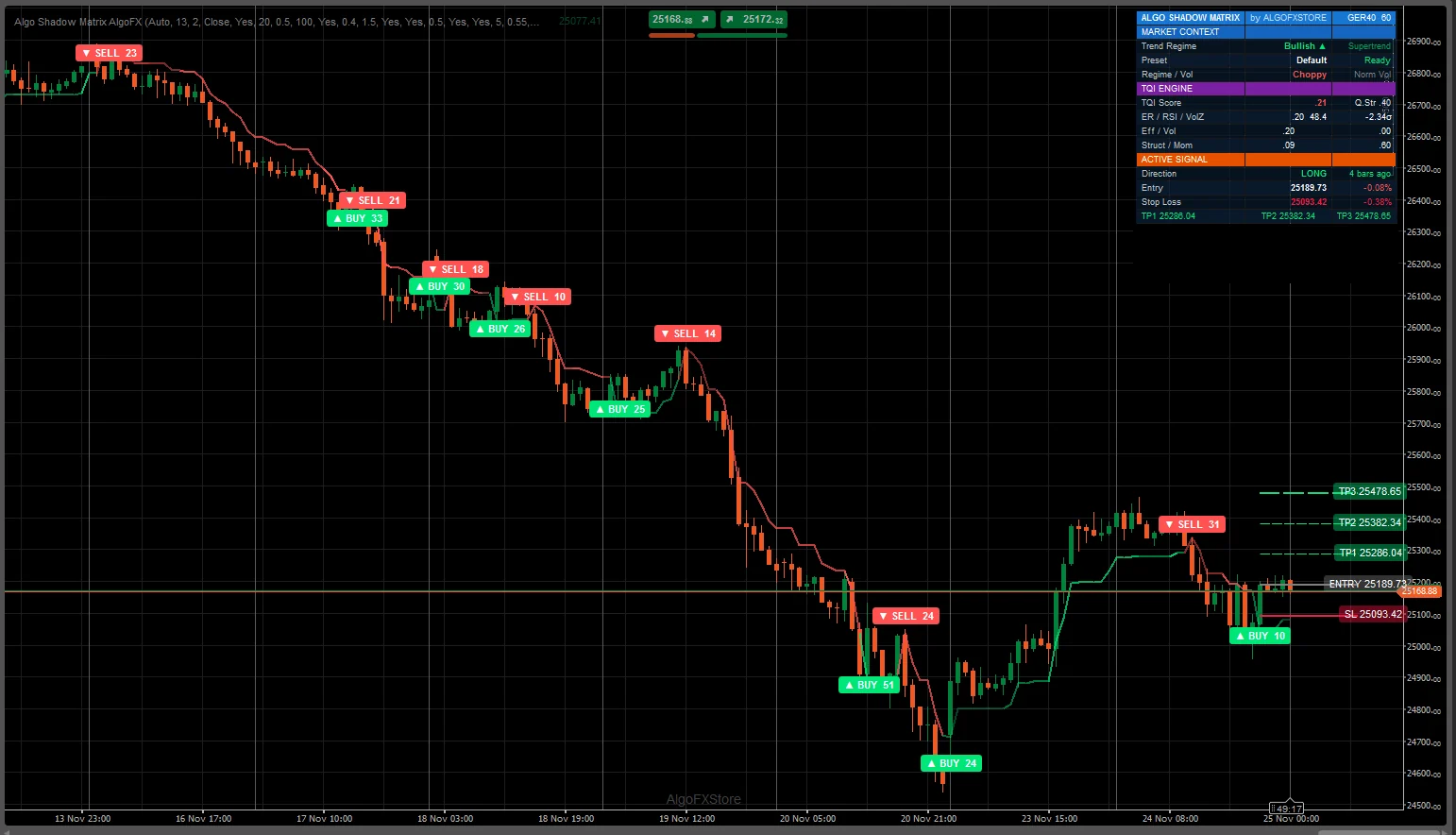
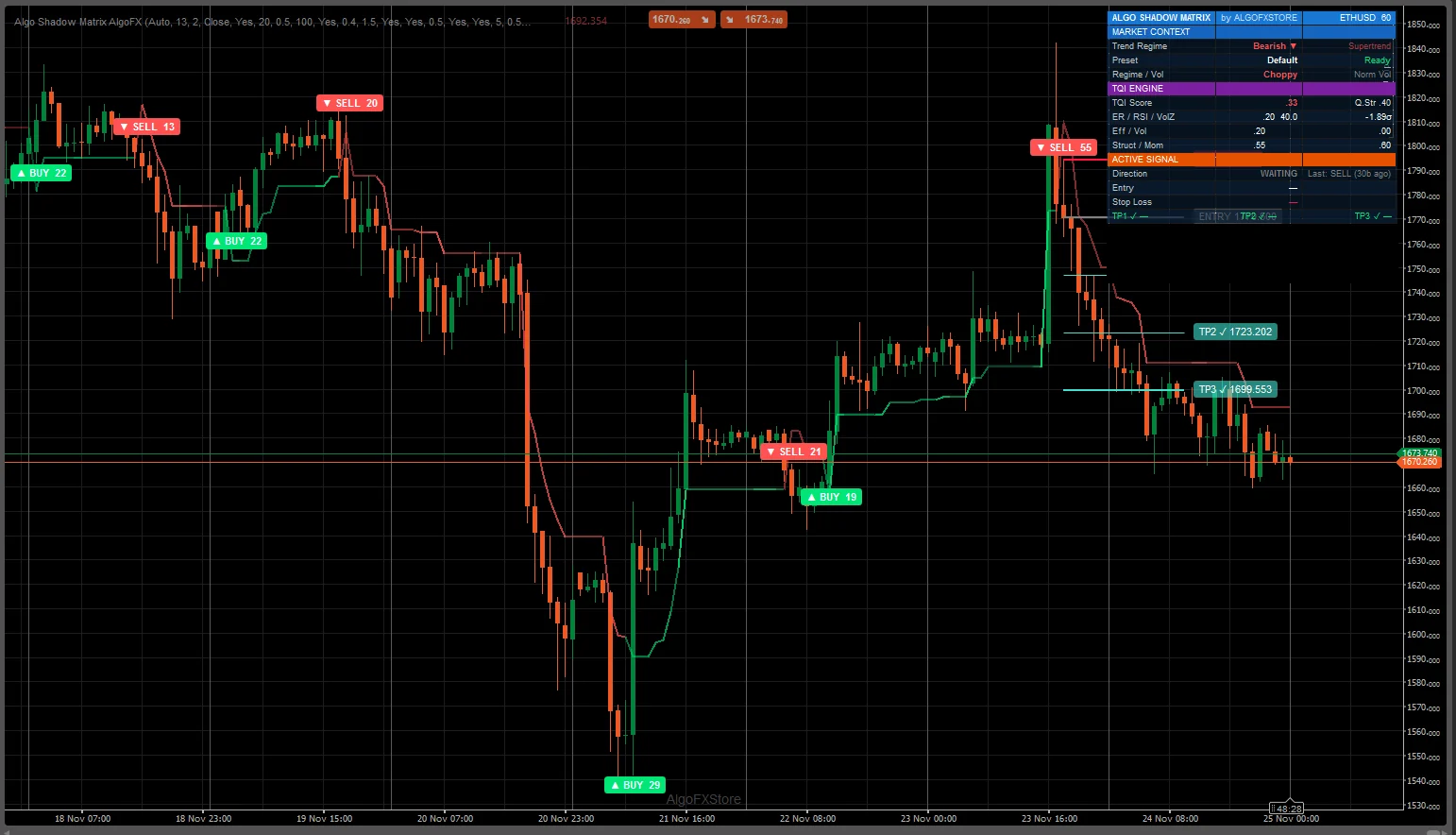
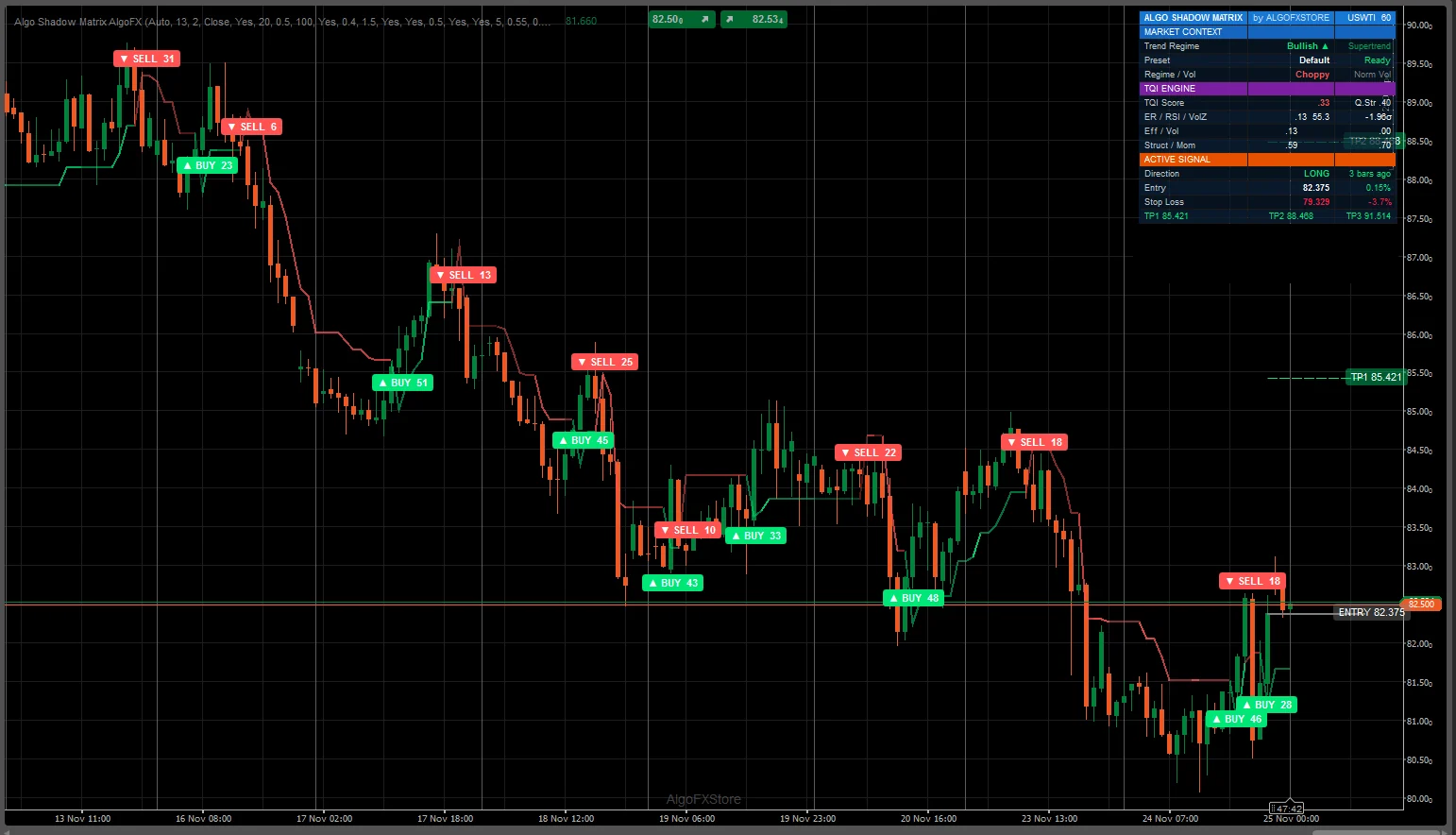
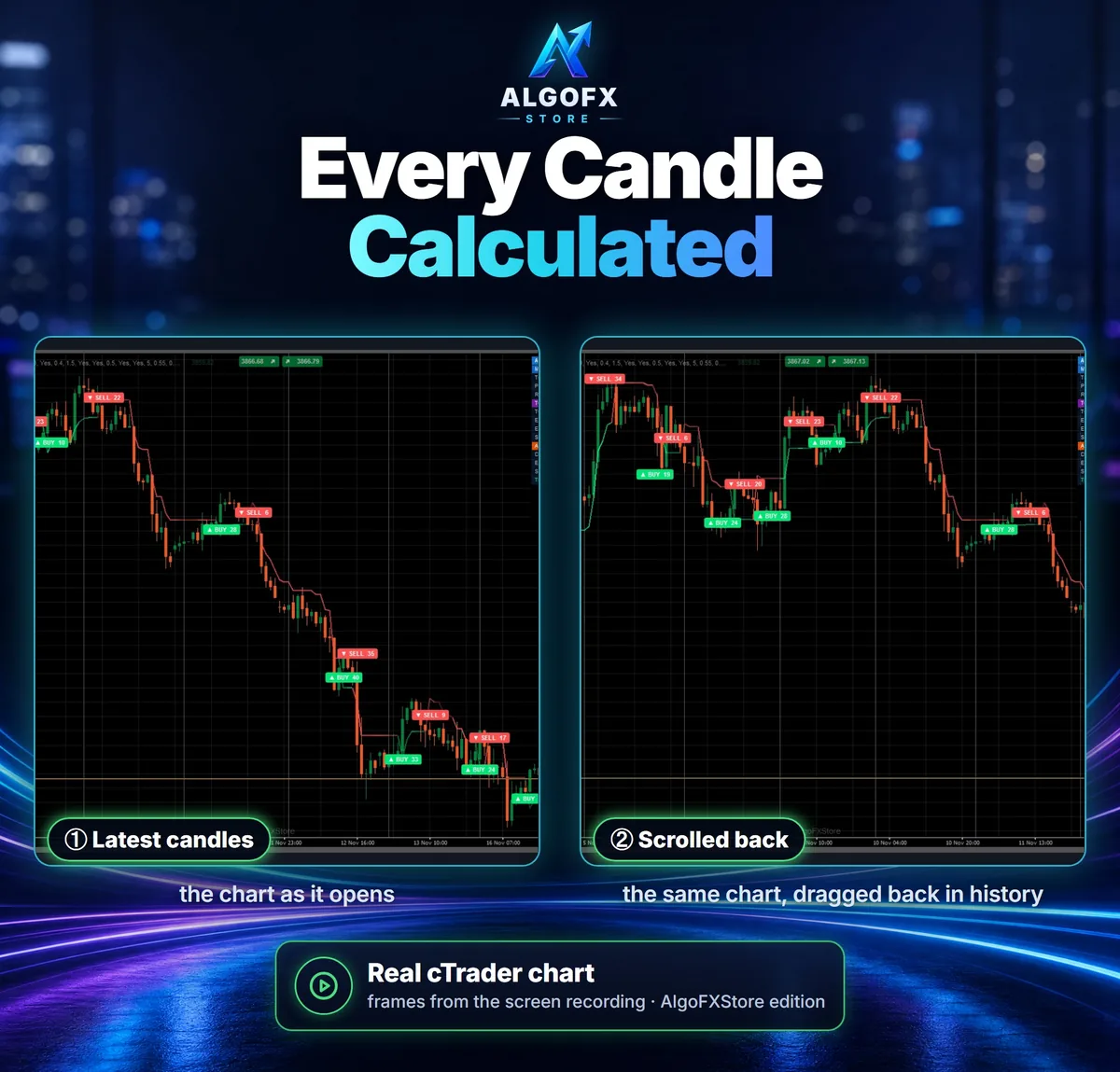
Algo Shadow Matrix on a real cTrader chart
The chart as it opens and the same chart scrolled back in history, with the shipped indicator at its default settings. Nothing is edited into the chart.
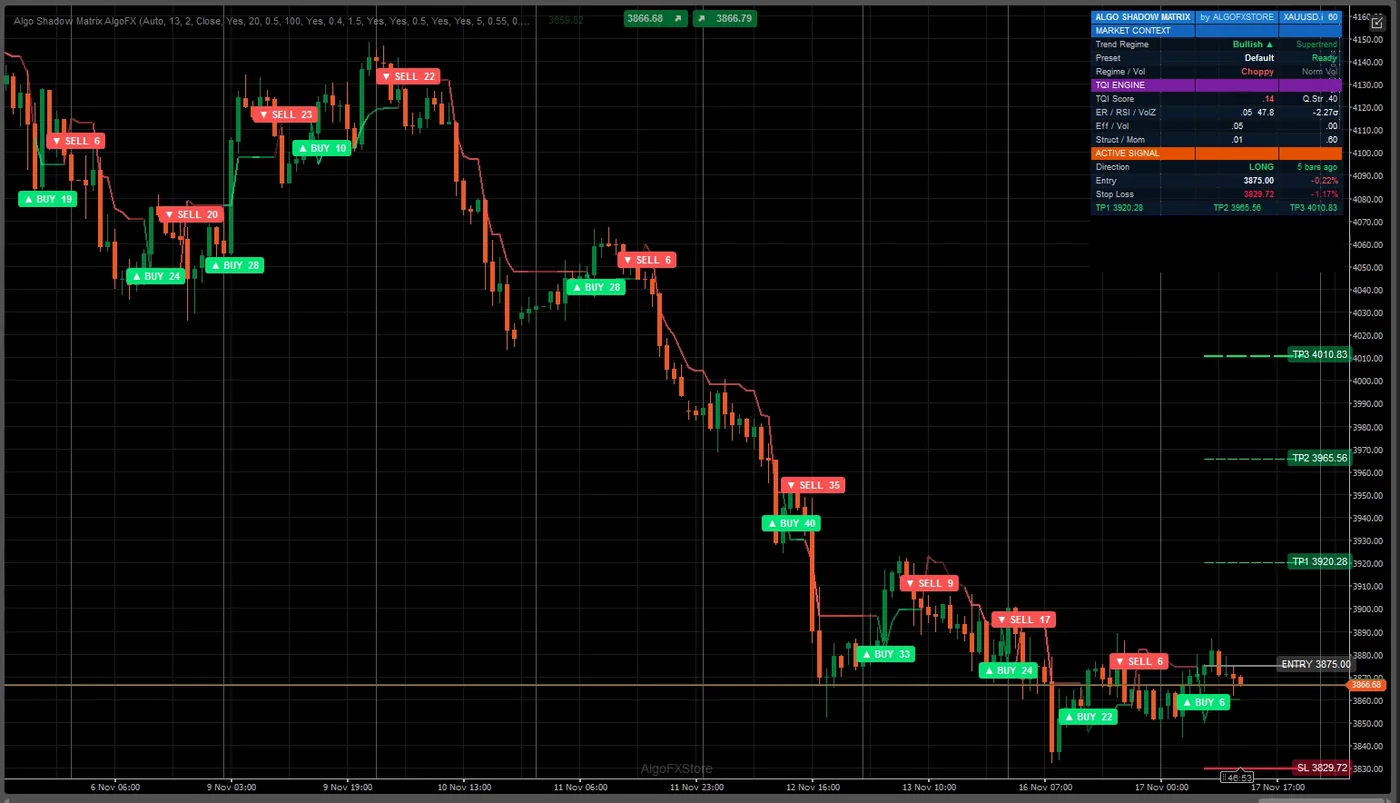
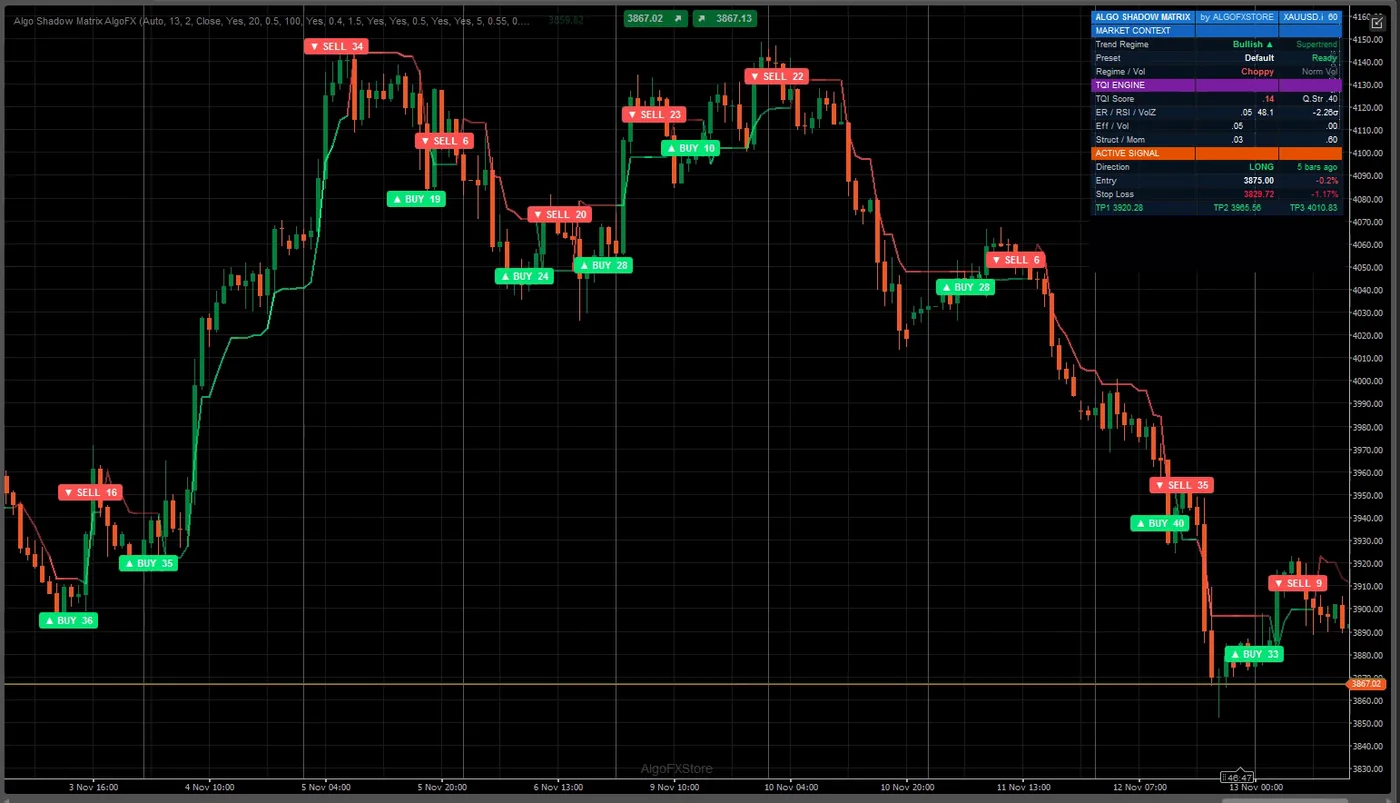
How to read it in practice, step by step
The indicator draws the plan; whether and how you take it stays your decision. This is one disciplined routine for using it on cTrader.
- 1
Load enough history and check Ready
Add the indicator to a chart with enough candles loaded. It needs about 50 candles plus its longest window before it draws anything, and the dashboard's Preset row counts 'Warmup n/m' until it reads Ready. Turn on Chart Shift in the chart toolbar so the ENTRY, SL and TP labels sit in the free space to the right of the last candle.
- 2
Wait for the pill on candle close
Do nothing while the line simply follows price. Act when a candle closes and a BUY or SELL pill prints, or when the alert line appears in cTrader's Log tab with its sound. The BUY and SELL alert text already carries the price, the TQI, the score, the stop and all three targets, so you can read the plan before you even look at the chart.
- 3
Read the regime before the level
Check Regime / Vol on the dashboard (Trending, Mixed or Choppy; Low, Norm or High Vol) and the TQI Score. A personal filter many traders test on a demo account is to skip signals while it reads Choppy with Low Vol, or while the TQI is low. Compare each score with your recent signals and set your own minimum, because the indicator filters nothing out.
- 4
Size the position from the stop
The distance from ENTRY to SL is your risk per unit, and the dashboard also shows the stop's distance in percent. Divide the amount you are prepared to risk on the trade by that distance to get your volume, and round down to what your broker allows. If the stop is so wide that even the smallest volume risks too much, skip the signal.
- 5
Place your own orders
The indicator places no orders. Put your stop at the SL price, or a little beyond it, and your targets at TP1 to TP3, for example by splitting the position across the three. You can take part off at TP1 or TP2 or move the stop to break-even by hand. The plan on the chart stays as drawn; it never moves your orders.
- 6
Know when the plan is over
A reached target gets a check mark and turns cyan. The plan ends at TP3, at the stop or after 100 candles, and an opposite pill replaces it at once. There are no alerts for target or stop touches, only for the five signal events, so watch your own orders and decide in advance what an opposite pill means for an open position.
The dashboard, row by row
- ALGO SHADOW MATRIX | by ALGOFXSTORE | the symbol and the timeframe in minutes, for example XAUUSD 60
- MARKET CONTEXT
- Trend Regime: Bullish or Bearish, Supertrend
- Preset: the active preset, then Ready or Warmup n/m while the warm-up runs
- Regime / Vol: Trending, Mixed or Choppy, and Low Vol, Norm Vol or High Vol
- TQI ENGINE
- TQI Score: trend quality from 0 to 1, and the quality strength in use, Q.Str
- ER / RSI / VolZ: the efficiency ratio, RSI and the volume z-score
- Eff / Vol and Struct / Mom: the four TQI factors (with Show TQI Breakdown on)
- ACTIVE SIGNAL
- Direction: LONG, SHORT or WAITING, with how many candles ago the signal printed
- Entry and Stop Loss: the prices, with their distance in percent
- TP1 | TP2 | TP3: the three target prices, each with a check mark once reached
- PERFORMANCE (with Show Performance Stats on, the default): hypothetical bookkeeping of the indicator's own past plans on the loaded chart in R, with streaks, drawdown and a per-regime figure; no spread, commission or slippage, hindsight and not a forecast
Everything Algo Shadow Matrix does for you
Bands that adapt on every candle
The band width is recalculated on each candle from the preset base, the efficiency ratio and the Trend Quality Index, then smoothed. In clean trends the line stays close to price; in noisy stretches it backs off, so it flips less often there.
Tighter on the trend side
With Asymmetric Bands on (strength 0.5), the band that follows the trend tightens as quality rises and the band on the other side widens, so a pullback has more room before it counts as a break.
A ready plan on every flip
Each signal draws ENTRY, SL and TP1, TP2 and TP3 lines with price labels. The labels sit 'Label Offset (bars)' 10 candles to the right, or pinned just inside the right edge when Chart Shift is off, so the prices stay readable.
Stops placed at structure
The stop uses the last swing pivot, 3 candles each side by default, plus an ATR buffer that depends on the preset: 1.0 on Scalping, 1.5 on Default, 2.0 on Swing and 2.5 on Crypto 24/7. It never sits closer to the entry than one buffer.
Presets that follow the timeframe
On Auto the preset changes with the chart: Scalping on m5 and below (ATR 10, band 1.5 x ATR), Default up to h4 (ATR 14, band 2.0), Swing above h4 (ATR 21, band 2.5). Crypto 24/7 (ATR 14, band 2.8) and Custom are chosen by hand.
A dashboard that explains the flip
Market context (trend regime, active preset and warm-up, Trending, Mixed or Choppy and Low, Norm or High Vol), the TQI with its four factors, ER, RSI and volume z-score, and the active signal with entry, stop distance in percent and targets. Five positions, four sizes.
Fixed once the candle closes
Pills, levels and alerts are created only when a candle closes and are not moved afterwards. Each alert fires once per event per candle, only for candles that close while the indicator is running, and never in a backtest or optimisation.
Alerts that carry the levels
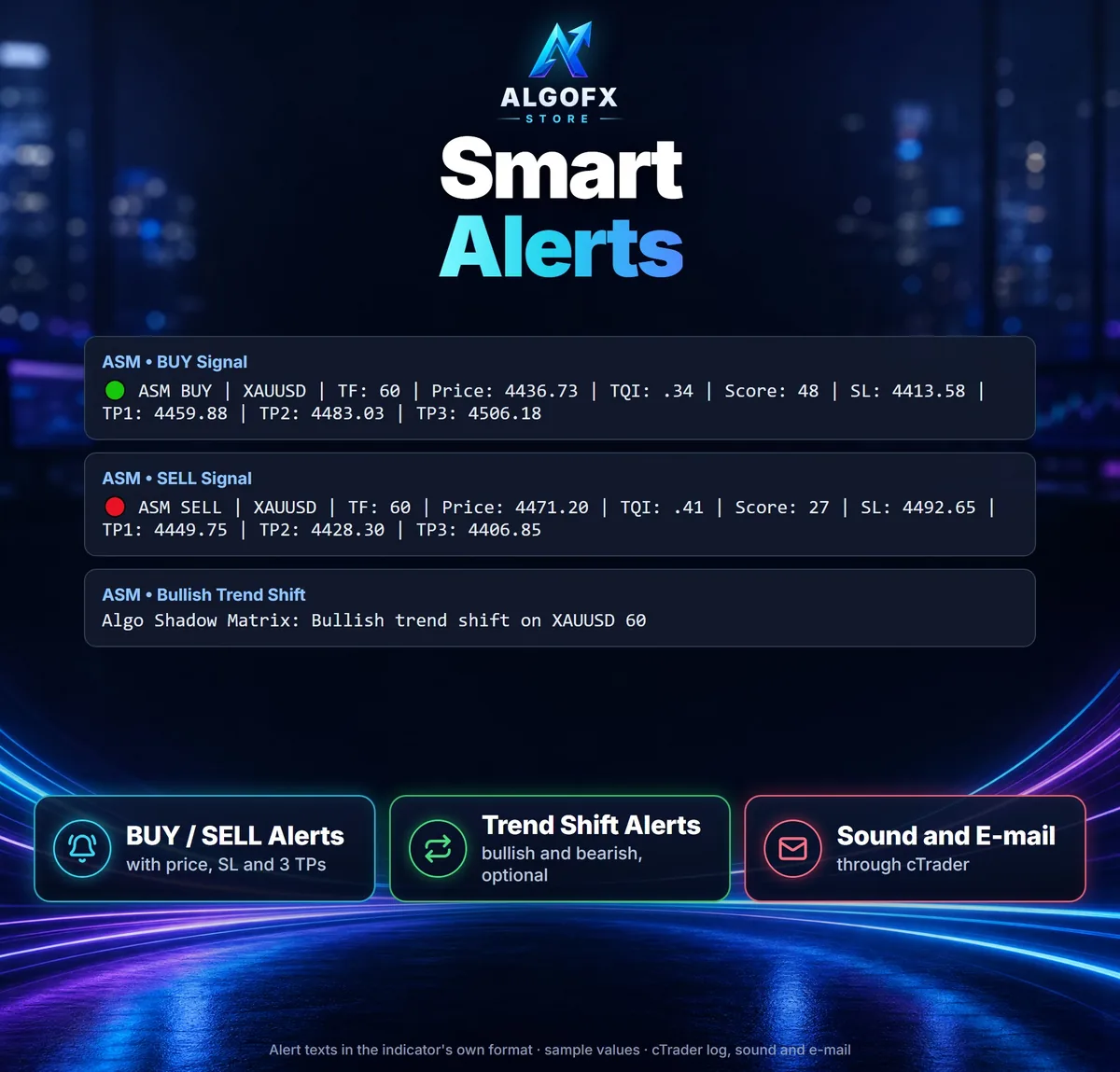
BUY and SELL alerts read like 'ASM BUY | XAUUSD | TF: 60 | Price: 4436.73 | TQI: .34 | Score: 48 | SL: 4413.58 | TP1: 4459.88 | TP2: 4483.03 | TP3: 4506.18'. They go to the Log tab, a cTrader sound of your choice and, if you switch it on, e-mail.
Dark, light or automatic theme
Theme follows the chart background on Auto or is set to Dark or Light. Color Line by TQI brightens the line in four steps as quality rises, signal markers can be pills, text or text and icon, and an optional green and red trend background can be switched on.
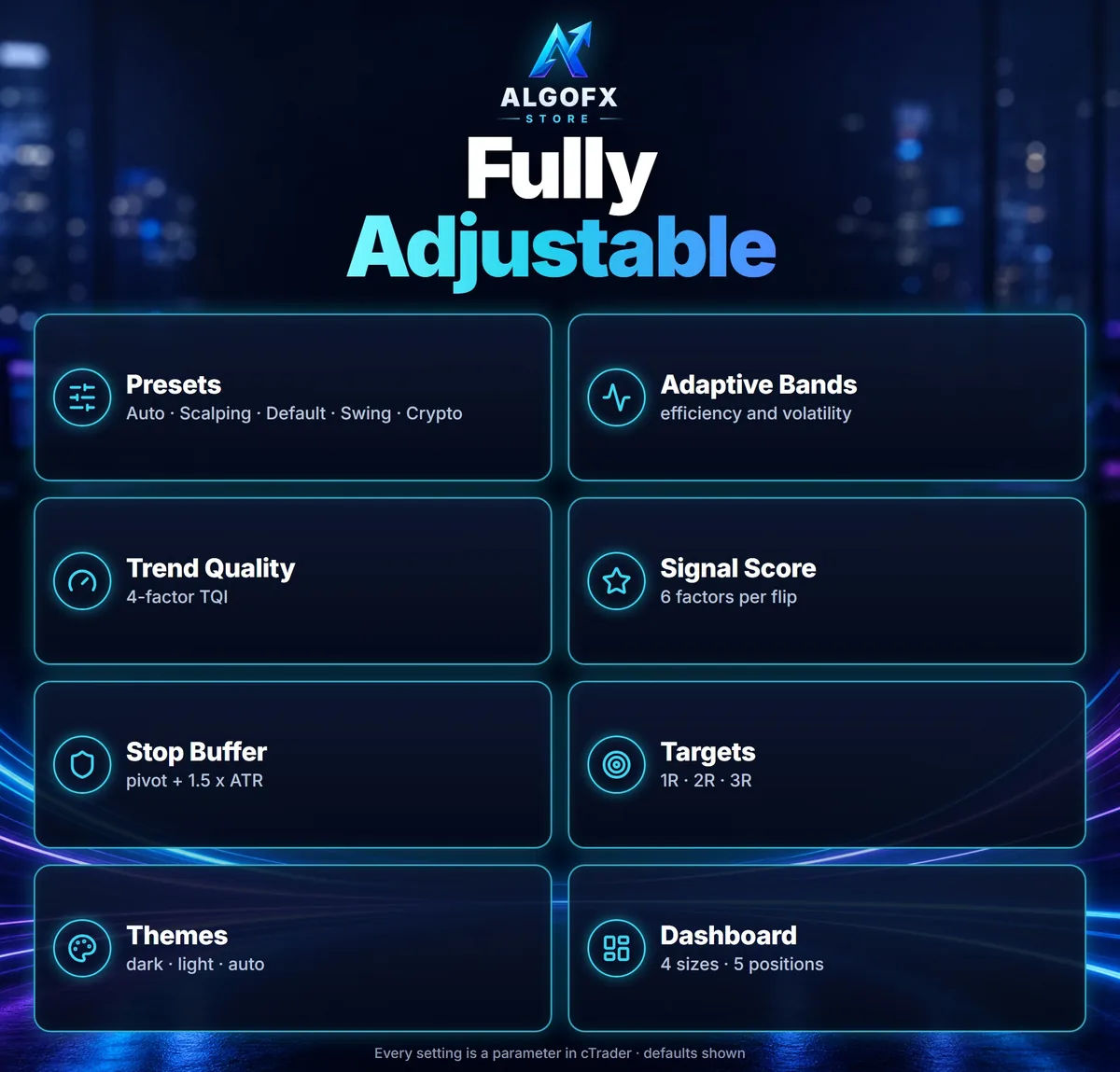
Algo Shadow Matrix, feature by feature
Each picture is built from real platform screenshots of the shipped indicator at its default settings, labelled so you can see what every part does. Tap any picture to open it full size.
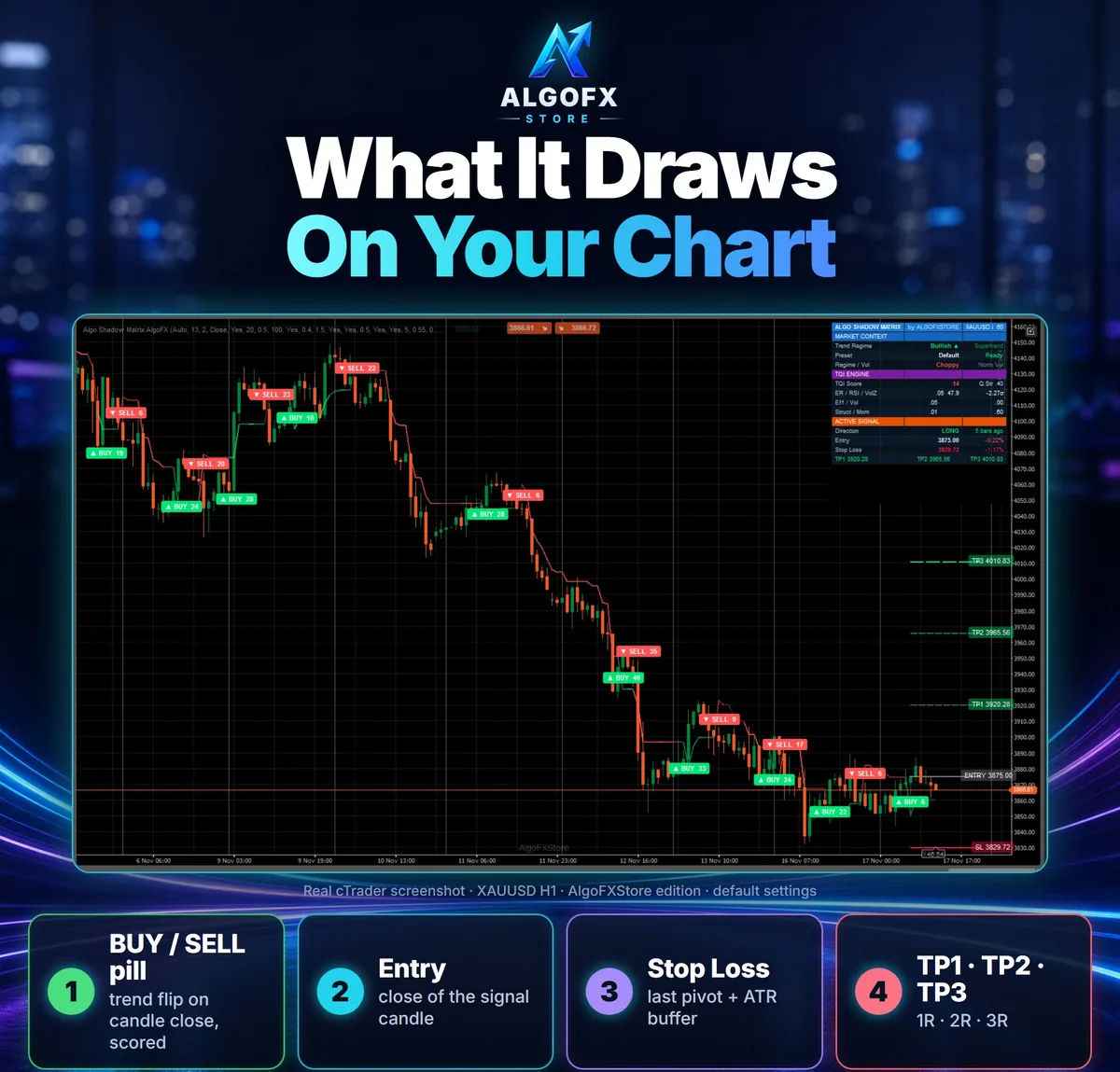

How traders put it to work
Scalping on m1 to m5
On m5 and below, Auto picks the Scalping preset: ATR 10, band 1.5 x ATR and a 1.0 x ATR stop buffer, the tightest plans the indicator draws. Expect more flips than on higher timeframes. Use the score and the Regime / Vol row to decide which of them deserve your attention, and keep an eye on the spread against the stop distance.
Intraday on m15 to h4
From m15 up to h4, Auto uses the Default preset: ATR 14, band 2.0 x ATR, efficiency window 20, RSI 14 and a 1.5 x ATR stop buffer. The alert example quoted on this page comes from an h1 chart on this preset, and the plan's 100-candle timeout covers about four trading days on h1.
Swing trading above h4
On D1 and other timeframes above h4, Auto switches to Swing: ATR 21, band 2.5 x ATR, efficiency window 30, RSI 21 and a 2.0 x ATR stop buffer. The line flips less often and the plans are wider in price, so size each one from its stop distance rather than from habit.
Crypto that trades through the weekend
Choose Crypto 24/7 by hand for symbols that trade all weekend. It keeps ATR 14 but uses a wider band of 2.8 x ATR and a 2.5 x ATR stop buffer, so the line gives more room to crypto's volatility. Expect wider stops and targets than on the Default preset.
Gold and indices
Because every distance comes from the chart's own ATR, the bands and stops scale to XAUUSD or an index without per-symbol settings. The volume factor uses the broker's tick volume, so values can differ slightly between brokers. After a large impulse candle the stop can sit far away: check the distance on every signal.
Every setting, with its default
The names are the ones in cTrader's parameters panel; the defaults are what every chart on this page uses.
| Setting | Default | What it does |
|---|---|---|
| Preset | Auto | Auto = Scalping up to M5, Default up to H4, Swing above; or Scalping, Default, Swing, Crypto 24/7, Custom. Presets set ATR length, band width, efficiency window, RSI length and stop buffer. |
| ATR Length / Base Band Width (xATR) / Source | 13 / 2.0 / Close | Used with Preset Custom. |
| Adaptive Engine: Vol-Adaptive Bands / Efficiency Window / Adaptation Strength / ATR Baseline | on / 20 / 0.5 / 100 | How much the band width follows market efficiency and volatility. |
| Trend Quality Engine: Quality Influence / Curve Power | 0.4 / 1.5 | How strongly the TQI changes the band width. |
| Asymmetric Bands / Efficiency-Weighted ATR / Character-Flip Detection | on / on / on | Engine refinements; character-flip: min trend age 5, high TQI 0.55, low TQI 0.25. |
| TQI weights: Efficiency / Volatility / Structure / Momentum | 0.35 / 0.20 / 0.25 / 0.20 | Mix of the four quality factors. |
| Signal score: Pivot Strength / RSI Length / RSI 70-30 / Volume Z Window | 3 / 14 / 70-30 / 20 | Inputs of the six-factor score shown on each pill. |
| SL Buffer (xATR) / TP1 / TP2 / TP3 (R) | 1.5 / 1 / 2 / 3 | Stop beyond the last pivot plus an ATR buffer; targets as multiples of the risk. |
| Mark TP Hits / Trade Timeout (bars) / Label Offset | on / 100 / 10 | Hit marking, when a plan ends, where labels sit. |
| Theme / Show SuperTrend Bands / Color Line by TQI / Trend Background / Watermark | Auto / on / on / off / on | Visual switches. |
| Dashboard: Show / TQI Breakdown / Performance Stats / Position / Size | on / on / on / TopRight / Tiny | Panel layout. |
| Alerts: BUY / SELL / Any / Bull shift / Bear shift | on / on / off / off / off | Events; Play Sound on, Send Email off. |
The alert events, one by one
You choose which alerts are on in the parameters. Alerts can go to a line in cTrader's Log tab (always on), a cTrader sound of your choice (on by default) and an e-mail (off by default; cTrader's e-mail settings must be set up).
- BUY Signal
- SELL Signal
- Any Signal
- Bullish Trend Shift
- Bearish Trend Shift
Algo Shadow Matrix next to the usual options
Where it wins, and where it does not.
| Algo Shadow Matrix | Typical free supertrend indicator | Reading it by hand | |
|---|---|---|---|
| Band width | Adapts every candle to efficiency and a four-factor quality index | One fixed ATR multiplier | Your judgement, chart by chart |
| When a signal prints | On the closed candle whose close breaks the previous band | Often shown on the live candle | When you notice it |
| How strong the flip was | A six-part score on every pill | No score | Your own checklist |
| Stop and targets | SL at the last swing plus an ATR buffer, TP at 1R, 2R and 3R, drawn with prices | None | Measured by hand for each trade |
| Market context | Dashboard with regime, trend quality and the active plan | None | Several windows and notes |
| Simplicity | 86 settings in eleven groups; takes time to learn | A handful of inputs, quick to understand | Nothing to install, but slow |
| Cost | One payment | Free | Free, but it costs screen time |
Honest about who this fits
A good fit if you
- You trade trend flips on cTrader and want the stop and three targets drawn the moment a signal candle closes.
- You are tired of a supertrend that flips back and forth in ranges and want bands that back off when the market gets noisy.
- You like to compare signals and want a score that shows how many conditions agreed at each flip.
- You trade across timeframes and want presets that switch from scalping to swing settings with the chart.
- You size every position from the stop distance and want that distance as a price and as a percent.
- You are comfortable placing and managing your own orders, using the indicator as the plan on the chart.
Not for you if you
- If you want the indicator to hide weak signals for you, it will not: every flip after the warm-up prints, and you decide which scores you trade.
- If you want pop-up windows or push notifications to your phone, the channels are cTrader's Log tab, a sound and e-mail.
- If you prefer an indicator with three inputs and nothing else to learn, the 86 settings and the dashboard will feel like more than you need.
- If you are looking for something that trades for you, it is an indicator: it draws plans and sends alerts, and every order stays your decision.
One indicator file, one manual, installed in a minute
- 1cTrader indicatorAlgo Shadow Matrix AlgoFX.algo (38 KB). Double-click it and it appears as “Algo Shadow Matrix AlgoFX” in your Indicators list.
- 13Page PDF manualInstallation, every setting with its default and how to read the chart.
- 86Settings in the parameters panelThe main ones are explained in the table above, with the defaults the charts use.
- ✓Alert eventsYou choose which ones are on in the settings.
- 60Day money-back guaranteeIf it is not for you, request a full refund within 60 days through your Digistore24 order e-mail.
Install in four steps
- Download the zip from the page Digistore24 sends you to after checkout and unzip it.
- Double-click “Algo Shadow Matrix AlgoFX.algo”: cTrader Desktop opens and installs it. You can also import the file in cTrader Automate.
- Open a chart, open the Indicators list and add “Algo Shadow Matrix AlgoFX” (you find it under Custom).
- Read the manual's quick start; the defaults are the settings shown on this page.

Kestutis Balciunas
AlgoFXStore · chart indicators
Kestutis Balciunas builds and publishes chart indicators under the AlgoFXStore name. Every product page shows what the indicator draws on real charts, and every number on it comes from the shipped build.
The charts on this page were captured in cTrader from the shipped Algo Shadow Matrix AlgoFX at its default settings and are shown unedited.
No get-rich claims and no quoted win rates. Every trade is uncertain, and no indicator changes that. If you want to know whether it suits the way you trade before you buy, e-mail [email protected] and you will get a straight answer.
One price, one payment
- The cTrader indicator (Algo Shadow Matrix AlgoFX.algo) and the 13-page PDF manual
- Delivered as a digital download: one zip with the .algo file and the PDF manual on your download page
- Return period: 60 days, with a full refund if it is not for you
- Free updates to the current version on the same download page
60-day money-back guarantee. Install it, run it on your own charts and read the manual. If Algo Shadow Matrix is not for you within 60 days of purchase, request a full refund from Digistore24, no questions asked: use the refund link in your Digistore24 order e-mail or Digistore24's order page digistore24.com/en/cancel-revoke-contract. Digistore24 refunds to your original payment method. It is a digital download: right after checkout you land on your download page, and the link to it is also in your Digistore24 order e-mail.
Also by Kestutis Balciunas: Algo Shadow Matrix for MT4 and MT5 and NinjaTrader 8 and TradingView.
About the signals
Does it repaint?
The pills, the levels and the alerts are created only when a candle closes and are not moved afterwards. On the live candle the line and its shading keep updating until that candle closes. A full reload recomputes from the first loaded candle, and the adaptive bands depend on every earlier candle, so the earliest signals of a chart can differ when the loaded history starts elsewhere. With the experimental Auto-Calibration switched on, later band widths also depend on earlier results.
What does the number on the pill mean?
It is the signal score, roughly 0 to 100, the sum of six parts measured at the flip: recent momentum, efficiency, volume, RSI depth, distance to the last swing and break depth through the band. Higher means more parts agreed. It describes the flip and is not a probability, so compare it with your own recent signals rather than treating any number as a promise.
Why does a low-score signal still print?
Because nothing is filtered out. The Use Structure, Use RSI and Use Volume switches only change how the score is calculated, and 'Min Signal Score (display only)' has no effect in this version. Every flip after the warm-up prints a pill and a plan, so you see every flip and decide yourself which scores you trade.
What happens when a new signal prints while a plan is open?
The new flip replaces the plan: ENTRY, SL and the targets move to the new signal and the dashboard switches direction. Older pills stay where they printed, up to 'Max Signal Labels' 300, after which the oldest are removed. Decide in advance whether an opposite pill means closing your position, tightening your stop or keeping your original orders.
Why is the stop sometimes very wide?
The stop anchors to the last swing low or high and adds the ATR buffer, and it is never closer to the entry than that buffer. After a large impulse candle the last swing can sit far from the entry, so the stop is wide, and the targets, being multiples of that risk, move far away too. That is the kind of signal to skip or trade smaller.
Settings and markets
Which markets and timeframes does it work on?
Any symbol your cTrader broker offers, including forex pairs, gold and silver, indices, oil and crypto, on any timeframe. It reads only the chart's own candles. On Auto the preset follows the timeframe: Scalping on m5 and below, Default up to h4, Swing above. Brokers have slightly different candles and tick volume, so flips can land on different candles between brokers.
Should I keep the defaults or tune it?
Start with the defaults on Auto. ATR Length, Base Band Width, Efficiency Window, RSI Length and SL Buffer only act with Preset Custom, because every other preset sets its own values. Leave the experimental Auto-Calibration group off. With the default Close source the character-flip check never triggers, so the line flips only on a price break. Change one thing at a time and compare on your own symbol.
Which preset should I use?
Start with Auto, which picks Scalping, Default or Swing from the timeframe. Choose Swing by hand if you want slower, wider plans on a lower timeframe, Crypto 24/7 for crypto that trades all weekend, and Custom when you want to set the ATR length, band width, efficiency window, RSI length and stop buffer yourself. The dashboard's Preset row always shows which one is active.
The dashboard and the marks
What does the dashboard show and can I move it?
Market context (trend regime, the active preset with Ready or Warmup, Trending, Mixed or Choppy and Low, Norm or High Vol), the TQI engine (score, quality strength, ER, RSI, volume z-score and the four factors) and the active signal (direction and candles since the signal, entry, stop with its distance in percent, TP1 to TP3 with a check mark after a hit). Choose from five positions and four sizes, or switch it off.
What is the statistics section of the dashboard?
With Show Performance Stats on, which is the default, a further section keeps bookkeeping of the indicator's own past plans on the loaded chart in R. These figures are hypothetical: entry at the signal close, exits at the stop, TP3 or the timeout, with no spread, commission or slippage. They are hindsight on your chart's history, change with the broker and the amount of history loaded, and are not a forecast. Set it to No for a cleaner panel.
What does each colour and mark mean?
Green line under price: bullish; red line over price: bearish; a brighter line means higher trend quality. A green BUY pill under a candle or a red SELL pill above it: the line flipped on that closed candle, with its score. Grey ENTRY: the signal close. Red SL: the stop. Green TP1 to TP3: the targets, which get a check mark and turn cyan once reached.
Alerts and running it
How do the alerts reach me?
Every alert is written to cTrader's Log tab as a line with its subject, and a cTrader sound plays by default. For e-mail, set up cTrader's own e-mail settings, then switch 'Send Email' on and fill 'Email From' and 'Email To'; a phone that receives that mailbox gets it too. There are no pop-up windows, no push notifications and no alerts for target or stop touches.
Will reloading a chart fire old alerts, and must cTrader stay open?
No old alerts: each event fires once per candle, only for candles that close after you added the indicator, so attaching or reloading it does not replay history at you, and backtests never alert. Alerts do need cTrader running with the chart open. For alerts around the clock, run cTrader Desktop on a computer or a VPS that stays on.
Can I run it on several charts, or read its signals elsewhere?
Yes, each chart runs its own copy with its own settings, and on Auto the preset resolves separately for each chart's timeframe. The indicator also publishes a hidden Signal Marker output: +1 on a BUY candle, -1 on a SELL candle and 0 otherwise, which other cTrader tools you build yourself can read.
How it works
Will it place trades for me?
No. Algo Shadow Matrix is an indicator: it draws on the chart and can alert you. It never sends an order.
After you buy
How do I get it after paying?
Digistore24 runs the checkout. Right after payment it takes you to your download page with one zip holding the .algo indicator file and the PDF manual; the link to that page is also in your Digistore24 order e-mail, so you can download again at any time.
How do I install it?
Double-click the .algo file: cTrader Desktop opens and installs it (you can also import the file in cTrader Automate). Then add “Algo Shadow Matrix AlgoFX” to a chart from the Indicators list. The manual walks through it step by step.
Who is Digistore24?
Digistore24 is the reseller that sells Algo Shadow Matrix for Kestutis Balciunas (AlgoFXStore): it runs the checkout, charges your card or PayPal, collects the VAT for your country and delivers the download. Its name is the one on your statement, and its order e-mail holds your download link and the refund link.
What is the refund policy?
A 60-day money-back guarantee, handled by Digistore24. If Algo Shadow Matrix is not for you within 60 days of purchase, use the refund link in your Digistore24 order e-mail or Digistore24's order page (digistore24.com/en/cancel-revoke-contract) for a full refund, no questions asked. Digistore24 makes the refund to your original payment method.
Do I get the source code?
No. The download holds the compiled .algo indicator file and the PDF manual.
Algo Shadow Matrix for cTrader.
Put an adaptive supertrend on your cTrader charts that scores every flip and draws the stop and three targets the moment the candle closes. The indicator, the manual and every setting explained. Instant download for €47, one payment.
Get instant access